
This is For Real, and these Gamers Were Targeted for a Reason
For years, parents have been telling their kids to get off the video games and do something productive. Now the federal government is essentially saying: keep playing. You may have been training for a career in air traffic control this entire time.
The U.S. Department of Transportation and Federal Aviation Administration have launched an unusual recruiting campaign aimed directly at video gamers, arguing that many of the skills developed while gaming could translate surprisingly well into the high-pressure world of air traffic control.
The campaign, promoted by Transportation Secretary Sean Duffy, carries the tagline “It’s Not a Game. It’s a Career.” The accompanying advertisement deliberately looks and sounds like a video-game promotion before switching to actual air traffic controllers working in front of radar and computer displays.
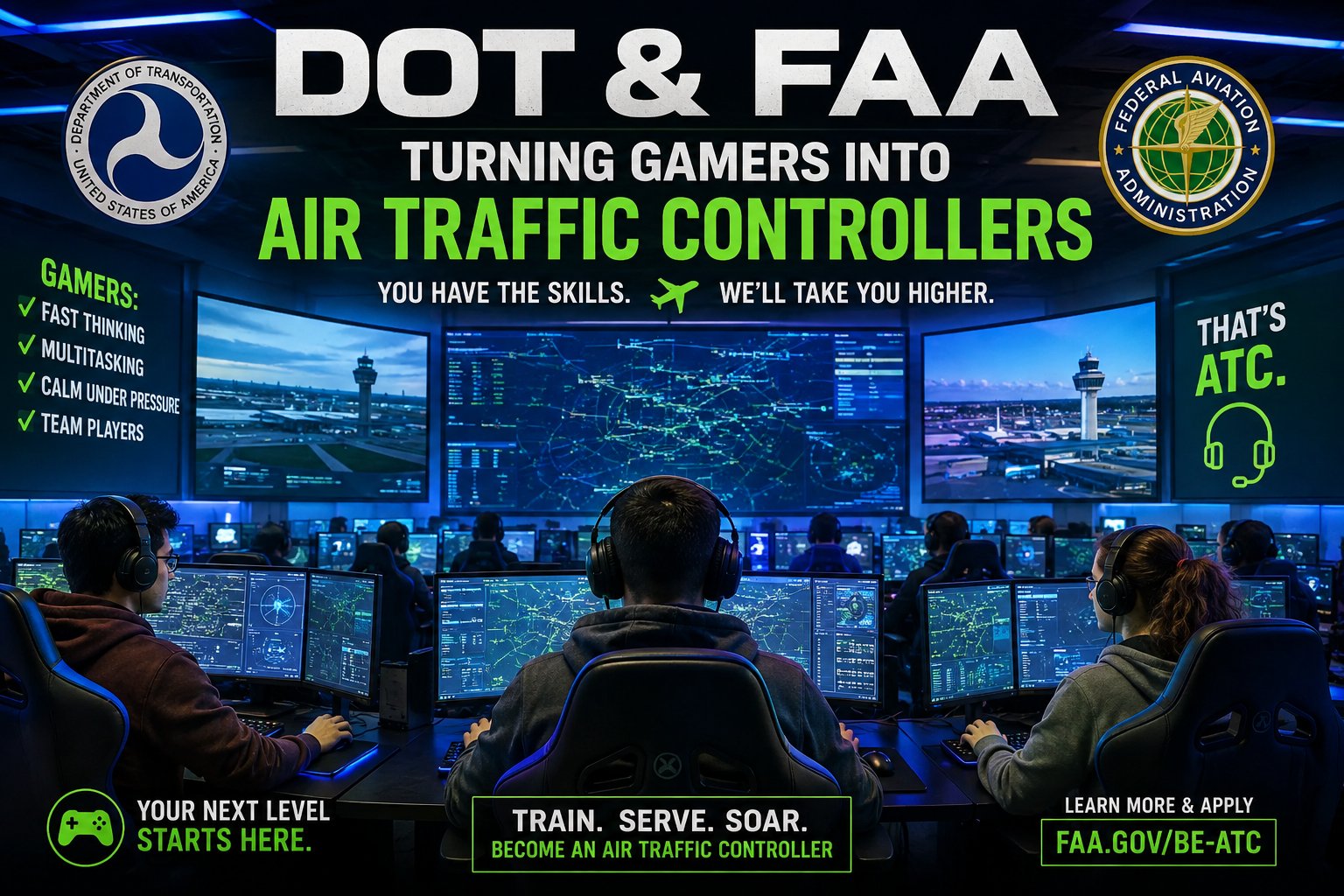
The pitch is simple: If you can keep track of multiple things happening simultaneously on a screen, communicate with teammates, make decisions quickly and remain focused while everything around you is moving at ridiculous speed, perhaps you have been unknowingly preparing yourself to keep hundreds of aircraft from crashing into one another.
And considering the condition of America’s air traffic-control workforce, the government is apparently willing to try just about anything short of hiring someone whose only qualification is being able to yell “NOOB!” into a headset.
Why Were Gamers Chosen?
The FAA isn’t claiming that playing Call of Duty automatically qualifies someone to sit in an air traffic-control tower. There is still a lengthy selection and training process.
The argument is that certain abilities developed through gaming overlap with skills needed by controllers.
According to the DOT, those include multitasking, spatial awareness, strategy, problem-solving and other cognitive abilities. The department also points to feedback from existing controllers who have said gaming helped them learn to process information quickly, maintain concentration and manage complex situations.
The numbers make the potential recruiting pool enormous.
The DOT says approximately 65% of Americans, or more than 200 million people, regularly play video games. And the FAA notes that only about 25% of current controllers have a traditional college degree, meaning the agency isn’t necessarily looking for people who followed the conventional four-year-college-to-office-job pipeline.
In other words, the federal government is looking at a gigantic pool of people who already spend hours staring at complicated digital environments and asking whether some of them might be capable of doing it while actually getting paid.
The Air Traffic Controller Shortage Is Very Real
The gamer campaign isn’t simply a cute publicity stunt. The FAA has been dealing with a serious shortage of air traffic controllers for years.
The agency’s 2026 workforce plan says approximately 11,000 certified professional controllers were working across more than 300 FAA facilities as of April, with roughly 4,000 additional controllers in the training pipeline. The FAA’s target is to reach 12,563 certified professional controllers based on projected demand.
The agency is targeting 2,200 new controllers in fiscal year 2026, followed by 2,300 in 2027 and 2,400 in 2028. The problem is that you can’t simply hire somebody on Monday and put them in a control tower on Tuesday.
Air traffic control requires extensive training, testing and certification. New controllers attend training at the FAA Academy in Oklahoma City and then receive additional facility-specific training. The FAA says it can take two to three years of additional training and on-the-job experience after the Academy before a new controller becomes fully certified, depending on the complexity of the facility.
So while the gamer campaign may generate thousands of applications, those applicants still have a long road ahead of them.
And Apparently Gamers Took the Bait
The response was enormous.
When the FAA opened its April 2026 hiring window, the agency received 12,350 applications during a single 24-hour period, including 10,779 applicants who were qualified. The DOT called it the most successful recruitment launch in FAA history.
Reuters reported that the campaign generated more than 8,000 applications in the first 13 hours alone, with 7,252 applicants meeting the basic qualifications at that point.
By August, the department was reporting even more significant results.
Duffy said the FAA had hired more than 2,000 controller trainees in 2026, reaching approximately 94% of its hiring goal, with another 2,000-plus candidates in the pipeline.
What Does an Air Traffic Controller Actually Do?
This is where the whole thing becomes considerably more serious. Air traffic controllers aren’t simply watching little airplanes move around on a computer screen.
They coordinate aircraft movements, issue instructions to pilots, maintain required separation between aircraft and help manage traffic from takeoff through landing.
The FAA says its controllers help guide approximately 2.7 million passengers every day through the nation’s airspace. Controllers have to process enormous amounts of information while making decisions quickly and accurately. Weather, aircraft locations, altitude, speed, runway availability, emergency situations and communications can all change rapidly.
That is precisely why the FAA believes some gamers could have an advantage.
A person who is accustomed to tracking multiple objects, communicating with teammates, responding to changing conditions and making decisions under pressure may already possess some of the cognitive skills the job requires.
Of course, there is one rather significant difference between a video game and real life. In a video game, if you screw up, you hit restart. In air traffic control, there is no restart button.
You Don’t Need a College Degree to Qualify
One of the more interesting aspects of the FAA’s recruitment effort is that a traditional four-year college degree is not required for entry-level air traffic controller applicants.
According to the FAA, applicants generally must be U.S. citizens, be under 31 years old for the standard entry-level path, pass medical and security requirements, pass the FAA’s pre-employment testing and meet education or work-experience requirements.
That means someone who spent four years getting a degree in something they don’t particularly care about isn’t automatically more attractive than someone who skipped college and developed valuable skills elsewhere.
And that matters because air traffic control can be a lucrative career. The DOT says the field can offer a six-figure salary within three years, although actual compensation varies based on location, experience, facility and other factors.
The FAA also pays applicants while they are undergoing required training.
The Government Has Also Been Speeding Up the Hiring Process
Recruiting gamers is only one piece of the larger effort.
The FAA has been trying to overhaul its hiring system after years of complaints about how long it took qualified applicants to move through the process.
The agency changed its traditional eight-step hiring process to a five-step process, which the DOT says has cut more than five months from the process.
The FAA’s 2026 workforce plan says the new process is designed as a continuous-flow system rather than the older linear approach.
The agency has also expanded training capacity at the FAA Academy in Oklahoma City and created additional pathways through colleges.
Several colleges now participate in the FAA’s Enhanced Air Traffic-Collegiate Training Initiative, which can allow qualified students to move more directly into facility-specific training after completing approved programs and meeting the necessary testing, medical and security requirements.
From Gaming Chair to Control Tower
Still, there is something fascinating about the strategy.
For decades, gaming was often portrayed as an obstacle to productivity. Parents complained about kids wasting time. Teachers worried about attention spans. Employers wondered whether young people could concentrate without checking their phones every fourteen seconds.
Now the federal government is looking at many of those same behaviors and asking whether they might actually represent useful workplace skills.
The FAA’s campaign is essentially betting that somewhere among America’s enormous population of gamers are people who are exceptionally good at processing information, tracking multiple moving objects, communicating quickly and making decisions under pressure.
And given the shortage of air traffic controllers, finding those people could be extremely valuable.
The FAA has already demonstrated that the recruitment campaign can generate enormous interest. The bigger test will be whether those applicants can survive the demanding training process and ultimately become certified controllers.
Because keeping airplanes safely separated in the real world is considerably harder than keeping virtual airplanes from colliding on a screen.
Still, if you have spent the last decade hearing that your gaming hobby was “going nowhere,” there is now a federal agency prepared to make a rather compelling counterargument.
Maybe you were training for the job all along.
Want to Apply?
The FAA’s official air traffic controller hiring page is available here: FAA Air Traffic Controller Hiring
The Department of Transportation’s official gamer recruitment announcement explains the reasoning behind the campaign and the skills the agency is looking for.
And yes, there is actually a government recruitment commercial built around the idea. Humanity has finally reached the point where getting paid to tell airplanes where to go may begin with proving you are really good at telling imaginary soldiers where to go.


















































Want to join the conversation?
Create an account or sign in to share your thoughts, vote,
and reply to other readers.
Showing 0 of 0 comments
Don't have an account?
Already have an account?