
It Was Only a Matter of Time in Modern America
For generations, the image of an NFL cheerleader was pretty easy to understand. Football players played football, fans watched football, and cheerleaders stood on the sidelines performing highly choreographed routines designed to keep the crowd energized. That formula became one of the most recognizable parts of the NFL experience, particularly after the rise of the Dallas Cowboys Cheerleaders and the glamorous, highly polished cheerleading culture that followed. But the NFL has been steadily changing that formula, and increasingly, men are joining the ranks of teams once dominated almost exclusively by female cheerleaders and dancers.
Today, roughly one-third of the NFL’s 32 teams have incorporated male cheerleaders or dancers in some form. The Baltimore Ravens were among the early pioneers, using men on their co-ed stunt team beginning in 1998. But what was once largely a role built around gymnastics, tossing and providing the physical strength necessary for elaborate pyramids has evolved into something considerably different.
This Isn’t Just Stunts Anymore… These Guys Have Pom Poms
The modern movement really accelerated in 2018 when Quinton Peron and Napoleon Jinnies made history by joining the Los Angeles Rams. Unlike the traditional male stunt performers who had appeared with some squads in previous decades, Peron and Jinnies weren’t simply there to throw female cheerleaders into the air. They performed the same dance routines alongside their female teammates, putting male dancers directly into the center of what had traditionally been a female-dominated part of NFL entertainment. In 2019, they became the first male cheerleaders to perform at a Super Bowl.
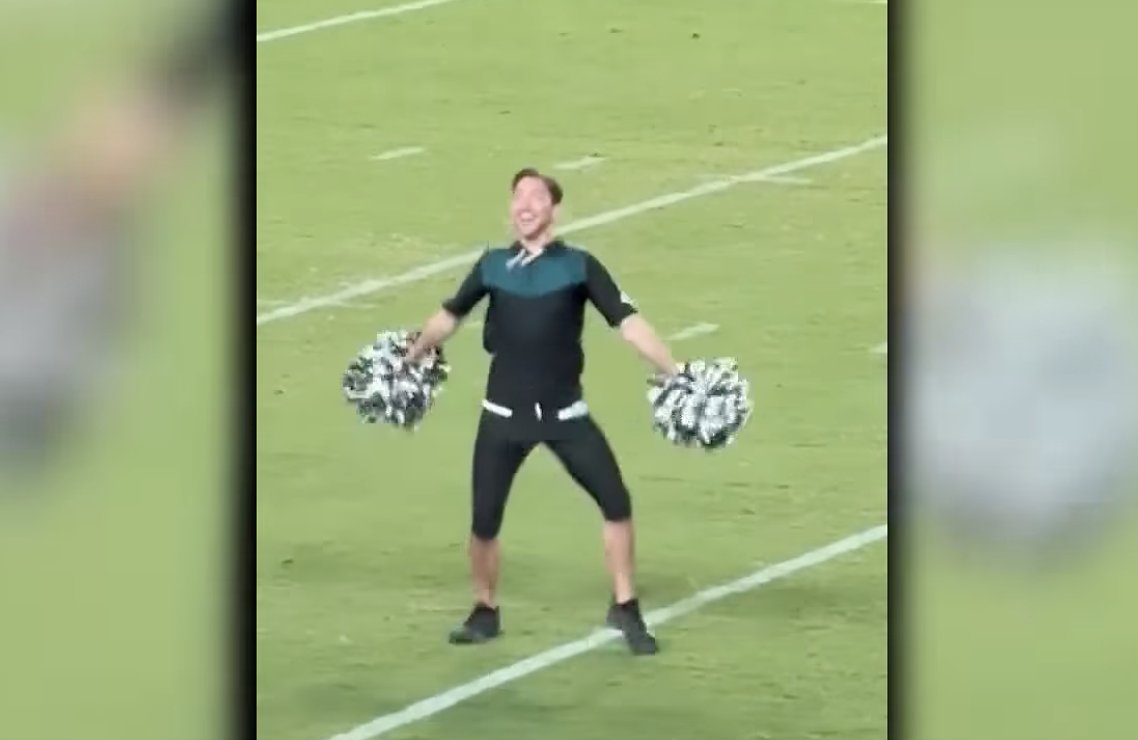
That opened the door for other franchises. The New Orleans Saints added male dancers to the Saintsations in 2018, while the New England Patriots and Philadelphia Eagles followed in 2019. The Seattle Seahawks transformed their traditionally named Sea Gals into the co-ed Seahawks Dancers. The Tampa Bay Buccaneers added male cheerleaders, while the Tennessee Titans brought men into their squad for stunts and high-energy routines. The Washington Commanders eventually went even further, creating Command Force as a fully co-ed performance squad featuring multiple styles of entertainment. The San Francisco 49ers and Minnesota Vikings have also incorporated male performers into their respective squads.
There is nothing inherently wrong with men dancing. Men have been professional dancers, gymnasts, acrobats and performers for centuries. In fact, cheerleading itself began as a predominantly male activity in the late 19th century. Several prominent American figures, including Dwight Eisenhower and Ronald Reagan, were collegiate cheerleaders.
But that’s also what makes the modern NFL debate interesting. The question isn’t whether men are capable of dancing or performing athletic stunts. Obviously they are. The question is whether the NFL is slowly eliminating one of the traditional elements of its game-day presentation in the name of modernization.
A Change in NFL Identity
For many longtime football fans, the traditional cheerleader was part of the NFL’s identity. The uniforms, choreography, pom-poms and highly synchronized routines became a recognizable piece of the spectacle surrounding professional football. As teams increasingly replace the word “cheerleaders” with terms such as “dancers,” “performers” and “entertainment teams,” the product is beginning to look less like traditional cheerleading and more like a general-purpose halftime or sideline dance troupe. And that isn’t necessarily an improvement simply because it is newer.
The argument from supporters is predictable and understandable. They point out that male dancers bring athletic ability, energy and a different physical dynamic to routines. They also argue that professional performance shouldn’t be restricted according to gender. From that perspective, if a man can successfully audition, dance and perform at the required level, there is no reason he shouldn’t have the opportunity.
Critics see it differently. Some fans simply don’t want to see male dancers performing what they consider traditional cheerleading routines at NFL games. For them, this isn’t about whether men can dance. It’s about preserving a familiar part of football culture. There is also a segment of fans who believe the NFL has become increasingly obsessed with making every aspect of its entertainment product reflect broader cultural trends rather than simply giving fans what they traditionally came to see.
That criticism shouldn’t automatically be dismissed as hatred or intolerance. People are allowed to dislike changes to entertainment they have enjoyed for decades. Sports are built heavily on tradition, after all. The uniforms change, the rules change and the stadiums change, but fans still become attached to the rituals and imagery surrounding their teams.
The NFL Does What the NFL Wants
The NFL, meanwhile, has never been particularly shy about changing its entertainment formula when it believes doing so will attract attention and audiences. Cheerleading has already evolved dramatically since the 1970s. What began primarily as crowd-leading became increasingly centered on dance, appearance and entertainment. Now the league appears to be moving toward a model in which the distinction between cheerleader and professional dancer is becoming increasingly irrelevant.
The irony is that cheerleading started as a male activity before becoming overwhelmingly female. Now, more than a century later, the NFL is effectively moving back toward a mixed-gender model, although today’s version has little resemblance to the college cheerleading of the past.
Whether fans love that evolution or think the NFL is fixing something that wasn’t broken will probably depend heavily on the individual fan. There is certainly no question that these performers are athletes. The tumbling, jumping, choreography, lifts and stunts require considerable physical ability and training.
But athletic ability isn’t really the issue. The bigger question is whether the NFL needs to keep reinventing every part of the game-day experience. Football already has plenty of spectacle. It has enormous stadiums, giant video boards, pyrotechnics, celebrity appearances, music, elaborate introductions and enough advertising to make Times Square look understated. The traditional cheerleader was one small piece of that enormous machine.
Now that piece is changing, too. Maybe that’s progress. Maybe it’s simply another example of the NFL deciding that tradition is something to be updated whenever the marketing department gets restless. Either way, male cheerleaders are no longer a novelty in professional football. They are becoming part of the league’s new normal, whether every fan is ready to cheer for it or not.
SOURCES FOR STORY
NFL.com: Rams Make NFL History with Male Cheerleaders at Super Bowl LIII
CBS News: Super Bowl 2019 – Meet the Male Cheerleaders Making History
CBC Kids News: Touchdown for Equality – First Super Bowl to Include Male Cheerleaders
The Outline: A Short History of the Very Short History of Male NFL Cheerleaders
The Vintage News: For Decades, Cheerleaders for Football Were a Male-Only Prestigious Group


































































Want to join the conversation?
Create an account or sign in to share your thoughts, vote,
and reply to other readers.
Showing 0 of 0 comments
Don't have an account?
Already have an account?