
Massie Unloads on GOP Leadership in House Floor Speech, Defends Epstein Push and Details Eight Articles of Impeachment Against Hegseth
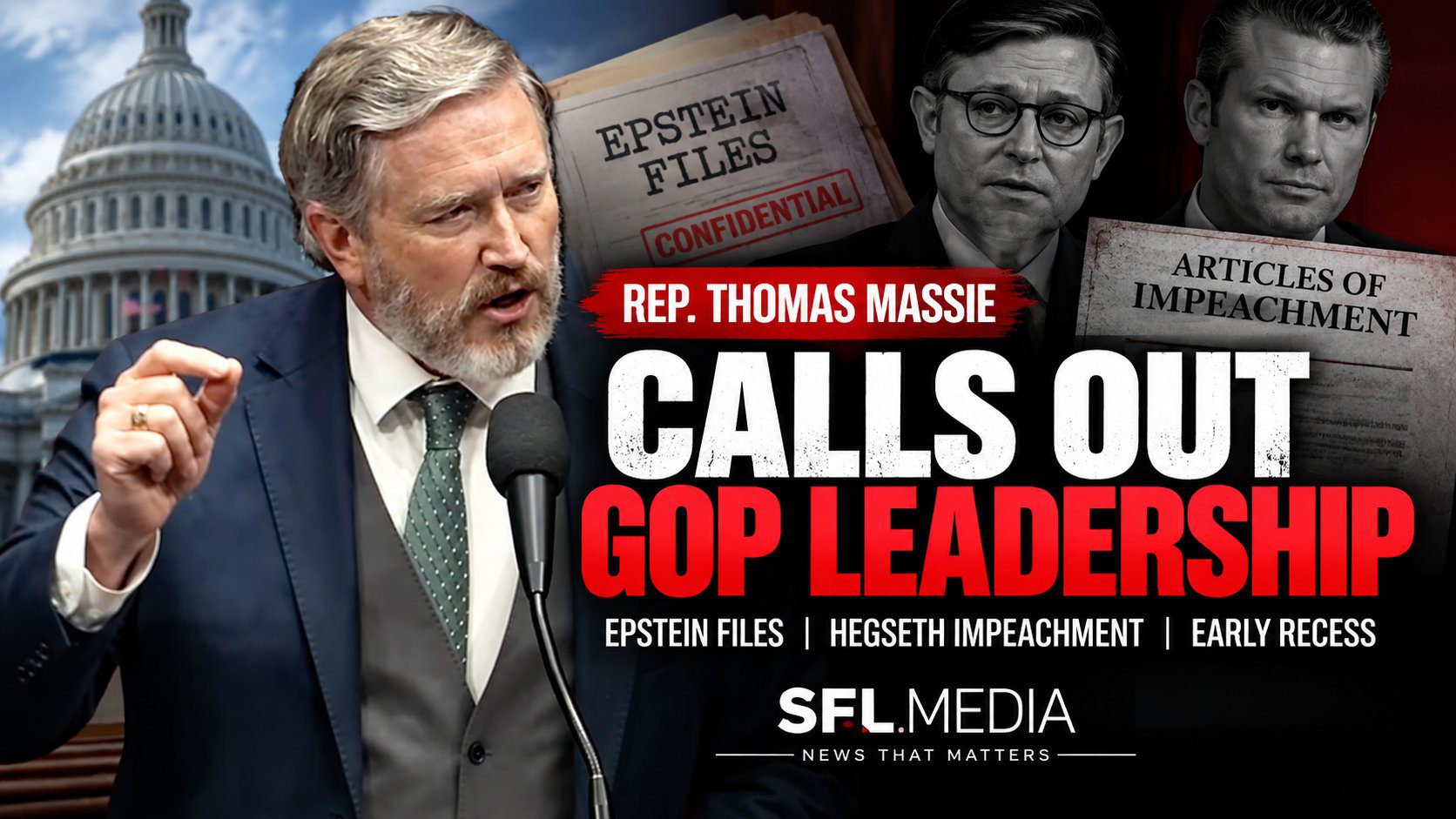
Rep. Thomas Massie used an extraordinary hour long House floor speech to answer Speaker Mike Johnson’s accusation that he was not “participating as a full member of Congress,” turning the criticism back on Republican leadership as lawmakers prepared to leave Washington early. The Kentucky Republican defended his bipartisan campaign for additional Jeffrey Epstein records, laid out his eight articles of impeachment against Defense Secretary Pete Hegseth and accused House leaders of cutting the congressional calendar rather than allowing politically difficult votes.
WASHINGTON — Rep. Thomas Massie delivered a sweeping rebuke of his own party’s leadership Wednesday, taking to the House floor under a rarely used question of personal privilege after Speaker Mike Johnson publicly questioned whether the Kentucky Republican was fully participating in Congress. Massie’s answer was essentially an hour-long recitation of the work he says Republican leadership would rather not vote on. He pointed to his bipartisan campaign to force disclosure of Jeffrey Epstein investigative records, his newly filed eight articles of impeachment against Defense Secretary Pete Hegseth, previous bipartisan legislation and his opposition to military action undertaken without congressional authorization. He repeatedly returned to one central complaint: House leaders were sending lawmakers home while major questions involving war powers, government transparency, consumer prices and federal spending remained unresolved.
“I’m here today to let you know that I’m a full participating member of the House of Representativ es,” Massie said. “In fact, when other people want to go home, I’m here to work.” He added that he wanted Congress working on justice for Epstein survivors and lowering food and fuel costs. Johnson had earlier characterized one of Massie’s predictions about the House schedule as “stupid” and called his argument “nonsensical,” saying it came from someone “not participating as a full member of the Congress.”
The confrontation unfolded as Johnson moved to end House business earlier than originally scheduled and send lawmakers home ahead of the November midterm elections. The decision left several contentious matters unresolved, including Massie’s Hegseth impeachment resolution and the latest bipartisan effort to force additional Epstein related disclosures. The House ultimately left Washington for a seven week recess, with members not scheduled to return until after the midterm elections.
Massie Turns Johnson’s Own Words Against Him
The dispute began weeks earlier when Massie predicted that House leaders would cut September voting days as politically difficult matters approached the floor. Johnson publicly rejected the prediction, saying Republicans intended to work throughout the scheduled September session. House leadership subsequently eliminated two weeks from the September calendar and later ended the final week early. Massie used the personal privilege procedure specifically to answer Johnson’s criticism of his integrity and participation as a member of Congress.
Massie seized on the reversal during his speech, arguing that he had been ridiculed for predicting almost exactly what leadership eventually did. His broader argument was that House leadership has the procedural power to prevent uncomfortable votes not necessarily by defeating legislation, but by simply preventing the House from being in session long enough to consider it. That allegation remains Massie’s interpretation of leadership’s motives. Johnson has defended the shortened schedule and the Republican majority’s legislative record, describing the Congress as highly productive and rejecting Massie’s impeachment effort as a “stunt.”
“We’re calling off Congress? And we’re in the majority?” Massie said. “I’m trying to get justice for the Epstein survivors. I’m trying to stop a war.” He later asked, “Why would we be canceling days when the country is burning? We should stay here for every day that’s on the calendar and we should debate.”
Johnson countered that “the House has done its job” and said members could be recalled to Washington on 48 hours’ notice if necessary. “We’re walking out here with our heads high,” the speaker said.
Epstein Files Become the Centerpiece of Massie’s Defense
Massie devoted a substantial portion of the speech to his work with Democratic Rep. Ro Khanna of California on the original Epstein Files Transparency Act. The legislation ultimately passed the House by an overwhelming 427–1 vote in November 2025. The Senate subsequently cleared the legislation before President Donald Trump signed it into law on November 19, 2025.
Massie used that outcome to challenge the suggestion that he was ineffective because he frequently breaks with Republican leadership. He emphasized that his Epstein effort succeeded precisely because he worked across party lines. “When did it become a dirty word to work across the aisle?” Massie asked during the speech. “I thought that was supposed to be a good thing, to form coalitions.” He then pointed to the 427–1 vote as evidence that his approach had produced one of the broadest bipartisan coalitions possible.
The dispute did not end with passage of the first law. Massie and Khanna contend that the Justice Department has failed to fully comply with its disclosure requirements and that millions of records remain unreleased or improperly redacted. Massie has specifically alleged that DOJ continues to unlawfully withhold more than 3 million Epstein related files, a claim also advanced by other sponsors of the follow up legislation. The exact number of records legally required to be released and whether DOJ’s remaining redactions and withheld materials comply with the law remain subjects of litigation and political dispute.
That dispute has increasingly moved into federal court. U.S. District Judge Emmet Sullivan warned Attorney General Todd Blanche this week that contempt proceedings could eventually become appropriate if DOJ fails to comply with a court order involving the release and review of Epstein related records, although the judge said a civil contempt finding would be premature at this stage.
Massie and Khanna Are Now Pushing Epstein Transparency Act II
Massie, Khanna and Democratic Rep. Teresa Leger Fernández subsequently introduced H.R. 9694, the Epstein Files Transparency Act II, an attempt to give several groups the ability to challenge alleged DOJ noncompliance in federal court. The legislation would create a private right of action allowing state attorneys general, district attorneys, other authorized state officials, Epstein victims and members of Congress to sue the U.S. attorney general over records allegedly being unlawfully withheld, redacted, delayed or concealed.
The legislation would also give survivors the right to obtain full, unredacted records concerning themselves or the harm they suffered, including relevant FBI FD-302 reports, while requiring DOJ to provide state and local prosecutors with records necessary for investigations and prosecutions. Sens. Jeff Merkley and Ben Ray Luján are leading the Senate version. The proposal is significant because it attempts to change who can enforce the disclosure law. Instead of relying almost entirely on the Justice Department to determine whether it has complied with Congress’ mandate, the legislation would create avenues for outside parties to ask courts to review that compliance.
Massie framed the second bill as evidence that his campaign was never simply about dumping documents onto the internet. He argued that survivors should have greater ability to obtain records concerning their own cases and that state authorities should have access to information potentially relevant to prosecutions within their jurisdictions. The fight has continued even after the House left Washington. Massie and Khanna announced Thursday that they had secured the 218 signatures needed on a discharge petition to force the Epstein Files Transparency Act II toward another House vote when lawmakers return. That development gives Massie’s floor argument additional significance: the legislation he accused leadership of avoiding now has enough support to bypass the normal committee process and reach the House floor, although passage of the bill and Senate approval remain separate questions.
Massie Details Eight Articles of Impeachment Against Pete Hegseth
Massie then shifted to perhaps the most consequential part of his speech: his effort to impeach Defense Secretary Pete Hegseth. One day earlier, Massie had introduced a 34-page resolution containing eight articles of impeachment, accusing Hegseth of “high crimes and misdemeanors.” The resolution represents Massie’s allegations; filing articles of impeachment does not establish that the alleged conduct occurred unlawfully or that Hegseth committed an impeachable offense.
The first three articles center on the Iran war and the War Powers Resolution of 1973. Massie alleges that Hegseth participated in hostilities without constitutionally required congressional authorization, continued the conflict after Congress directed the removal of U.S. forces and allowed hostilities to continue beyond the War Powers Resolution’s statutory termination periods.
The remaining articles broaden the case considerably. Article IV accuses Hegseth of ignoring laws intended to minimize civilian casualties. Article V alleges that he replaced maritime law enforcement with unauthorized lethal military targeting of suspected drug traffickers, resulting in at least 221 deaths. Article VI alleges that Hegseth used Defense Department authority to retaliate against Sen. Mark Kelly over constitutionally protected speech. Article VII concerns the U.S. military operation that seized Nicolás Maduro and Cilia Flores in Venezuela, while Article VIII alleges that Hegseth initiated an unlawful war in Yemen without congressional authorization or an imminent threat to the United States.
The Pentagon rejected Massie’s broader characterization of Hegseth’s tenure. Pentagon press secretary Kingsley Wilson said the department was unified behind the secretary and would continue working to put American service members and the country first. The constitutional and statutory questions surrounding presidential war powers have long been disputed by administrations of both parties, particularly over when military operations legally constitute hostilities requiring specific congressional authorization.
Iran War Powers Form the Core of Massie’s Case
The most substantial portion of Massie’s impeachment resolution concerns the separation of war making powers between Congress and the executive branch. Massie has long taken the position that Article I of the Constitution gives Congress, not the president acting alone, the authority to take the country into sustained war absent an attack or imminent threat requiring immediate defensive action. His impeachment resolution argues that Hegseth participated in continuing the Iran conflict despite the absence of a declaration of war or specific statutory authorization.
Article I alleges that the Iran war was unlawful from its inception because there was no declaration of war, statutory authorization, attack on the United States or imminent threat. Article II alleges that Hegseth continued the conflict after both chambers of Congress directed the removal of U.S. forces through H. Con. Res. 86. Article III alleges that hostilities continued after expiration of the War Powers Resolution’s 60-day termination period and potential 30 day withdrawal period.
The dispute extends beyond Massie. Congress has repeatedly debated resolutions seeking to terminate or restrict U.S. participation in the Iran conflict, reflecting a broader institutional struggle over how far a president can conduct military operations without a new authorization from lawmakers. Massie’s decision to pursue impeachment, however, pushes that argument considerably further by contending that Hegseth’s implementation of the administration’s military policy amounts to impeachable misconduct.
Hegseth Resolution Also Targets Drug Boat Strikes, Mark Kelly, Venezuela and Yemen
Massie’s articles are notable because they do not limit his impeachment case to Iran. His resolution challenges Hegseth’s role in strikes against vessels suspected of drug trafficking, alleging that some operations amounted to unlawful killings rather than legitimate military action. Massie’s resolution specifically alleges denial of quarter, secondary strikes on survivors and failures to rescue shipwrecked people during the maritime campaign.
Another article concerns the Pentagon’s treatment of Sen. Mark Kelly, with Massie alleging that Hegseth attempted to use military authority to retaliate against and intimidate the senator because of public statements questioning potentially unlawful military orders. Another targets the U.S. operation that resulted in the seizure of Nicolás Maduro and Cilia Flores, while the final article concerns Operation Rough Rider and the military campaign in Yemen, including allegations involving civilian casualties, strikes on civilian objects and failures to satisfy war powers reporting requirements.
These are allegations contained in Massie’s impeachment resolution, not findings reached by Congress or a court. They nevertheless create an unusually broad constitutional challenge from a Republican member of Congress against the defense secretary serving a Republican president.
Massie Says Bipartisan Work Is a Feature, Not a Failure
Massie also used the speech to defend a congressional career frequently defined by disagreements with his own party. He highlighted his involvement in industrialh emp legislation, efforts to reduce federal barriers facing small meat processors, legislation concerning firearm background check data and repeated attempts to limit warrantless government surveillance. The common thread in Massie’s telling was that many of those efforts required cooperation with Democrats.
That was also a direct response to Johnson’s criticism. Massie argued that being a fully participating member of Congress does not mean consistently voting with party leadership or attending every internal party gathering. His definition centered instead on writing legislation, building coalitions, forcing recorded votes and asserting Congress’ constitutional powers even when doing so creates problems for his own party.
The speech also carried the weight of a political farewell. Massie lost his Republican primary earlier this year after Trump backed challenger Ed Gallrein, meaning the Kentucky congressman is not expected to return for the next Congress. Rather than moderating his disputes with party leadership in his final months, Massie has intensified them.
Johnson Sends the House Home as the Fight Remains Unresolved
Johnson’s decision to recess the House ensured that neither Massie’s impeachment push nor several other politically sensitive matters would receive immediate floor consideration. By one tally reported by the Associated Press, the House has lost a net 24 legislative days this year through shortened schedules and recesses, while Johnson has defended the chamber’s record and argued that members needed to return to their districts ahead of the midterm elections.
Johnson pointed to hundreds of bills passed by the House and major legislation completed during the session, while Massie argued that legislative volume was beside the point if Congress refused to confront major unresolved questions involving war, transparency, prices and executive power.
For Massie, that became the final irony of the dispute. Johnson had accused him of not fully participating in Congress. Massie responded by standing on the House floor for an hour, detailing legislation he had written, bipartisan coalitions he had assembled, records he was attempting to force into public view and eight impeachment articles he wanted Congress to debate.
Then Congress went home.

Sources & Further Reading
C-SPAN — Rep. Thomas Massie on Epstein Files and Impeaching Secretary Hegseth
https://www.c-span.org/
Associated Press — Speaker Johnson Recesses the House Early as Rep. Thomas Massie Pushes Hegseth Impeachment
https://apnews.com/article/3ace27e682dd85c0146df79189be119c
Reuters — U.S. Republican Lawmaker Seeks Hegseth’s Impeachment Over Iran
https://www.reuters.com/world/us/us-republican-lawmaker-seeks-hegseths-impeachment-over-iran-2026-09-15/
CBS News — GOP Rep. Thomas Massie Introduces Impeachment Articles Against Hegseth Over Iran War
https://www.cbsnews.com/news/pete-hegseth-iran-war-impeachment-thomas-massie/
PBS NewsHour — Speaker Johnson Recesses House Early, Blocking Massie’s Push to Impeach Hegseth
https://www.pbs.org/newshour/politics/speaker-johnson-recesses-house-early-blocking-massies-push-to-impeach-hegseth
Roll Call — One Republican Rages Against House’s Early Exit
https://rollcall.com/2026/09/16/one-republican-rages-against-houses-early-exit/
Rep. Thomas Massie — Rep. Massie Forces Vote to Impeach Secretary of Defense Peter Hegseth
https://massie.house.gov/news/documentsingle.aspx?DocumentID=395853
Rep. Thomas Massie — Massie, Khanna, Leger Fernández, Merkley, Luján Introduce the Epstein Files Transparency Act II
https://massie.house.gov/news/documentsingle.aspx?DocumentID=395849
Congress.gov / GovInfo — H.R. 9694, Epstein Files Transparency Act II
https://www.govinfo.gov/app/details/BILLS-119hr9694ih
Axios — Khanna, Massie Say They Can Force Another Epstein Vote
https://www.axios.com/2026/09/18/epstein-files-vote-massie-khanna-support
Axios — Blanche Warned of Contempt Risk in Epstein Files Case
https://www.axios.com/2026/09/17/epstein-files-doj-contempt-judge-blanche
The Guardian — Republican Thomas Massie Proposes Impeaching Pete Hegseth Over Iran War
https://www.theguardian.com/us-news/2026/sep/15/thomas-massie-pete-hegseth-iran-war



















































Want to join the conversation?
Create an account or sign in to share your thoughts, vote,
and reply to other readers.
Showing 0 of 0 comments
Don't have an account?
Already have an account?