
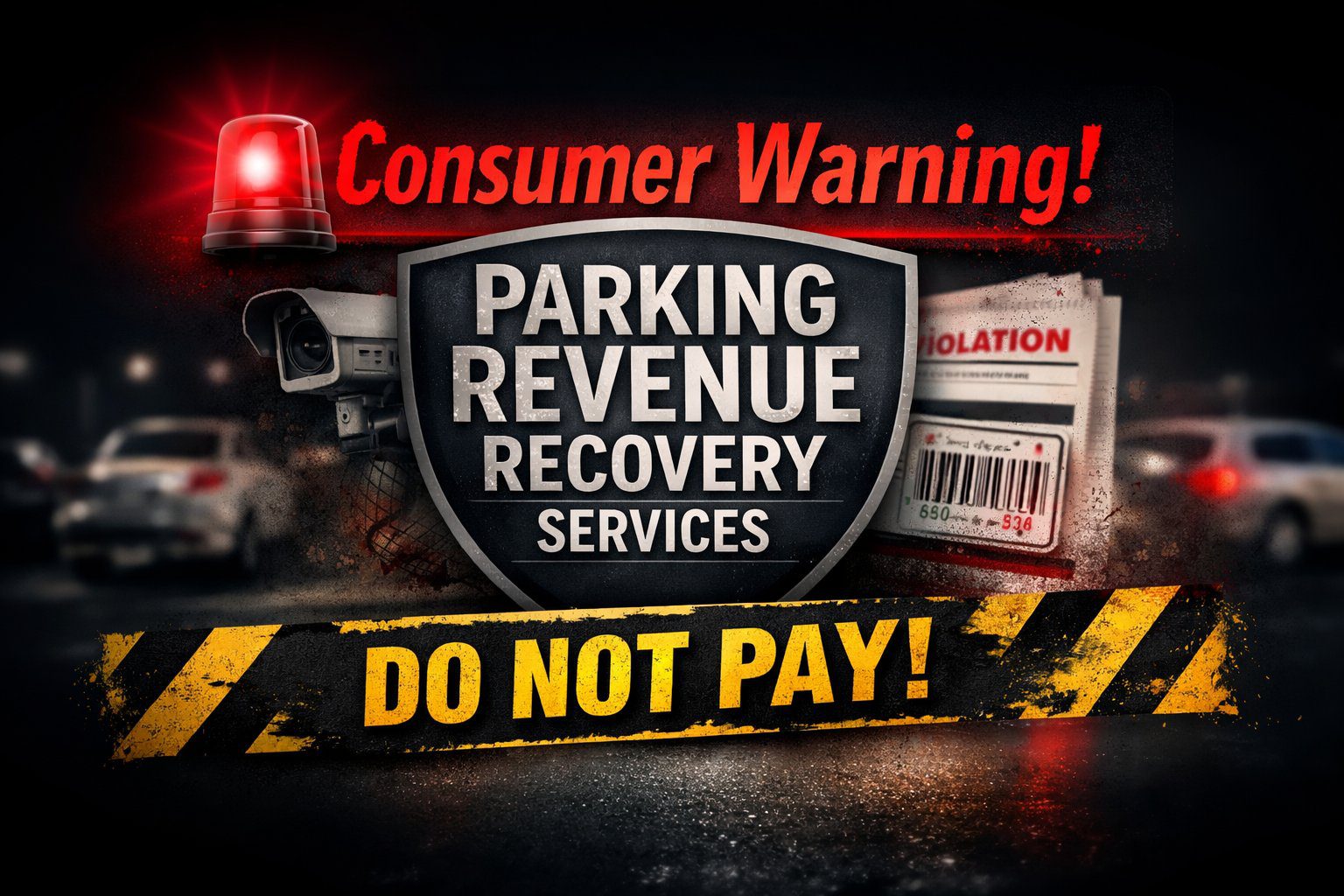
Florida’s Private Parking Corporations Are Acting Like Fake Police
“These aren’t tickets. They’re fake invoices dressed up like law.”
Across South Florida, drivers are opening their mail to find something that looks unmistakably official, a citation, a violation notice, a demand for payment. It comes with photos, barcodes, deadlines, and the kind of language most people associate with law enforcement. But it’s not from a city. It’s not from the police. It’s from a private company. And thanks to recent changes in Florida law, this fraudulent system isn’t just happening, it’s protected, and we have to deal with it.
The Rise of “Corporate Citations”
What used to be a niche enforcement tactic has quietly evolved into a scaled, automated industry. Companies like Parking Revenue Recovery Services have built entire business models around monitoring private lots using license plate recognition cameras, tracking when drivers enter and exit, and issuing charges the moment a rule is broken, sometimes by minutes. There’s no attendant. No warning. No human interaction. Just a camera, a timestamp, and a fake bill in your mailbox days later.
The shift away from traditional enforcement, towing, booting, physical tickets, wasn’t accidental. It was strategic. Automated enforcement is cheaper, faster, and infinitely scalable. One system can frivolously “ticket” thousands of vehicles a day without a single employee on site.
The Illusion of Authority
The controversy isn’t just about the charges which you legally do not have to pay, it’s about how they’re presented. These notices often mimic government citations almost perfectly. Bold headers. Violation numbers. Official looking formatting. Even photographic “evidence” of your vehicle. Buried somewhere on the page is a legally required disclaimer stating the notice is not issued by a government authority. But the design does the talking and it’s designed to look like law, instead of what it is, garbage.
Critics argue this isn’t accidental. It’s behavioral engineering. The closer the notice looks to a real ticket, the higher the likelihood someone pays it quickly without questioning it.
The Legal Shift That Changed Everything
For years, cities like Miami and Fort Lauderdale saw this coming and tried to stop it. Local governments moved to restrict or outright ban private parking companies from issuing these kinds of citation style notices, arguing that only a government entity should have that authority.
Then the corrupt GOP led state stepped in. Through legislation like HB 271, Florida created a statewide framework that explicitly allows private parking enforcement to send these ridiculous letters and more importantly:
Blocked cities from banning it.
The law requires things like signage, a 15 minute grace period, and an internal appeals process. But it also gives companies a clear legal path to continue operating and expanding even though the entire business model is based on fake ticketing. What was once a contested gray area is now a regulated industry of fake tickets. This is the absurdity of Florida Republican leadership.
The Business Model: Volume, Pressure, and Compliance
At its core, this system runs on three things: automation, scale, and pressure.
A driver enters a lot. The system logs the plate. If payment isn’t recorded or time limits are exceeded, sometimes by just a few minutes, a “violation” is generated. Days later, an invoice arrives at your home. If ignored, follow up notices escalate. Eventually, the threat of collections enters the picture.
Not because it’s a criminal issue, but because it’s a debt the company created and tossed on you with no legal framework or legitimacy at all.
That distinction matters legally, but not psychologically. Most people don’t know the difference. And that confusion is where the system thrives.
The Legal Reality vs. Public Perception
Under the law, these companies are not issuing fines. They are enforcing a contract. By entering a privately owned lot with posted terms, the argument goes, you’ve agreed to those conditions. But that legal framework doesn’t align with long standing law or how the system feels to the average person.
It feels like enforcement. It looks like enforcement. It pressures like enforcement. But its really just digital stalking, resulting in junk mail sent right to your home.
These letters operate without the oversight, due process, or accountability that comes with actual law enforcement. There’s no court issuing the citation. No neutral judge handling the appeal. No public system ensuring consistency. The company that charges you is often the same entity reviewing your dispute. It’s absurd on its face.

A Track Record That Raises Questions
The concerns aren’t hypothetical. They’re documented. Parking Revenue Recovery Services has faced regulatory action and widespread consumer complaints tied to its practices. In one case, a state investigation found violations related to improper collections and fees. Consumer reports have detailed issues ranging from incorrect charges to disputes being ignored.
The pattern is clear: high volume, low friction, and a system that relies on people paying first and questioning later.
Why It Feels Like Harassment
For many drivers, the experience doesn’t end with a single notice. It becomes a series of escalating communications, reminders, warnings, and eventually references to collections. Its closer to the mafia then it is an honest business enterprise. Legally, these companies are bound by federal and state debt collection laws. But within those boundaries, they can still apply persistent pressure. And when the original charge itself is disputed, that pressure starts to feel less like billing and more like harassment.
The Bigger Problem: Blurring the Line Between Public and Private Power
At its core, this issue is about more than parking. It’s about what happens when private companies adopt the appearance and tone of government authority and are legally allowed to do so.
Because once that line blurs, trust erodes.
Drivers don’t know what’s real and what isn’t. Cities lose control over enforcement within their own boundaries. And corporations gain a form of influence that looks, feels, and operates like public power without being accountable to the public. This isn’t just a parking dispute. It’s a shift in how enforcement works. Florida didn’t accidentally allow this system, it structured it. It legalized it. And it removed the ability of local governments to stop it.
What remains is a system where private entities can monitor, charge, and pursue drivers using tools and tactics that closely resemble law enforcement, while operating entirely outside of it. And for many people across South Florida, that doesn’t feel like innovation. It feels like something else entirely, digital corporate slavery.

















































Want to join the conversation?
Create an account or sign in to share your thoughts, vote,
and reply to other readers.
Showing 0 of 0 comments
Don't have an account?
Already have an account?