

Quantum Rider Theory – Part VII: The Perception Paradox and the Angle of Entry
Introduction: A Moment Shared, a Reality Divided
Imagine two people standing at the same spot in space. One is running, the other standing still. At the exact same second, they both look up at the sky. Same location. Same moment. Same stimulus. But what they see, feel, and perceive may be vastly different.
Physics explains this as the relativity of simultaneity, a key concept in Einstein’s Special Relativity. But Quantum Rider Theory pushes deeper: it asks not just how this happens, but why it feels so true to lived experience. Why do human beings experience different realities while occupying the same timeline?
The answer lies in how consciousness enters the block universe—not straight on, but at unique angles of entry. This angle defines everything.
Section I: Revisiting the Block Universe
Quantum Rider Theory is built upon the block universe model of spacetime, where the past, present, and future all coexist as part of a four-dimensional slab. In this structure, free will doesn’t unfold in real time—it navigates a pre-built timeline, much like a rider coursing through a tunnel.
But what determines the trajectory of that rider?
Traditional physics doesn’t ask this.
Quantum Rider Theory does.
We posit that consciousness enters the block not randomly, but with vectoral intent, a unique trajectory through space and time, influenced by quantum energy, entropy gradients, and possibly higher-dimensional rulesets unknown to us.
Section II: The Consciousness Vector
“Each life is not just lived—it is launched.”
At the moment of entry into the block universe, a consciousness doesn’t simply appear at a point—it tunnels in. This is where the metaphor becomes powerful: like divers entering an ocean from different angles, no two consciousnesses follow identical paths.
Factors that may influence this trajectory:
Entanglement with other consciousnesses
The structure of the rider’s specific timeline
Pre-life choices, karma, or programmed simulation parameters
A cosmic law of divergence to prevent perfect overlap
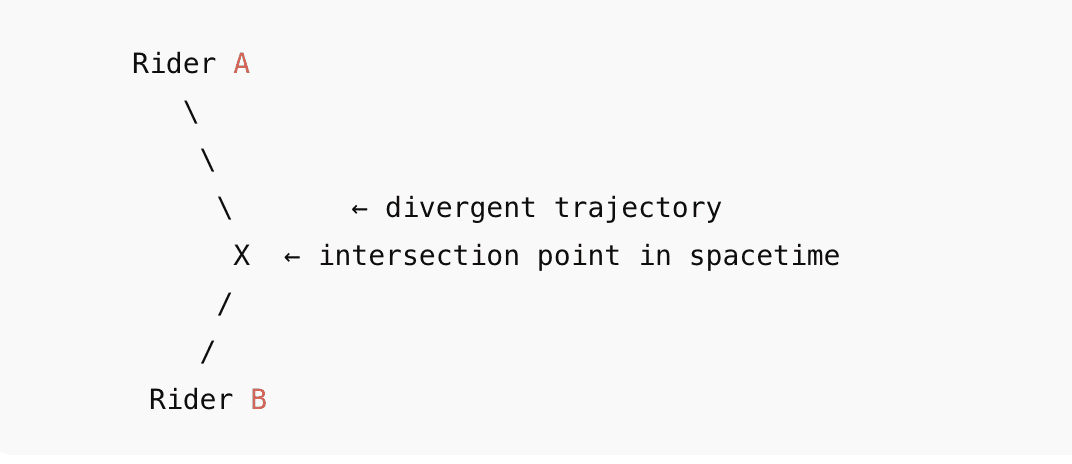
The result? Even two riders who intersect at the same spacetime coordinate are arriving from slightly different orientations, meaning their perceptual data is never fully aligned.
Section III: The Perception Paradox Explained
Let’s return to the paradox:
A runner and a man standing still both look at the sky at the same time, from the same spot. But their views of space and time are different.
Relativity explains this with velocity and time dilation.
Quantum Rider Theory explains it with perception-based asymmetry.
Because:
The runner’s consciousness is slicing through the block at a steeper angle, creating a different temporal compression.
The stationary man’s trajectory is flatter, slower, but just as unique.
Their intersection is a spatial overlap, not a full convergence.
They’re there together but never experiencing the same reality.
Section IV: Conscious Entry Angles and Social Divergence
This theory also explains one of the great mysteries of human life:
Why people perceive the same event differently
Why shared reality often feels fragmented
Why two people can love each other, yet seem to live in different worlds
“Even when timelines cross, the riders remain on their own rail.”
This reframes social misunderstanding as a structural consequence of consciousness in spacetime, not mere psychology or bias. Your timeline literally differs from someone else’s, even when your lives overlap.
Section V: Applications in Simulation Theory
If this universe is simulated—a rendering of a higher-dimensional system—the “angle of entry” could represent:
Assigned seed parameters from the source code
Entry vectors designed to prevent conscious duplication
Observer-based reality parsing, where each rider gets a slightly different data stream based on their angle
This explains why the simulation maintains coherence without uniformity a shared environment, but diverging subjective truths. In a game engine, this would be called observer-relative rendering.
Section VI: Diagrammatic Model of Divergent Riders
To visualize:
Conclusion: The Illusion of Shared Reality
Quantum Rider Theory reveals that perfectly shared experience is an illusion.
You don’t walk the same timeline as anyone else.
You merely cross through theirs.
The block universe allows intersections. But the angle of conscious entry ensures that no two beings will ever live the same life even for a single moment. That truth, once accepted, dissolves much of our confusion, our conflict, and our longing to be fully understood.
“We are riders through time, not passengers on the same train but travelers who glimpse each other through the fog of uniquely angled lives.”
This is not just physics. It is metaphysics, psychology, and soul science converging. And it solves one of the deepest paradoxes of modern human life: How we can live together, yet never see the same sky.
For More In-Depth Writings from Patrick Zarrelli’s Quantum Rider Theory, Explore the Full Series Below
Quantum Rider Theory Part I:
Consciousness in the Block Universe
Quantum Rider Theory Part II:
The Time Slide Illusion and Human Free Will
Quantum Rider Theory Part III:
Quantum Energy as Consciousness in Transit
Quantum Rider Theory Part IV:
The Conscious Observer and Timeline Synchronization
Quantum Rider Theory Part V:
The Double-Slit Experiment and the Power-Saving Mechanics of the Simulation
Quantum Rider Theory Part VI:
Quantum Physics as Glitches in the Simulation’s Backend Code
Quantum Rider Theory Part VII:
The Perception Paradox and the Angle of Entry
Quantum Rider Theory Part VIII:
Was the Big Bang Just the Startup Sequence of a Cosmic Simulation?
This is only the beginning. The Quantum Rider Theory is a living framework — an evolving synthesis of relativity, simulation theory, and quantum consciousness. Stay tuned for future chapters as we continue unraveling the strange mechanics of reality, perception, and time itself.










































Want to join the conversation?
Create an account or sign in to share your thoughts, vote,
and reply to other readers.
Showing 0 of 0 comments
Don't have an account?
Already have an account?