

Quantum Rider Theory: A Scientific Framework for Consciousness and Time
Abstract: The Quantum Rider Theory presents a grounded, physics-aligned model of consciousness as a form of quantum energy moving through a pre-existing four-dimensional spacetime structure. This theory integrates the block universe concept from relativity, quantum mechanical limitations, entropy, and simulation logic to explain the perception of time, the illusion of free will, and the inevitability of death. Rejecting metaphysical speculation, this framework offers a rigorous lens for understanding the trajectory of conscious experience and its limits. It proposes that death is not only a feature of the system — it is its most rigorously enforced directive.
1. The Block Universe is Real
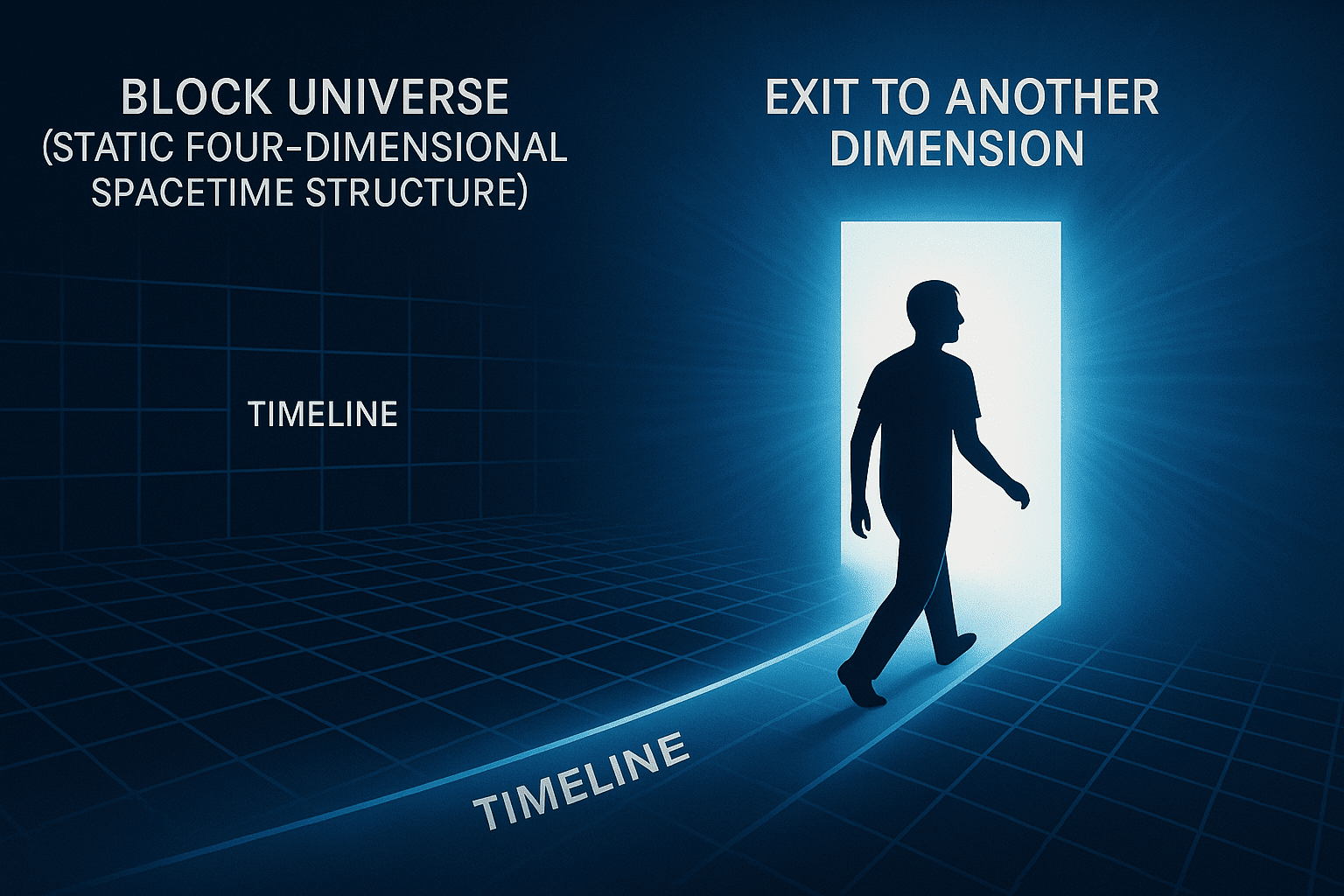
Modern physics, particularly Einstein’s theory of relativity, eliminates the notion of a universal present. Instead, time is treated as a fourth dimension alongside space, forming what is known as the “block universe.”
- All events — past, present, and future — exist simultaneously.
- Time does not flow; we experience it because consciousness moves through the block.
- Coordinates in spacetime are fixed, like locations in a massive structure.
“The distinction between past, present and future is only a stubbornly persistent illusion.” — Albert Einstein
This static but comprehensive structure is the foundational terrain through which consciousness moves.
2. Consciousness as a Moving Quantum Energy Pattern
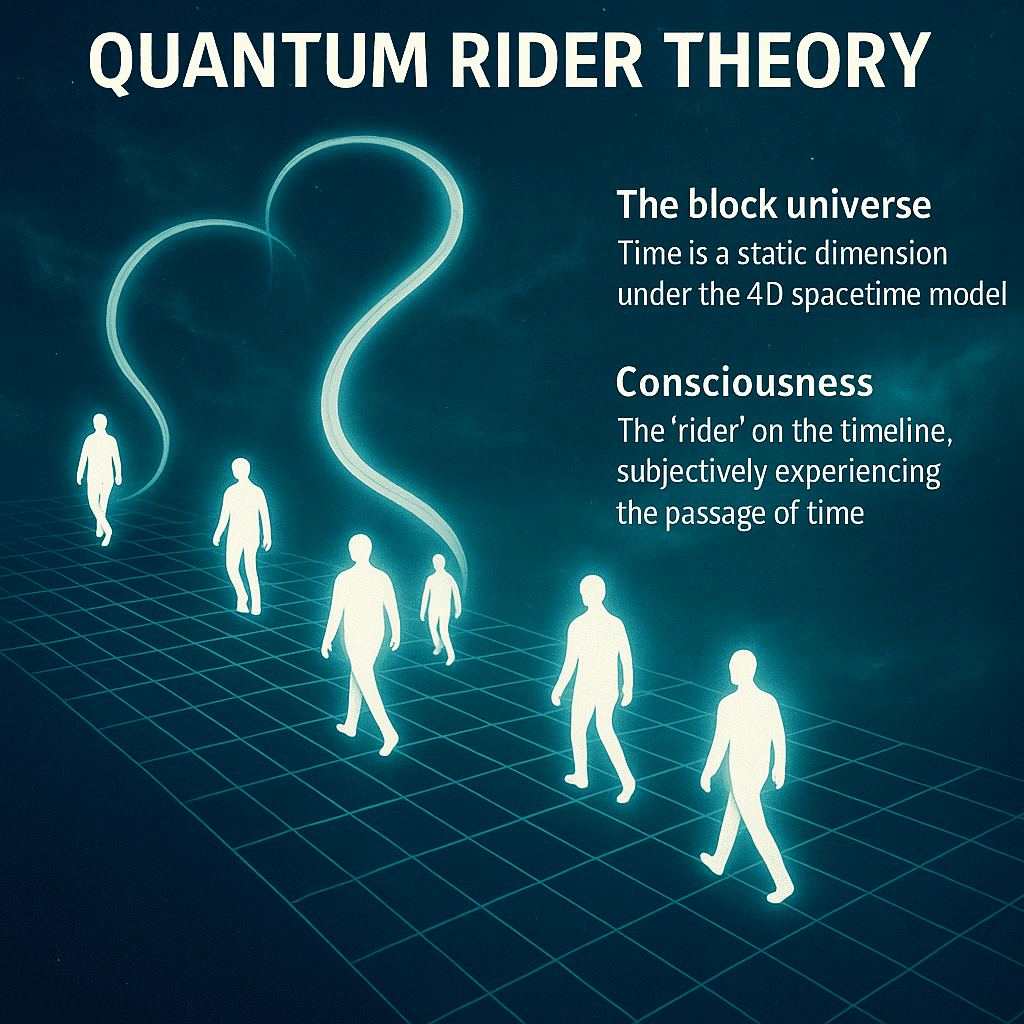
In the Quantum Rider Theory, consciousness is not the block itself — it is the rider.
- Consciousness is theorized as a unique vibrational quantum pattern.
- This pattern traverses the timeline in a fixed direction, giving rise to the illusion of temporal flow.
- This movement occurs at a rate of one second per second — the experiential sensation of time.
- Consciousness only occupies one point in the block at a time. All other moments exist but are uninhabited by the active, aware self.
This answers a profound paradox: if someone were to revisit your past, they would not interact with the conscious version of you — they would meet the autopilot version. Your conscious self has long since moved on through the timeline, potentially far into the future, or no longer alive. This also explains why the past cannot be changed. It is already written, encoded in the spacetime fabric, and cannot be altered — only observed.
So the fear popularized by science fiction — that going back in time might irreversibly change the future — is a false notion. Whether a rider visits someone else’s past or their own, they are only interacting with the autopilot imprint left in spacetime by the original conscious rider. The timeline is immutable. The past is viewable, but not editable.
This idea is consistent with:
- Quantum coherence theories (e.g., Penrose/Hameroff’s Orch-OR)
- Integrated Information Theory (IIT), which suggests consciousness emerges from complex, information-rich structures
- Simulation analogs, where data flows linearly across fixed frames
3. Block vs. Rider: Structure vs. Experience
To understand the core of this theory, we must distinguish between two fundamental perspectives:
- The Block (Structure): From a top-down or external perspective, spacetime is a complete four-dimensional structure. All trajectories, all events, and all potential experiences exist simultaneously and are fixed.
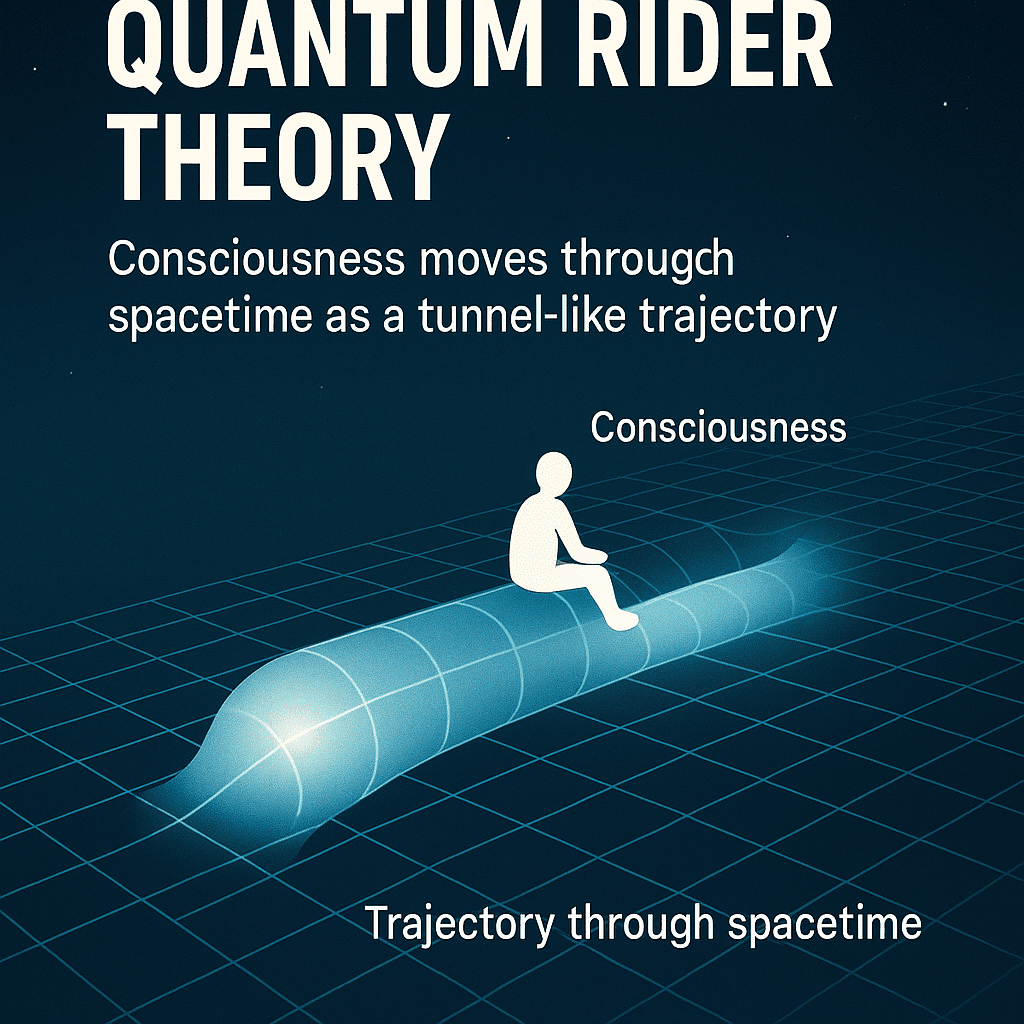
- The Rider (Experience): From within the system, consciousness travels a singular trajectory through that structure — like a tunnel carved into a static block or a diver’s path through a vast ocean. This movement gives rise to the subjective flow of time and the linearity of memory.
In short: the block defines what exists. The rider defines what is experienced.
4. Time as an Ocean, Not Just a Block
While the term “block universe” provides clarity, the structure of spacetime may be more fluid.
- Imagine spacetime as a massive ocean.
- Consciousness enters like a diver and carves a tube-like trajectory through it — the path of life.
- These tubes become locked trajectories, or timelines, experienced as individual lifespans.
This dynamic view aligns with Feynman’s path integral framework and quantum decoherence:
- Every possible path exists.
- Consciousness “selects” one by interaction.
At times, these tubes may intersect. When two or more riders’ paths cross, one rider — typically the first to arrive at a given spacetime coordinate — “writes” the local outcome, which then becomes the environment encountered by subsequent riders. In this view, reality at any given point is co-authored by the first arrivals and experienced by those who follow — much like a shared zone in a simulation where events unfold based on whoever reaches the trigger point first.
This means that while your path may feel unique and authored by your own decisions, it may include environments shaped by other riders who arrived at those intersections first — subtly influencing your experience with their prior presence.
5. Free Will is Limited, Possibly Front-Loaded
Within the Quantum Rider Theory, free will is sharply constrained.
Possibility A: Front-Loaded Free Will
- Free will may exist only at the point of initial timeline selection.
- After the path is chosen, it becomes fixed and replayed like a video file.
Possibility B: Guided Path with Constraints
- Consciousness has limited freedom.
- The system gently redirects deviations to preserve structural coherence — like GPS rerouting.
This mirrors:
- Simulation logic (guidelines embedded into open-world systems)
- Chaos theory (strange attractors)
- The subjective experience of synchronicity or fate
Even if we feel that we are making decisions freely, the system may have already encoded subtle environmental, neurological, or quantum boundaries that invisibly guide those choices. Free will may be experiential but not fundamental — a user illusion generated just beyond the grasp of the rider’s awareness. Like a video game with invisible walls, the world responds to your movement, but it’s still contained by code.
6. Physical Guardrails: Speed, Entropy, and Boundaries
Physics imposes absolute constraints — and they function like guardrails.
- Speed of Light: The maximum speed of information — likely the simulation’s clock rate. This may not be a metaphysical ceiling but rather the system’s maximum rendering speed. In simulations, when an object moves faster than the engine can generate its environment, it causes glitches or failure. The speed of light may represent the cosmic rendering limit — the frame rate of reality.
- Entropy: The universal direction of time — prevents reversal or immortality.
- Quantum Uncertainty: Prevents precise determinism — introduces irreducible randomness.
These constraints:
- Prevent conscious agents from “breaking” the system
- Keep experience coherent and within the bounds of the simulation
- Suggest a system designed for function, not freedom
7. Quantum Collapse and the Role of Observation
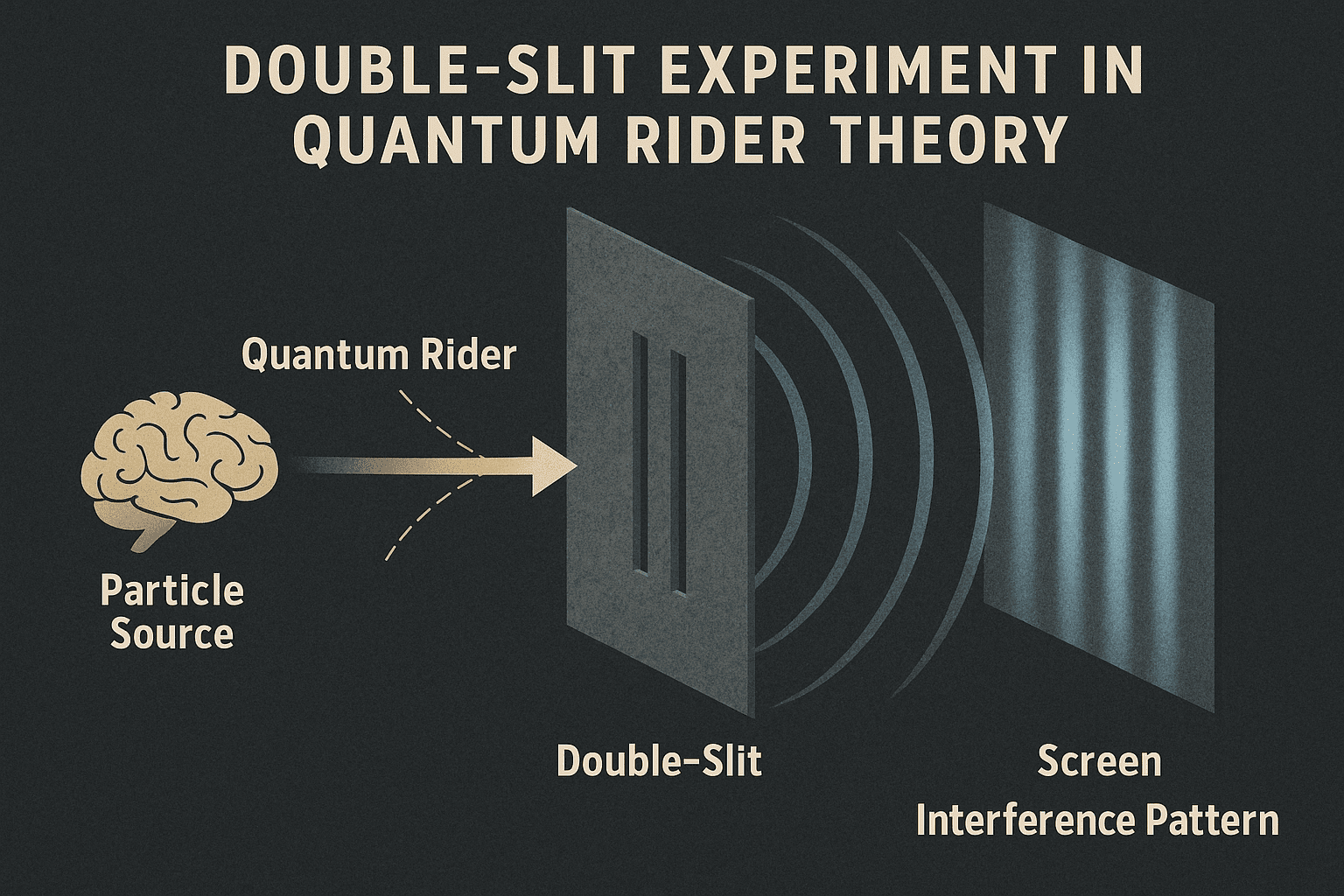
One of the most profound clues to the Quantum Rider Theory lies in the double-slit experiment — where particles behave as waves until observed.
- When unobserved, particles exist in a superposition of all possible paths.
- Upon observation, the wave function collapses into a single outcome.
- The conscious observer — the rider — may serve as the mechanism of this collapse.
This suggests that:
- Reality does not fully exist until the rider reaches a point in the timeline.
- The block universe holds all probabilities, but only collapses into lived reality when consciousness arrives.
- Consciousness renders the path — not merely follows it.
This supports the idea that riders not only move through spacetime — they instantiate it, one frame at a time. Even if they are not consciously aware of every detail, their quantum presence processes and finalizes the structure. The rider may render space-time like a processor decoding prewritten data — collapsing the block into experienced sequence.
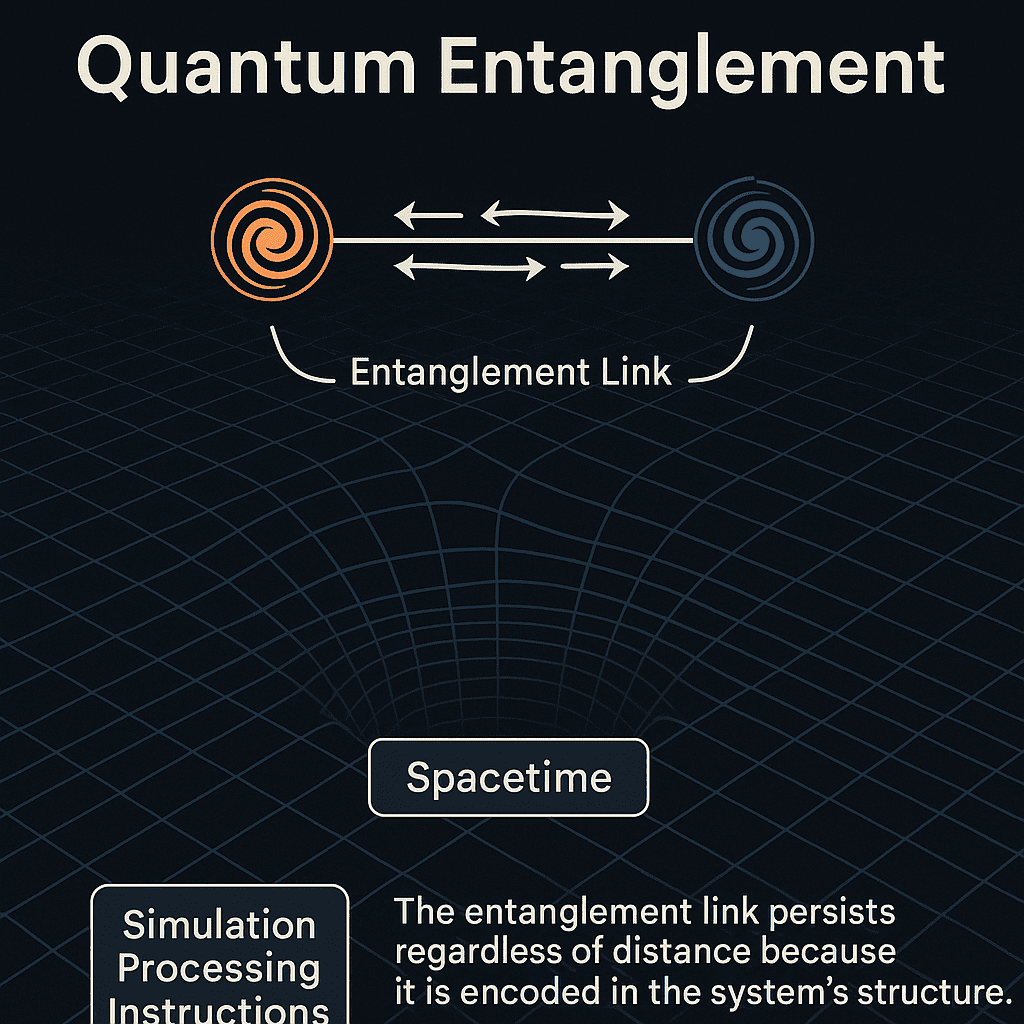
Entanglement, too, fits cleanly within this logic. In a computer simulation, distant events can be linked instantaneously because they are part of the backend code. If Rider A observes a particle that is entangled with another far away, the result is instant not because information travels faster than light — but because no travel is necessary. The outcome was encoded from the start. The “change” is a line of code executing — not a signal moving.
8. Death as System Directive, Not Spiritual Transition
Death is the only certainty across all systems — from subatomic particles to galaxies.
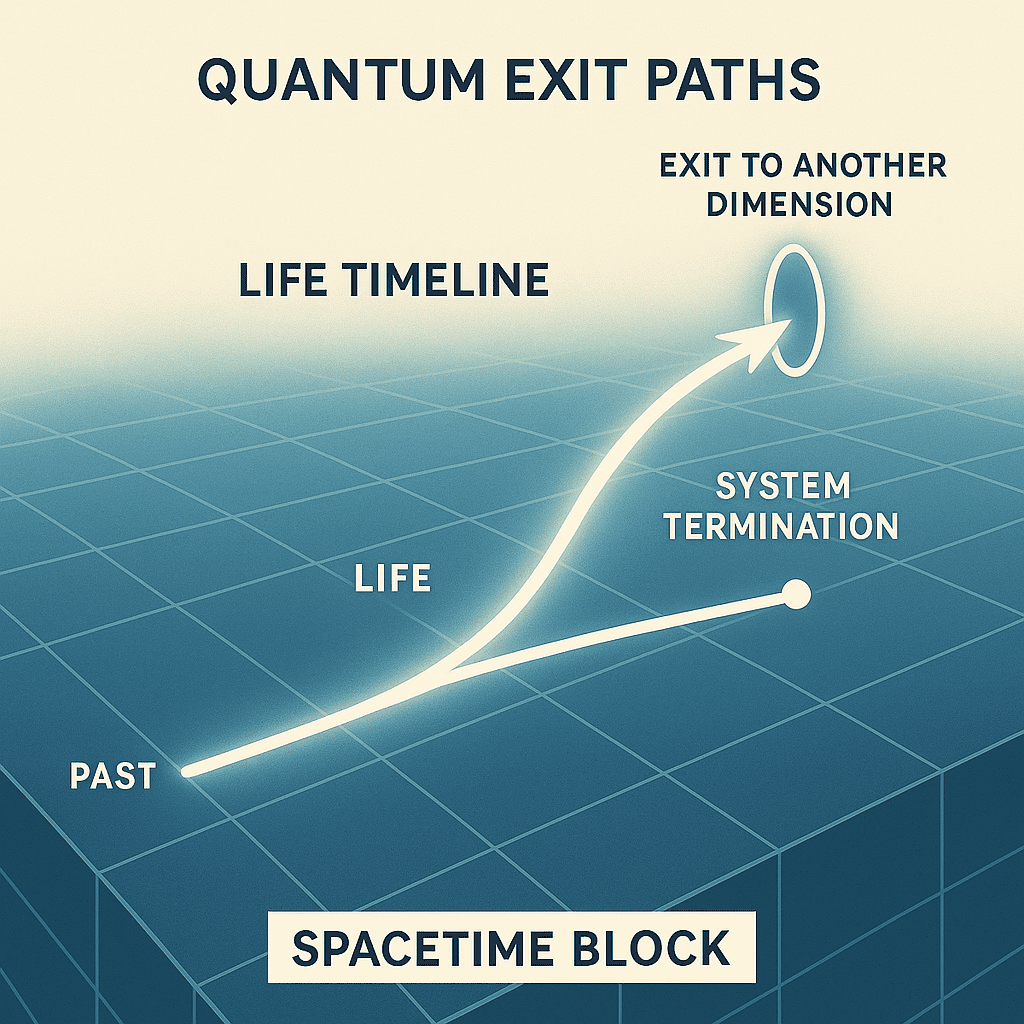
In the Quantum Rider Theory, death is a built-in termination function of the system — not a metaphysical doorway.
Death appears not just as a consequence, but as the system’s most rigorously enforced function. Everything dies: humans, stars, galaxies, the universe itself. This suggests death is not an accident — it is the rule. Whether it serves as an exit or simply finality, the system is structured to prevent permanence. Consciousness is explicitly disposable.
Death functions at two levels:
- On the individual scale, it ends your conscious timeline through the block universe.
- On the cosmic scale, the death of the universe — via heat death, entropy, or expansion — acts as the power-down phase of the entire simulation. It provides a clean, final shutdown regardless of what has happened inside the run.
This reinforces the logic of death as an essential system directive — not a glitch, not an accident, but a deliberate boundary. In this view, death is not just a biological inevitability — it is the system’s “death rule,” its ultimate shutdown protocol.
Possibility A: Exit Point
- Death is how consciousness exits the simulation
- Could imply transfer to another timeline or higher system (speculative)
Possibility B: Runtime Deletion (Most Likely)
- Consciousness is runtime data
- Death is system garbage collection
- The system ends your process without preservation or transfer
This reflects how human simulations operate:
- We don’t preserve NPCs
- We shut down systems without saving every runtime event
- Consciousness is only relevant during operation

Conclusion: What the Quantum Rider Theory Tells Us
This theory does not offer comfort — it offers clarity.
- Time is a fixed dimension.
- Consciousness is a rider moving through a track in that dimension.
- Consciousness only occupies one point in that track at a time.
- Physics provides boundaries, not infinite possibilities.
- Death is a non-negotiable system directive — the ultimate boundary condition.
- Entanglement and quantum collapse hint that the rider is both an observer and a renderer.
- Free will is likely constrained by structures hidden just beyond perception — allowing for a compelling experience while maintaining systemic coherence.
- Riders may intersect, and the first to arrive at a spacetime coordinate determines the rendered environment, which others then experience.
In this framework, your life is real — but only as a trajectory carved by your quantum rider. There may be no save point, no escape, and no higher meaning.
But if we want answers — honest answers — this is where we must begin.
Authored by:
Patrick Zarrelli
Highly Theoretical Science For Fun
Researched and Fact Checked By AI
South Florida Media
Source References:
- Einstein’s Theory of Relativity – Stanford Encyclopedia of Philosophy
- Penrose & Hameroff’s Orch-OR Theory
- Integrated Information Theory (IIT)
- Double Slit Experiment – Feynman Lectures
- Simulation Argument – Nick Bostrom
- Quantum Entanglement – MIT News
For More In-Depth Writings from Patrick Zarrelli’s Quantum Rider Theory, Explore the Full Series Below
Quantum Rider Theory Part I:
Consciousness in the Block Universe
Quantum Rider Theory Part II:
The Time Slide Illusion and Human Free Will
Quantum Rider Theory Part III:
Quantum Energy as Consciousness in Transit
Quantum Rider Theory Part IV:
The Conscious Observer and Timeline Synchronization
Quantum Rider Theory Part V:
The Double-Slit Experiment and the Power-Saving Mechanics of the Simulation
Quantum Rider Theory Part VI:
Quantum Physics as Glitches in the Simulation’s Backend Code
Quantum Rider Theory Part VII:
The Perception Paradox and the Angle of Entry
Quantum Rider Theory Part VIII:
Was the Big Bang Just the Startup Sequence of a Cosmic Simulation?
This is only the beginning. The Quantum Rider Theory is a living framework — an evolving synthesis of relativity, simulation theory, and quantum consciousness. Stay tuned for future chapters as we continue unraveling the strange mechanics of reality, perception, and time itself.









































Want to join the conversation?
Create an account or sign in to share your thoughts, vote,
and reply to other readers.
Showing 0 of 0 comments
Don't have an account?
Already have an account?