

Putin’s War in Ukraine Has Reportedly Killed More Than 700,000 Russian Soldiers, a Staggering Human Cost
An investigation by independent Russian news organizations Mediazona and Meduza estimates that more than 700,000 Russian military personnel may have died since President Vladimir Putin launched his full scale invasion of Ukraine in February 2022, revealing a potentially devastating human cost that the Kremlin has largely concealed from the Russian public.
The findings, highlighted in a CNN report, are based on leaked data from Russia’s federal statistics agency, Rosstat. The investigation identified approximately 490,000 registered military deaths through the end of September 2026. After accounting for delays in death registrations and soldiers listed as missing who are believed to have died, researchers estimated that the actual death toll could be approximately 720,000.
If accurate, the figures would represent military losses on a scale rarely seen among major powers since World War II, raising profound questions about Putin’s military strategy, political accountability and willingness to sacrifice Russian lives in pursuit of territorial expansion. Importantly, the estimate refers to military fatalities, not the combined number of soldiers killed and wounded, meaning Russia’s overall military casualties would be substantially higher.
Leaked Russian Government Records Expose the Scale of the War
The investigation followed the disclosure of a breach involving Rosstat, Russia’s federal statistics agency, by two hacking organizations, Belarusian Cyber Partisans and Ukraine’s Silent Crow. The groups subsequently provided independent journalists with a vast collection of government mortality records containing information that Russian authorities had stopped making publicly available.
Journalists at Meduza and Mediazona cross referenced the leaked information against inheritance records, court rulings, previously published government statistics and their independently maintained database of Russian military deaths. The researchers found that the leaked records closely matched information collected through other sources, providing substantial evidence of their authenticity.
“Based on registered deaths alone, we estimate that 490,000 Russian service members had been killed by fall 2026.” — Meduza and Mediazona
The researchers then applied statistical modeling techniques drawn from epidemiology and actuarial science to estimate deaths that had not yet been officially registered. Their methodology accounts for missing military personnel, reporting delays and the lengthy legal process through which missing soldiers are formally declared dead. The precise death toll remains uncertain, particularly for the most recent year of fighting, when incomplete records create the greatest statistical uncertainty.
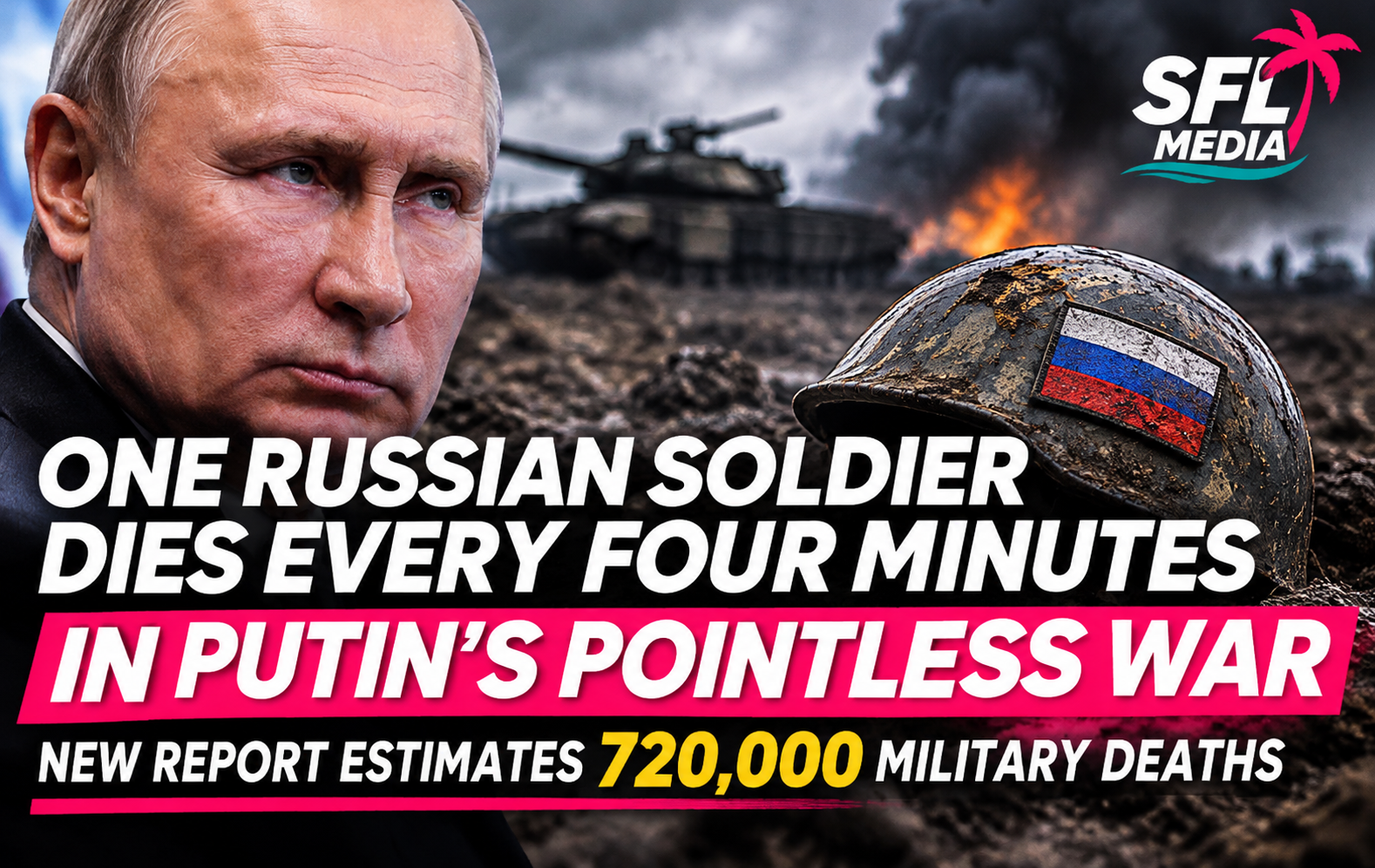
One Russian Soldier Dead Approximately Every Four Minutes
CNN reported that the estimated death toll amounts to approximately one Russian soldier dying every four minutes since the beginning of the full-scale invasion. Based on the researchers’ estimate of 720,000 fatalities through September 2026, Russia would have suffered an average of approximately 428 military deaths every day over more than four and a half years of warfare.
| Russian Military Fatalities | Death Toll |
|---|---|
| Registered military deaths | Approximately 490,000 |
| Additional statistically estimated deaths | Approximately 230,000 |
| Total estimated military deaths | Approximately 720,000 |
| Average daily military deaths | Approximately 428 |
| Average time between deaths | 3.4 minutes |
The magnitude of the losses is particularly striking given that Russia launched the invasion with expectations of a much faster military victory. Instead, Ukrainian resistance, Western military assistance and the Kremlin’s inability to achieve its initial strategic objectives transformed the conflict into a prolonged war of attrition. Although the intensity of fighting has fluctuated considerably throughout the war, the cumulative death toll illustrates the extraordinary human cost of sustaining Russia’s military campaign.
Putin’s Military Strategy: Trading Human Lives for Territory
Much of Russia’s fighting has concentrated on eastern Ukraine, particularly the Donetsk region, where Russian forces have repeatedly attempted to break through heavily defended Ukrainian positions. Battles around Avdiivka and Pokrovsk have become emblematic of a grinding military strategy that has imposed enormous human costs while frequently producing incremental territorial gains. Military analysts have criticized Russia’s reliance on manpower-intensive offensive operations, commonly described as meat assaults, in which troops are committed to dangerous attacks against entrenched defensive positions.
Modern military doctrine generally emphasizes coordinated operations, intelligence, maneuver, technological superiority and the preservation of trained personnel. While every major military must contend with battlefield losses, the scale of Russia’s reported fatalities raises fundamental questions about the effectiveness of its command structure and operational planning.
Russia has demonstrated an ability to continue recruiting personnel and sustaining offensive operations despite severe losses. However, the ability to replace dead soldiers is not necessarily evidence of military efficiency. It may instead demonstrate the Kremlin’s capacity to absorb extraordinary human costs without facing immediate domestic political consequences.
Russian Military Deaths Reach a Scale Rarely Seen Since World War II
The estimated Russian death toll stands in stark contrast to the military losses commonly associated with modern regional conflicts. Russia’s disastrous intervention in Afghanistan during the Soviet era and its subsequent wars in Chechnya generated significant domestic controversy, yet their military death tolls were substantially smaller than the estimated losses in Ukraine.
The Soviet Union lost approximately 15,000 military personnel during its nearly decade long war in Afghanistan. If the latest estimate is accurate, Putin’s invasion of Ukraine has killed approximately 48 times as many Russian military personnel in less than five years. The comparison is especially significant because the Soviet Afghan War contributed to growing disillusionment with the Soviet government, exposed weaknesses in its military establishment and became a symbol of the dangers of prolonged foreign military intervention.
The historical parallels with World War I are also striking. The extensive use of trenches, artillery, fortified defensive positions and repeated attritional offensives has revived images of industrial warfare that many believed modern military technology would make increasingly obsolete.
Although sweeping claims that Russia’s losses exceed those of every major power in every conflict since World War II require careful qualification, particularly given disputed historical casualty estimates from conflicts such as the Korean War, Putin’s invasion has produced military fatalities on a scale extraordinary for a contemporary regional war.
A Demographic Catastrophe for Russia
Beyond the immediate battlefield consequences, the deaths represent a potentially devastating long term demographic and economic crisis for Russia. Even before the invasion, the country faced declining birth rates, an aging population, workforce shortages and significant regional economic disparities. The loss of hundreds of thousands of predominantly working age men compounds those existing pressures, while military personnel who return with permanent disabilities may require decades of medical treatment and government assistance. Families that have lost breadwinners face emotional and financial consequences that extend well beyond the battlefield.
Russia’s wartime economy has also redirected substantial industrial capacity, government spending and labor toward military production. Although defense spending can generate short term economic activity, it does not necessarily translate into sustainable improvements in productivity, civilian infrastructure or long-term living standards.
The demographic consequences could persist for generations. The deaths of working age men reduce the available workforce, affect future family formation and place additional pressure on a population already confronting structural demographic decline. Even if the Kremlin eventually achieves some of its territorial objectives, the human capital lost during the invasion cannot simply be restored through a peace agreement.
How the Kremlin Conceals the Human Cost of Putin’s War
Russia has gone to extraordinary lengths to restrict public access to accurate information about military deaths. The Kremlin treats detailed wartime casualty figures as sensitive information, and independent journalists investigating military losses operate under intense government pressure. Moscow has not publicly released a comprehensive updated military death toll since September 2022, while Rosstat stopped publishing key demographic statistics in 2025.
In the absence of reliable public government disclosures, independent researchers have relied on obituaries, cemetery records, social media announcements, inheritance filings and court documents to reconstruct the human cost of the invasion. The Rosstat leak represents a significant breakthrough because it provides researchers with information originating from the Russian government’s own administrative systems rather than relying exclusively on battlefield claims issued by Ukraine or Western intelligence agencies.
However, the distinction remains important: although the underlying records originated from Russian government systems, the estimated total of 720,000 deaths is the conclusion of independent researchers, not an official admission by the Kremlin.
The suppression of casualty information also has profound political implications. Democratic governments generally face considerable public scrutiny when military operations result in significant deaths. Elections, legislative oversight, independent journalism and public demonstrations can impose political costs on leaders who pursue unpopular or unsuccessful wars. Putin’s increasingly authoritarian political system has substantially weakened those mechanisms of accountability, allowing the Kremlin to sustain a level of military expenditure and human loss that would generate enormous political pressure in many democratic countries.
What the Death Toll Says About Vladimir Putin’s Leadership
The central question raised by the investigation is whether the Kremlin’s willingness to absorb such extraordinary losses reflects strategic determination or a catastrophic failure of military and political leadership. Supporters of Russia’s military strategy may argue that Moscow’s larger population, industrial capacity and ability to sustain a prolonged conflict give it advantages in a war of attrition. From that perspective, continued military pressure is intended to exhaust Ukrainian resources and undermine Western support for Kyiv.
Critics, however, argue that Putin has substituted Russia’s available manpower for effective military strategy, accepting enormous casualties rather than fundamentally reconsidering the objectives or execution of the invasion. The continued commitment of troops to costly offensive operations, despite the failure to achieve many of the Kremlin’s original objectives, has fueled accusations that the Russian president prioritizes his geopolitical ambitions over the lives of his own citizens. A government’s ability to conceal military losses does not make those losses strategically sustainable, nor does its ability to recruit replacement soldiers erase the consequences of failed operations.
Putin launched the full scale invasion as a war of choice. Unlike the Soviet Union’s struggle against Nazi Germany during World War II, Russia was not responding to an invading army threatening its national survival in February 2022. The Kremlin made the decision to invade an internationally recognized sovereign country, and Russian military personnel and Ukrainian civilians have continued to pay an enormous price for that decision.
An Entire Generation Paying the Price for Putin’s Ambitions
The latest findings offer a stark reminder that the consequences of Russia’s invasion cannot be measured exclusively through territorial maps, military equipment losses or diplomatic negotiations. Behind every registered death is a family, a community and a future that has been permanently altered by the war.
For Ukraine, the invasion has brought widespread destruction, civilian deaths, displacement and enormous economic damage. For Russia, the emerging mortality records suggest a national tragedy whose full dimensions remain obscured by government secrecy. More than four years after Putin launched the invasion, Russia continues fighting a war that has failed to secure many of its original strategic objectives while inflicting extraordinary damage on both countries.
History will ultimately judge Putin not simply by how much Ukrainian territory Russia manages to occupy, but by whether anything gained could possibly justify the human cost of obtaining it. If the latest mortality estimates are accurate, approximately 720,000 Russian military personnel have already paid the ultimate price for that calculation.

Sources & Further Reading
-
CNN – Staggering Russian Military Death Toll Revealed in New Report (Video)
-
Meduza – More Than 700,000 Russian Troops Died in the War in Ukraine by Late September 2026
-
Mediazona – Independent Russian Military Casualty Investigation and Database
-
Nacionale – Leaked Russian Mortality Records and Independent Death Toll Analysis
-
South Florida Media – International News, Politics and Military Affairs














Loading comments…