
Flock Cameras Were Supposed to Catch Criminals. Now Police Are Being Arrested for Allegedly Abusing Them
Automated license plate readers were sold to American communities as a powerful new way to catch car thieves, locate missing people and help police identify vehicles connected to serious crimes. Now the rapid expansion of Flock Safety’s artificial intelligence powered camera network is confronting a far more uncomfortable question: What happens when the people entrusted with access to an extraordinarily powerful surveillance system decide to use it for themselves?
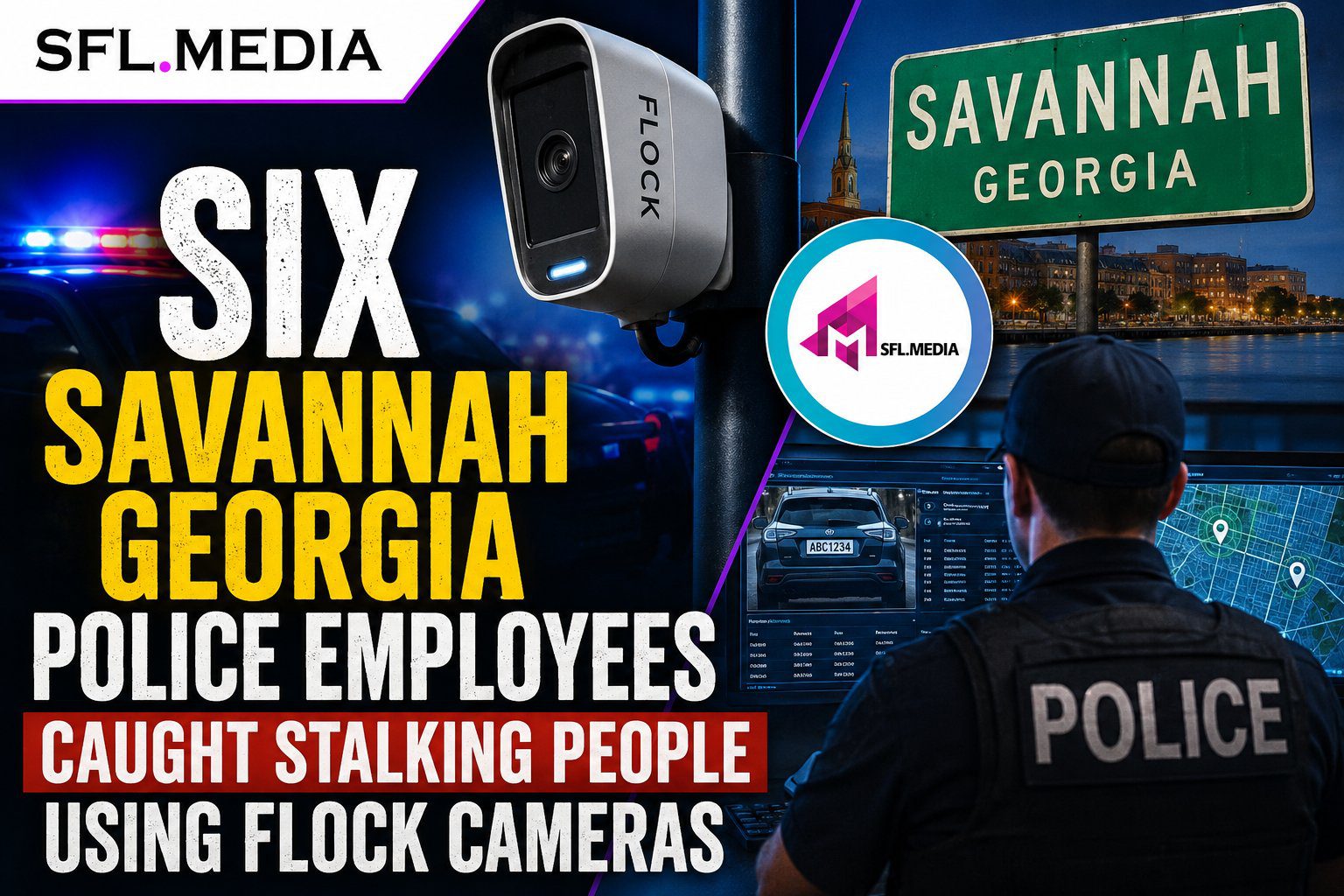
That question moved from hypothetical privacy debate to criminal investigation in Savannah, Georgia, where four former Savannah Police Department employees were arrested by the Georgia Bureau of Investigation in August 2026 following an internal audit of the department’s Flock Safety system. The investigation grew out of a broader departmental review that identified four officers and two civilian employees for potential unauthorized searches. Savannah police ultimately fired all six employees, while the GBI brought criminal charges against four former employees accused of accessing the system for non law enforcement purposes.
The Savannah case is part of a widening national controversy surrounding automated license plate readers, commonly known as ALPRs, and particularly the enormous interconnected network operated by Flock Safety. The technology has legitimate and potentially lifesaving applications, allowing investigators to identify stolen vehicles, generate leads in serious crimes and rapidly search for vehicles connected to missing people or wanted suspects. But the same infrastructure also gives authorized users access to something previous generations of police departments could scarcely have imagined: searchable records documenting where vehicles have been observed across increasingly large networks of cameras.
Recent cases demonstrate that the danger does not require hackers breaking into the system or the technology malfunctioning. An authorized user with legitimate credentials can potentially misuse the technology for an illegitimate purpose. That distinction has become central to the national debate as communities, courts, civil liberties organizations and police departments confront the implications of building an AI enabled vehicle surveillance infrastructure capable of recording millions of innocent drivers alongside legitimate criminal suspects.
Savannah Audit Leads to Firings and Criminal Charges
The Savannah investigation began after the police department conducted an internal audit of its Flock Safety system and opened an investigation on July 27. Six employees, including four sworn officers and two civilian staff members, were identified for potential misuse and initially placed on administrative leave while the department investigated whether searches had been conducted for legitimate law enforcement purposes. By August 7, Savannah police had terminated all six employees after determining they violated departmental policies governing the authorized use of law enforcement technology and resources. The department also referred the matter to the Georgia Bureau of Investigation for an independent criminal investigation.
On August 21, the GBI announced charges against four former Savannah Police Department employees. Former officers Marquis Dillard, Donald Phillips and Matthew Rich were each charged with two counts of misuse of a license plate reader system and one count of violation of oath of office. Former Community Service Specialist Calandic Thomas was charged with two counts of misuse of a license plate reader system. All four were booked into the Chatham County Jail, and the GBI said its investigation remained active.
According to state investigators, preliminary information indicated that the former employees accessed the Flock system for purposes unrelated to legitimate law enforcement activity. Local reporting has further described searches involving acquaintances and family members. Savannah Police Chief Lenny Gunther characterized the allegations as a violation of public trust while emphasizing that the actions attributed to the former employees should not be considered representative of the department’s broader workforce. The case nevertheless illustrates the fundamental problem confronting agencies adopting increasingly powerful surveillance technology. A system can operate exactly as designed and still create serious privacy and civil liberties concerns if the people authorized to use it abuse that access.
South Carolina Audit Found More Than 2,700 Unauthorized Searches
Savannah is not an isolated case. In neighboring South Carolina, an internal audit at the Colleton County Sheriff’s Office found that then Lieutenant Ruben Carter had allegedly conducted more than 2,700 unauthorized Flock searches involving just 14 people over approximately one year. According to the sheriff’s office, the searches involved Carter himself, fellow deputies, friends and former associates. Carter was terminated, and Sheriff Guerry Hill requested that the South Carolina Law Enforcement Division investigate whether the activity constituted criminal conduct.
The sheer scale of the searches forced the department to reconsider who should have direct access to the technology. Colleton County subsequently changed its procedures so individual deputies no longer maintain routine access to Flock searches. Instead, searches are generally handled through the agency’s Communications Division, while temporary investigative access can be granted under more restricted circumstances and subjected to auditing. The case demonstrates why the debate surrounding Flock cannot be reduced to whether the technology is effective at solving crimes. The more important question is whether police departments have sufficient safeguards to prevent the same capabilities from being turned against people who are not legitimately under investigation.
Flock Cameras Do Far More Than Photograph License Plates
Calling modern Flock devices simply “license plate cameras” understates the capabilities of the broader system. Flock’s platform uses machine learning to analyze vehicles and make observations searchable using characteristics beyond an exact plate number. Investigators can search using vehicle attributes such as make, model, color and other visible characteristics, allowing police to generate leads even when witnesses cannot provide a complete license plate. That capability dramatically changes traditional investigative work. A witness who remembers only a dark SUV, pickup truck or vehicle with a distinctive accessory can potentially provide enough information for investigators to narrow a search across available camera records rather than manually reviewing enormous quantities of video.
Flock has also promoted its ability to capture temporary and paper plates, vehicles without visible plates and other identifying vehicle characteristics. Used appropriately, those capabilities can substantially accelerate investigations involving stolen cars, robberies, kidnappings and other serious crimes. For privacy advocates, however, those same capabilities demonstrate why the technology should not be understood merely as an automated version of a police officer reading a license plate while standing beside a road. It is increasingly an AI powered vehicle indexing and search system capable of organizing observations from large numbers of cameras into a database investigators can query.
Every Passing Vehicle Can Become a Searchable Data Point
The deeper privacy controversy begins with the architecture of automated license plate reader networks. Cameras capture vehicles passing through their field of view and convert those observations into searchable information associated with a location and time. The overwhelming majority of vehicles passing those cameras are not suspected of involvement in any crime. Civil liberties organizations including the Electronic Frontier Foundation and the American Civil Liberties Union have warned that sufficiently large ALPR databases can reveal sensitive patterns in people’s movements. Repeated vehicle observations could potentially show where someone lives, works, worships, receives medical care, spends time socially or attends political events.
The constitutional and privacy question is therefore not simply whether motorists have a right to conceal their license plates on public roads. License plates are intentionally displayed in public. The larger issue is what happens when millions of individually ordinary observations are automatically collected, stored, indexed and potentially connected across numerous cameras and jurisdictions. A police officer seeing a vehicle pass through an intersection once is one thing. A searchable database capable of showing repeated appearances of that vehicle across multiple locations and dates is technologically and practically something very different.
Real Time Alerts Turn Cameras Into an Automated Police Lookout Network
Flock’s platform can also generate automated alerts when cameras detect vehicles associated with law enforcement databases or approved hot lists. Rather than requiring a patrol officer to recognize a wanted vehicle manually, the system can identify a matching plate and rapidly provide information to law enforcement. That capability can be extremely valuable when police are searching for stolen vehicles, suspects or missing people. Speed can matter enormously during kidnappings, Amber Alerts and other emergencies in which investigators are trying to locate a moving vehicle.
The same feature raises critical oversight questions. Who can place a vehicle on a custom hot list? What justification is required? How long does the designation remain active? Who reviews whether the search was connected to a legitimate investigation? What prevents an employee from creating a pretextual justification for monitoring someone for personal reasons? The recent misuse cases demonstrate why those questions cannot be answered simply by assuming every authorized user will follow policy.
The Surveillance Network Does Not Stop at City Limits
One of Flock’s greatest advantages for law enforcement is also one of its most controversial characteristics: participating agencies can share information across jurisdictional boundaries depending on their settings, policies and applicable law. Traditional police surveillance was often geographically fragmented. An investigator trying to locate a vehicle in another jurisdiction might have needed to contact another police department, explain the investigation and request assistance. Interconnected ALPR systems can dramatically accelerate that process by allowing participating agencies to share access to vehicle observations across much larger geographic areas.
That can be invaluable when criminals travel between cities or states. It can also create a surveillance system far more powerful than any single municipality’s camera network would suggest. Privacy advocates warn that interconnected databases could allow investigators to reconstruct portions of a vehicle’s movements across multiple jurisdictions without the degree of judicial oversight they believe should accompany access to historical location information. As additional cities, counties and private organizations join the ecosystem, the practical reach of the network becomes increasingly important to the constitutional debate.
Private Neighborhood Cameras Can Feed the Same Ecosystem
The surveillance footprint extends beyond cameras purchased directly by police departments. Flock markets its technology to homeowners associations, residential communities, apartment complexes, businesses and other private organizations. Private camera owners can choose to share information with law enforcement, creating a public private surveillance model in which privately funded cameras can contribute to criminal investigations.
For communities struggling with vehicle theft, burglary and other crimes, the attraction is obvious. Cameras positioned at entrances and exits can capture vehicles entering a neighborhood and potentially help investigators identify suspects after an incident. The arrangement also complicates traditional distinctions between private security and government surveillance. A camera may be privately purchased and installed, but information generated by that camera can potentially become accessible to police when the owner chooses to share it.
As these networks expand, residents deserve to know not merely that cameras exist, but how their data is stored, who can access it, how long it remains available and whether information collected by a private neighborhood system is being shared with local, state or federal law enforcement agencies.
Flock Is Becoming a Broader AI Surveillance Platform
The controversy is becoming more consequential because Flock’s technology ecosystem extends beyond conventional license plate searches. The company’s broader platform includes video integrations and AI assisted search capabilities designed to help investigators rapidly identify relevant footage and objects across connected systems.
Flock’s FreeForm technology, for example, allows authorized users to search enabled video and license plate evidence using natural language descriptions. The company says searches can incorporate observable characteristics including clothing, accessories, vehicle type, color and visible damage. Flock states that its people search technology does not use facial recognition or biometric person recognition and that people searches operate on enabled video systems rather than ordinary license plate reader cameras.
That distinction matters. Claims that every Flock ALPR camera is performing facial recognition or directly identifying pedestrians would overstate the technology. But the direction of development is unmistakable: law enforcement surveillance systems are becoming increasingly integrated, searchable and assisted by artificial intelligence. As those capabilities grow, the consequences of unauthorized access grow with them.
The Fourth Amendment Fight Is Far From Settled
The constitutional battle surrounding automated license plate readers is increasingly moving into American courts, but the legal picture remains unsettled. A Norfolk, Virginia, trial court ruled in 2025 that warrantless use of Flock information in a criminal case violated the Fourth Amendment and suppressed evidence. However, Virginia appellate litigation has subsequently produced decisions more favorable to law enforcement, demonstrating that courts have not reached anything approaching a nationwide consensus that Flock networks are unconstitutional.
A separate federal constitutional challenge involving Norfolk’s camera network has also continued through the courts. In January 2026, the U.S. District Court for the Eastern District of Virginia granted summary judgment to Norfolk, concluding that the city’s system did not capture enough information to reconstruct the entirety of individuals’ movements in the manner necessary to establish the asserted Fourth Amendment violation. Civil liberties organizations supporting the challenge argue that increasingly interconnected ALPR networks can accumulate sufficiently detailed historical location information to trigger constitutional protections.
The legal distinction may ultimately depend heavily on scale. A single photograph of a publicly visible vehicle passing one camera presents a very different privacy question from a dense network capable of documenting weeks or months of a person’s movements. Courts will increasingly have to decide when thousands of individually lawful observations become something constitutionally different when aggregated by artificial intelligence and made instantly searchable.
Flock Is Responding With New Safeguards
Mounting criticism and documented misuse have pushed Flock to strengthen its privacy and accountability controls. The company announced additional safeguards in August, including a shorter recommended default data retention period, stronger audit assistance, proactive account lockouts, case code requirements for searches, offense filtering and mandatory multifactor authentication. Flock says customers control their data and sharing settings and that license plate reader information is deleted according to applicable retention policies. The company has also emphasized audit capabilities designed to help agencies identify inappropriate searches and hold users accountable.
Those protections matter, but the recent cases expose a deeper challenge. Audit logs are useful only when somebody reviews them. Search justification requirements work only when agencies verify that the justification is legitimate. Access controls matter only when permissions are appropriately limited and revoked when necessary. Savannah’s case demonstrates that auditing can work because the alleged misuse was uncovered through an internal review. The more difficult question is how many agencies are conducting similarly rigorous audits and how much inappropriate activity may have occurred elsewhere without being detected.
The Debate Has Direct Implications for South Florida
The national controversy carries particular significance for South Florida, where automated license plate readers and interconnected security cameras have become increasingly common across municipalities, residential communities and private developments. Broward County has already become part of the broader debate as residents and privacy advocates question how Flock and similar systems are being deployed and what safeguards govern access to the information they collect.
For communities across Broward, Miami Dade and Palm Beach counties, the policy question should not simply be whether ALPR technology helps police solve crimes. There is little doubt that automated plate readers can generate valuable investigative leads. The more important question is what restrictions should accompany that power. Residents and elected officials should know who has access to local systems, what constitutes an authorized search, whether a case number or documented investigative reason is mandatory, how long vehicle observations are retained, which outside agencies can access locally collected information, whether federal agencies can obtain it, how frequently audit logs are reviewed and what penalties exist when employees misuse the system.
Those questions are no longer theoretical privacy concerns. Police employees have now lost their jobs, departments have changed their access policies and criminal investigations have been opened over alleged misuse of the technology.
This Is What the Surveillance Debate Was Always About
The lesson from Savannah, Colleton County and similar controversies is not that every police officer using Flock is abusing the system. There is no evidence supporting such a sweeping conclusion, and automated license plate readers have legitimate public safety applications that can help investigators locate dangerous suspects, stolen vehicles and missing people. The larger lesson is that surveillance infrastructure cannot be evaluated exclusively according to what a responsible police officer can accomplish with it. It must also be evaluated according to what an irresponsible authorized user can do with exactly the same access.
A database capable of helping detectives locate a kidnapping suspect can potentially be misused to search for a former partner. A network capable of finding a stolen vehicle can potentially reveal where another person’s car has appeared. A system designed to make legitimate investigations dramatically faster can also make illegitimate personal surveillance dramatically easier when safeguards fail.
The Savannah arrests and the more than 2,700 unauthorized searches uncovered in Colleton County have moved that concern beyond hypothetical warnings about what could someday happen. They demonstrate what can happen when powerful surveillance technology intersects with ordinary human misconduct. America is rapidly constructing an AI enabled surveillance infrastructure that previous generations could scarcely have imagined. The central question is no longer whether the technology works. It is whether the laws, courts, police departments and oversight systems governing that technology can keep pace with what it is becoming capable of doing.
Sources
Georgia Bureau of Investigation: Savannah Flock Arrests
https://gbi.georgia.gov/press-releases/2026-08-21/gbi-arrests-four-former-savannah-police-department-employees-misuse
Savannah Police Department: Six Personnel Investigated for Potential Flock Misuse
https://savannahpd.org/savannah-police-department-investigates-six-personnel-in-connection-with-potential-misuse-of-the-flock-safety-system/
Savannah Police Department: Six Employees Terminated Following Flock Investigation
https://savannahpd.org/savannah-police-department-terminates-six-employees-following-investigation-into-misuse-of-flock-safety-system/
Savannah Police Department: Response to Arrests of Former Employees
https://savannahpd.org/spd-responds-to-arrest-of-four-former-savannah-police-department-employees-for-misuse-of-a-license-plate-reader-system/
Live 5 News: Colleton County Lieutenant Made More Than 2,700 Unauthorized Flock Searches
https://www.live5news.com/2026/08/20/lowcountry-lieutenant-made-more-than-2700-unauthorized-flock-searches-audit-shows/
Flock Safety: License Plate Reader Platform
https://www.flocksafety.com/products/license-plate-readers
Flock Safety: Platform and Vehicle Search Capabilities
https://www.flocksafety.com/products/flock-safety-platform
Flock Safety: HOA Security and Law Enforcement Sharing
https://www.flocksafety.com/blog/hoa-security-license-plate-reader-cameras-reduce-crime
Flock Safety: Privacy and Accountability Guardrails
https://www.flocksafety.com/blog/flock-guardrails-address-lpr-privacy-concerns-and-police-transparency
Electronic Frontier Foundation: Automatic License Plate Readers
https://www.eff.org/files/2026/02/05/2025.11_alpr_one_pager_-_final.pdf
ACLU: Schmidt v. City of Norfolk ALPR Challenge
https://www.aclu.org/cases/schmidt-v-norfolk
Virginia Court of Appeals: Commonwealth v. Church
https://law.justia.com/cases/virginia/court-of-appeals-unpublished/2025/0737-25-1.html
Associated Press: Flock Announces Changes Amid Nationwide Privacy Backlash
https://apnews.com/article/2a93bc075e2f7ffcca9e04a35d75a3fe
Axios: Broward Backlash Grows Over Flock License Plate Readers
https://www.axios.com/local/fort-lauderdale/2026/08/24/broward-flock-ai-license-plate-readers-privacy-police-surveillance













































Want to join the conversation?
Create an account or sign in to share your thoughts, vote,
and reply to other readers.
Showing 0 of 0 comments
Don't have an account?
Already have an account?