
University of Miami Urologist Arrested on Sexual Battery Charges After Trainees Allege Unnecessary Intimate Exams
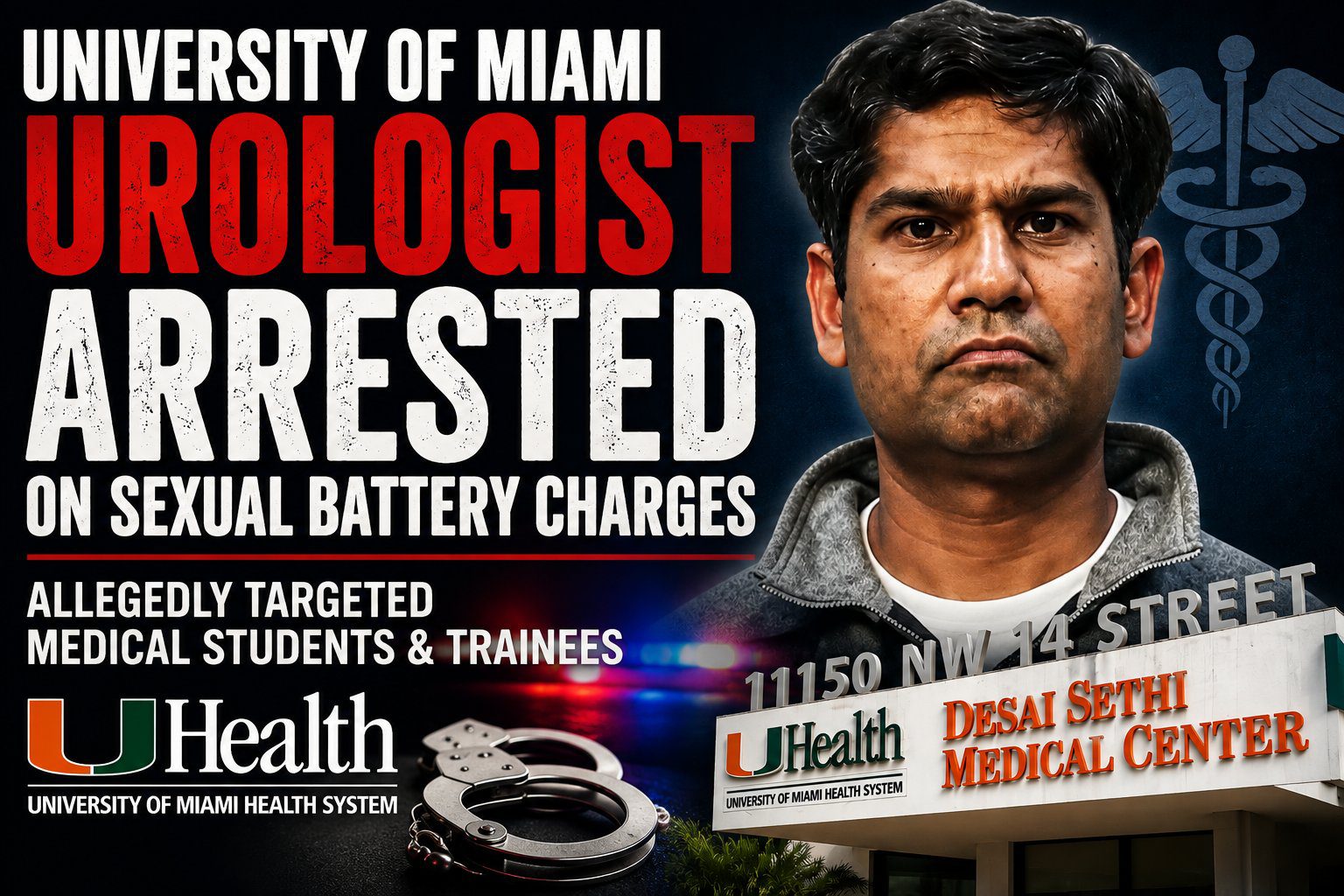
A prominent South Florida urologist who specialized in male infertility and sexual medicine has been arrested on three counts of sexual battery following a years long Miami police investigation into allegations that he used his medical authority to subject young male trainees and mentees to unnecessary intimate examinations.
Dr. Ranjith Ramasamy, 45, a former University of Miami Miller School of Medicine physician and researcher, was taken into custody Thursday morning at Miami International Airport after arriving on a flight from Dubai, according to Miami police and local news reports. Investigators allege that Ramasamy persuaded men working and studying under him that they had potential sexual-health problems and then performed physical, rectal and other intimate examinations that prosecutors contend had no legitimate medical purpose.
The criminal allegations are particularly serious because of the relationship investigators say existed between Ramasamy and the men involved. They were not simply patients walking into a doctor’s office seeking treatment. According to the arrest warrant described by WPLG Local 10, the alleged victims included medical trainees, research students and mentees working under a senior physician who occupied a position of professional authority over them.
Ramasamy is accused, not convicted. The charges against him remain allegations, and prosecutors will ultimately have to prove them beyond a reasonable doubt.
Police Say the Investigation Lasted More Than Two Years
The arrest follows an investigation by the City of Miami Police Department that stretched for more than two years. According to Local 10, allegations involving Ramasamy surfaced while he was affiliated with the University of Miami, prompting detectives to begin examining encounters between the physician and men who had worked or trained under him.
Three alleged victims are currently identified in connection with the charges supporting his arrest, but investigators have reportedly interviewed several additional people who could potentially be connected to the case. That makes the continuing investigation significant: the three criminal counts filed so far may not necessarily represent the full scope of what detectives are examining.
Police have not publicly established that every additional allegation or interview will result in another criminal charge. Additional witnesses and potential victims must be independently investigated, and prosecutors would have to determine whether evidence supports further cases.
Alleged Victims Say Medical Authority Was Used to Gain Their Trust
At the center of the case is an allegation that strikes directly at one of the most sensitive relationships in medicine: the trust between a physician and a person submitting to an intimate examination. According to the arrest warrant as reported by Local 10, Ramasamy allegedly convinced young men working under him that something might be medically wrong with their sexual or reproductive health. Investigators say that purported concern then became the justification for examinations that included intimate physical and rectal procedures.
Some of the alleged encounters reportedly occurred repeatedly, including examinations conducted as frequently as weekly. The distinction between a legitimate medical examination and criminal sexual contact will likely become central to the prosecution. Urologists routinely conduct examinations involving intimate parts of the body when medically indicated. The government’s allegation, however, is that these particular procedures were unnecessary and that the men agreed to them because they believed a physician and professional mentor was providing legitimate medical care.
If prosecutors establish that the examinations were intentionally misrepresented as medically necessary, the alleged deception could become a critical component of the case.
Missing Medical Records Allegedly Raised Suspicions
One of the most consequential details reported from the arrest warrant concerns what allegedly happened after the examinations: apparently very little was documented. According to Local 10, some of the men became suspicious when they realized the examinations and purported medical concerns were not being reflected in conventional medical records. Investigators reportedly found that expected documentation, test results or other records associated with legitimate medical treatment were absent.
That could become important evidence because modern medical care ordinarily generates documentation. A patient being evaluated for a suspected urological or reproductive condition would generally expect some combination of a medical history, clinical notes, test orders, laboratory results, diagnosis, treatment recommendations or follow-up records. The absence of such documentation does not independently prove that a crime occurred. But investigators appear to be examining whether the lack of records supports the accusers’ contention that the encounters were not genuine medical treatment.
The Power Imbalance Could Become Central to the Case
The allegations also raise questions extending beyond the physical examinations themselves because Ramasamy reportedly occupied a position of authority over the men accusing him. Medical students, researchers and trainees depend heavily on senior physicians for education, research opportunities, recommendations, publications, fellowships and career advancement. A respected specialist can therefore exercise substantial professional influence over someone at the beginning of a medical career.
That dynamic can complicate consent in ways fundamentally different from an ordinary physician-patient interaction. A trainee may be reluctant to challenge a supervisor’s medical opinion, refuse an examination or accuse a mentor of inappropriate conduct when that same person could influence future professional opportunities.
The criminal case will ultimately depend on Florida law and the specific evidence surrounding each alleged encounter, not simply the existence of a professional hierarchy. Nevertheless, the mentor-trainee relationship described by investigators provides essential context for understanding how the alleged conduct could have continued before being reported.
Ramasamy Left the University of Miami and Worked in Dubai
Ramasamy left the University of Miami in 2024 after the initial allegations emerged, according to Local 10. He subsequently worked in Dubai as a urology consultant at Jumeirah American Clinic. His departure from UM and subsequent employment overseas add an international dimension to what began as a South Florida investigation, but authorities ultimately took him into custody in Miami after his return from the United Arab Emirates.
According to the report, Ramasamy was arrested at Miami International Airport shortly after stepping off his flight Thursday morning. The arrest brought him back under the jurisdiction of the South Florida criminal justice system more than two years after investigators reportedly began examining the allegations.
Judge Sets $120,000 Bond and GPS Monitoring
Following his arrest, Ramasamy appeared before a judge and was granted release on a combined $120,000 bond, according to Local 10. The court also imposed significant restrictions, including GPS monitoring and orders prohibiting contact with the alleged victims. Such conditions allow a defendant to remain outside jail while the criminal case proceeds but provide authorities with a mechanism to monitor compliance with the court’s restrictions.
Bond is not a determination of guilt or innocence. The case must now move through the normal criminal process, which could include discovery, depositions, motions challenging evidence, plea negotiations and, unless otherwise resolved, a trial. The arrest warrant itself will likely become a major focus as Ramasamy’s defense attorneys examine the evidence investigators used to establish probable cause.
Florida Records Reportedly Show His Medical License Remains Active
Another major question concerns Ramasamy’s ability to practice medicine. According to Local 10’s review of Florida records, Ramasamy’s Florida medical license remained active at the time of the report despite the criminal charges. An active license does not necessarily mean he is currently treating patients in Florida, and criminal proceedings and professional licensing proceedings operate through separate systems.
The Florida Board of Medicine and Florida Department of Health can pursue disciplinary action independently of the criminal courts. Depending on the circumstances, regulatory consequences can include restrictions, suspension or ultimately revocation of a medical license. The existence of criminal charges alone does not establish professional misconduct, however, and any licensing action would have its own procedures and evidentiary requirements.
Investigators Are Looking for Other Potential Victims
Perhaps the most important unresolved issue is whether the three men connected to the current charges represent the entire case. Police have reportedly spoken with several additional potential victims during the investigation. That does not mean additional crimes have been established, but it indicates detectives have been examining allegations beyond the three counts currently before the court.
Cases involving alleged abuse of professional authority can be particularly difficult to investigate because potential victims may initially interpret an encounter through the authority granted to the professional involved. Medical procedures can be invasive by necessity, and patients and trainees generally assume a physician recommending an examination has a legitimate clinical reason for doing so.
That is precisely why the allegations against Ramasamy are so serious. Prosecutors are not merely alleging inappropriate behavior by a physician. They are alleging that medical expertise and professional trust were used to convince young men that intimate examinations were necessary when investigators contend they were not. Whether prosecutors can prove that allegation will now be tested in court.
For the University of Miami and South Florida’s medical community, the case also raises broader institutional questions about how trainees report misconduct involving powerful supervisors, what safeguards exist when mentors provide medical care to people working beneath them and how quickly institutions respond when professional boundaries may have been crossed.
For now, Ramasamy faces three sexual battery charges, remains subject to court-ordered restrictions and is entitled to the presumption of innocence. The Miami Police Department’s investigation, meanwhile, is not necessarily over.
Sources
- WPLG Local 10 — Urologist Accused of Sexually Battering Medical Students While Working for UM
- WSVN 7News — Former UM Doctor Surrenders After Allegations Involving Male Students
- Florida Department of Health — Ranjith Ramasamy License Verification
- Florida Department of Health — Ranjith Ramasamy Practitioner Profile














































Want to join the conversation?
Create an account or sign in to share your thoughts, vote,
and reply to other readers.
Showing 0 of 0 comments
Don't have an account?
Already have an account?