

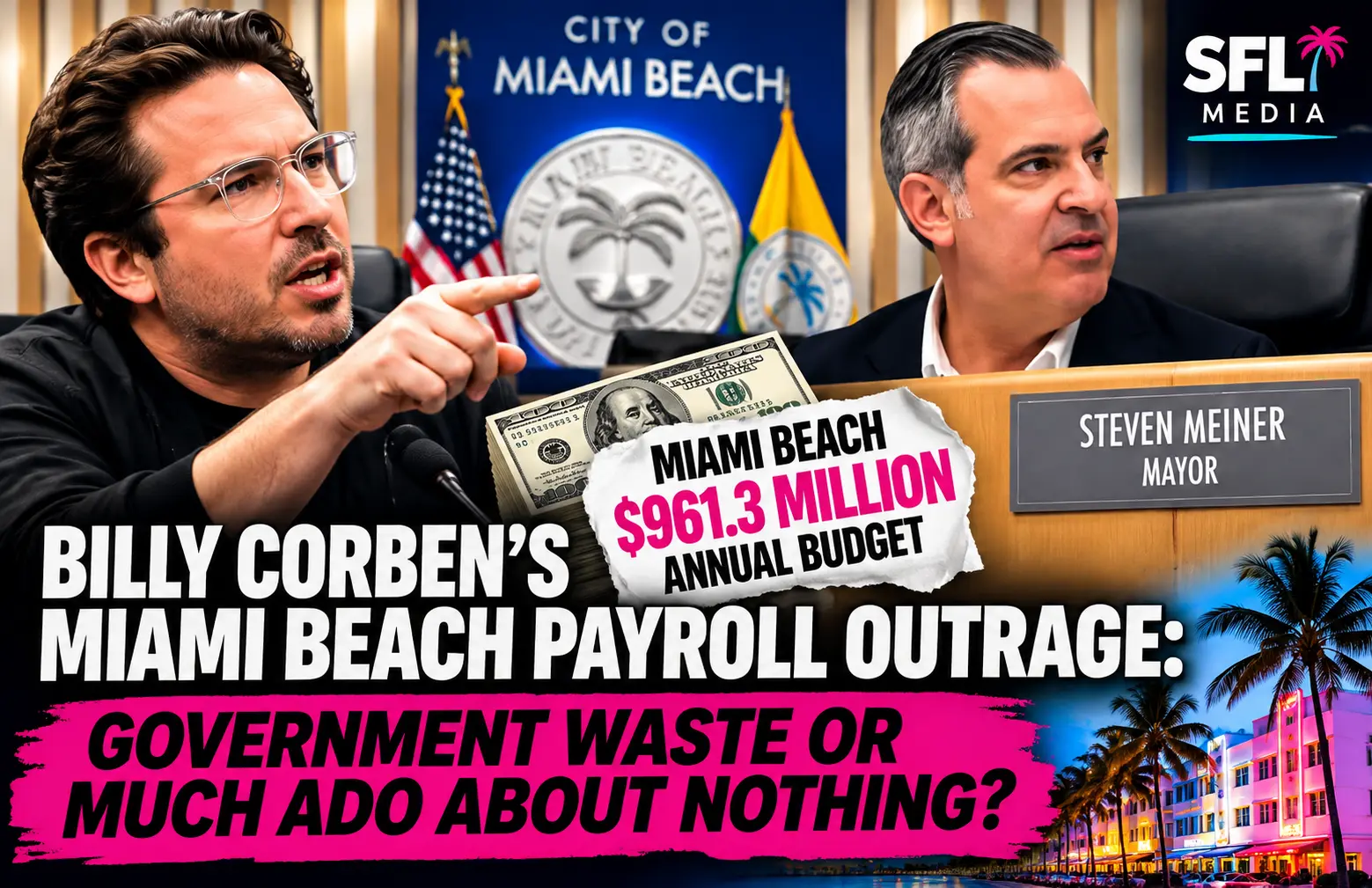
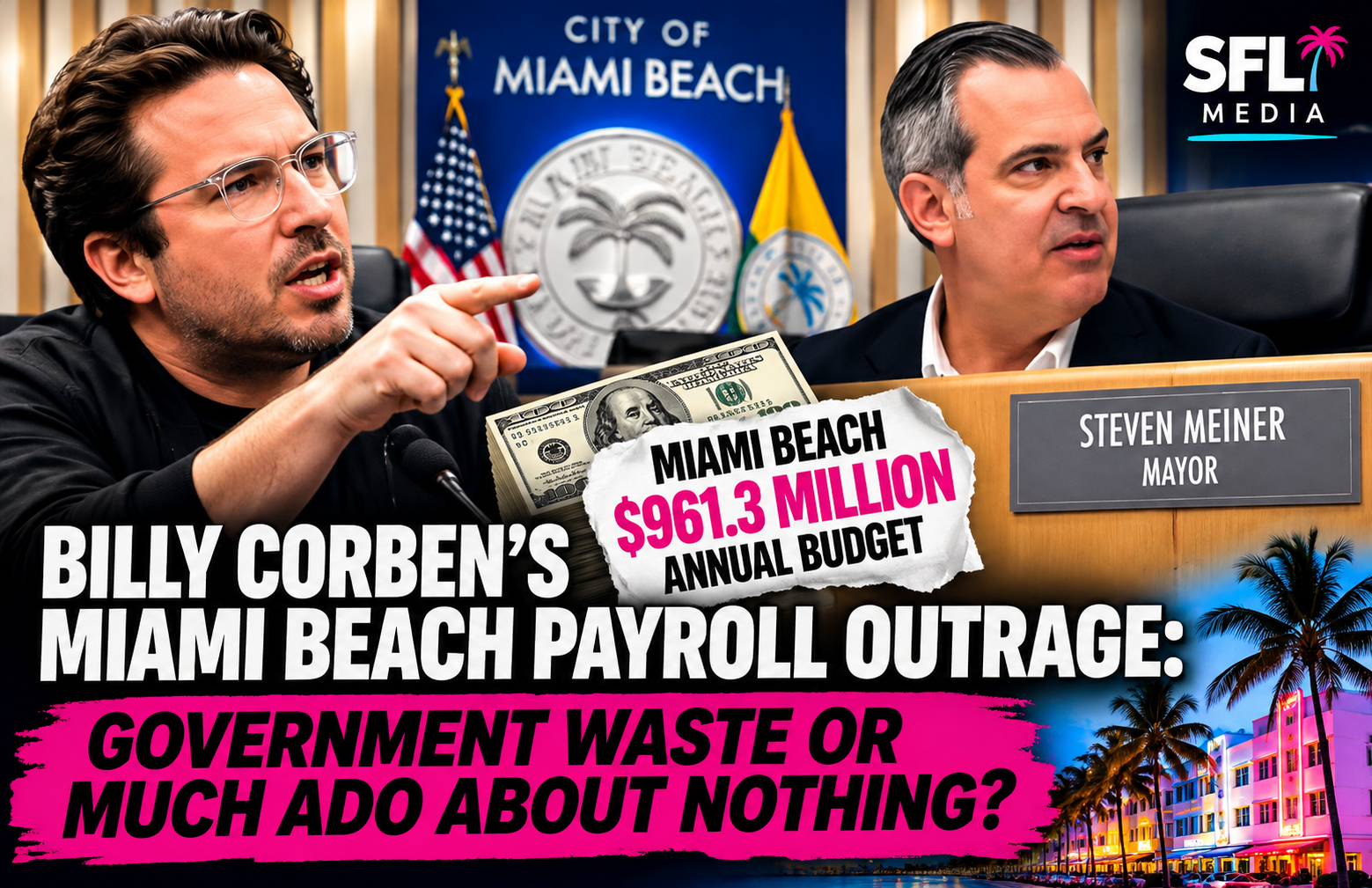
Billy Corben’s Latest Miami Beach Outrage: Government Waste or Much Ado About Nothing?
Miami Beach filmmaker and political commentator Billy Corben is once again taking aim at City Hall, this time accusing Mayor Steven Meiner of wasteful spending, questionable staffing decisions, and misleading the public about government payroll records. But behind the inflammatory social media posts and accusations of incompetence lies a more complicated financial reality: Miami Beach operates a municipal government with an annual budget approaching $1 billion, oversees expensive coastal infrastructure, and competes for professional talent in one of America’s most expensive housing markets.
The question is not whether Miami Beach taxpayers deserve transparency. They absolutely do. The question is whether Corben’s latest attack demonstrates genuine government waste or simply turns large salaries, stripped of their operational context, into another political spectacle.
Corben’s November criticism centers on compensation paid to senior Miami Beach officials, the cost of mayoral staff and police security, and Mayor Meiner’s dismissal of spending figures during a November 16 City Commission meeting. In a social media post accompanying footage of the meeting, Corben accused the mayor of spending more than $1 million annually on unnecessary staff and security while questioning whether city administrators could accurately account for their own compensation.
View this post on Instagram
Those are legitimate subjects for public scrutiny. But a six figure government salary is not, by itself, evidence of waste, corruption, incompetence, or an unnecessary position. Nor does a dramatic payroll figure tell taxpayers whether a public employee is overpaid without examining the responsibilities of the position, the labor market, comparable municipal governments, and what taxpayers receive in return.
Miami Beach Is Not a Small Town Government
Miami Beach may have approximately 80,000 year round residents, but its municipal responsibilities extend well beyond serving that residential population. The city must manage the infrastructure, public safety, transportation, tourism demands, coastal protection, and municipal services associated with an internationally recognized destination.
According to the city’s adopted fiscal year 2027 budget, Miami Beach operates with $961.3 million in annual operating expenditures, including a $516.1 million General Fund. That represents a $50.4 million increase, or 5.5%, over the previous year’s $910.8 million operating budget.
That is a substantial financial operation by almost any reasonable standard. A city managing hundreds of millions of dollars in public spending needs experienced financial officers, attorneys, department directors, administrators, and operational managers. Those positions require expertise that is also in demand among private companies, law firms, real estate developers, financial institutions, and other governments.
Miami Beach cannot reasonably expect to recruit and retain qualified professionals capable of managing an operation of that complexity while paying salaries disconnected from the regional labor market. The city is also operating in an unusually expensive environment. Employees who want to live in Miami Beach or nearby communities face significant housing costs, whether they rent or purchase property. A salary that might provide a comfortable upper middle class lifestyle in a less expensive region does not necessarily provide the same purchasing power in coastal Miami-Dade County.
That does not mean every government salary is justified. It means the cost of hiring competent people must be evaluated against actual market conditions rather than political outrage over the size of a paycheck.
The Salaries Behind Corben’s Latest Attack
Corben highlighted compensation figures for six senior Miami Beach officials, portraying them as evidence of an administration unable to justify its spending. The figures are substantial, particularly when viewed without context, but they also describe senior professionals occupying some of the most consequential administrative, legal, financial, and personnel positions in city government.
| Miami Beach official | Compensation cited by Corben |
|---|---|
| City Manager Eric Carpenter | $454,254.06 |
| City Attorney Ric Dopico | $420,864.58 |
| City Clerk Rafael Granado | $408,528.66 |
| Assistant City Manager | $345,558.72 |
| CFO Jason Greene | $318,801.34 |
| HR Director Marla Alpizar | $247,955.24 |
| Combined total | $2,195,962.60 |
The figures reflect amounts Corben cited from the city’s public salary records, including reported annual compensation rather than necessarily recurring base salaries. The distinction matters because government payroll databases can include more than contractual salaries. Depending on the reporting system, total annual compensation may incorporate allowances, overtime, retroactive adjustments, accrued leave payouts, and other payments that do not necessarily recur every year.
For example, Miami Beach’s official salary database lists Carpenter’s annual base salary at $397,837.44, compared with $454,254.06 in reported 2025 total compensation. That difference of approximately $56,417 is material when evaluating the recurring cost of the position. Before declaring these officials overpaid, taxpayers deserve to know exactly what each number represents.
What the City’s Payroll Database Actually Shows
Miami Beach’s public salary records support an important part of Corben’s argument: some senior officials receive substantial compensation, and the figures he highlighted are not simply invented numbers. However, the same records demonstrate why treating every total compensation figure as an employee’s ordinary annual salary can be misleading.
Carpenter’s official record lists $397,837.44 in annual salary and $454,254.06 in total pay for 2025. The city’s payroll system explicitly explains that annual pay can include overtime, off duty assignments, retroactive compensation, allowances, executive benefits, leave settlements, and collectively bargained premium payments. That is not a minor accounting technicality. It is the difference between understanding how much a position costs every year and treating a potentially exceptional payroll year as the permanent price of employing someone.
The same distinction applies across municipal government. Police officers, firefighters, department heads, and other employees may receive compensation above their base salaries because of overtime, contractual benefits, or additional duties. Those expenditures still deserve scrutiny, but an accurate financial assessment must separate recurring compensation from exceptional or variable payments.
Corben’s argument would be considerably stronger if it established which components of the reported compensation were unnecessary, excessive, or inconsistent with comparable public sector positions. Simply presenting the largest available payroll number does not answer those questions.
The Real Math: How Much of Miami Beach’s Budget Goes to These Executives?
The six compensation figures highlighted by Corben total approximately $2.196 million. Compared with Miami Beach’s adopted $961.3 million operating budget, that amounts to approximately 0.23% of annual spending. Put another way, the combined compensation of those six senior officials is equivalent to roughly 23 cents for every $100 in the city’s operating budget. That calculation is a scale comparison, not an accounting measure of the city’s actual fiscal year 2027 payroll. It compares reported compensation figures with a later year operating budget, and some amounts may include nonrecurring payments. Nevertheless, it helps put the size of the salaries into perspective.
Even eliminating the entire $2.196 million would represent less than one quarter of one percent of the city’s operating budget, before considering the cost of replacing the essential legal, financial, administrative, and personnel functions those officials perform. That does not establish whether the six officials are appropriately compensated. Their salaries must be judged against their individual responsibilities and comparable positions. But it does demonstrate why executive compensation alone is unlikely to explain the broader financial pressures facing Miami Beach.
The city’s operating budget increased 5.5% from the previous fiscal year, while its General Fund increased approximately 7%. Those broader spending trends, rather than executive salaries in isolation, deserve scrutiny from anyone seriously concerned about the city’s fiscal direction.
Comparing Miami Beach to Other Governments: What Is a Fair Salary?
A meaningful municipal compensation comparison must account for far more than population. Miami Beach’s financial responsibilities, tourism economy, housing costs, infrastructure demands, and commission manager government all influence the labor market for senior executives. The available figures support describing Miami Beach’s senior compensation as substantial, particularly at the city manager and city attorney levels. They do not, by themselves, establish that the salaries are unjustified.
| Position | Miami Beach reported base salary | Relevant comparison |
|---|---|---|
| City Manager | $397,837 | Municipal budgets, executive responsibilities and experience |
| City Attorney | Approximately $382,455 | Legal complexity, litigation exposure and outside counsel costs |
| City Clerk | Approximately $299,032 | Administrative responsibilities and staffing |
| Chief Financial Officer | Approximately $318,801 | Financial complexity and oversight responsibilities |
| HR Director | Approximately $247,955 | Workforce size, labor relations and personnel responsibilities |
These figures reflect the salary information supplied for the report, with Carpenter’s base salary independently confirmed in the city’s public database. They should not be mistaken for a completed compensation survey of comparable municipalities. The most relevant comparisons would involve similarly complex, high cost coastal cities, including Fort Lauderdale, Boca Raton, West Palm Beach, and comparable resort municipalities outside Florida. Their budgets, current employment contracts, benefits, and compensation definitions would need to be examined side by side.
A city with a smaller budget may still pay its top attorney more because of litigation exposure. Another may pay its manager less but provide deferred compensation or retirement benefits. A third may contract out legal or administrative work, making its direct payroll appear lower while shifting costs into professional services. Without accounting for those differences, declaring one government more wasteful than another based on a single salary figure is not sound financial analysis.
How Miami Beach’s Budget Compares Across South Florida
Regional budget comparisons help establish the scale of Miami Beach’s municipal operation. Although the city’s permanent population is smaller than that of many neighboring municipalities, its financial responsibilities are considerable.
| City | FY 2027 budget | Budget context |
|---|---|---|
| Miami Beach | $961.3 million | Operating budget, net of interfund transfers |
| Fort Lauderdale | $1.28 billion | Adopted citywide budget |
| West Palm Beach | $949.4 million | All funds budget, excluding specified redevelopment entities |
These figures come from municipal budget documents and local reporting. The accounting boundaries are not identical, so the amounts should not be treated as perfectly equivalent measures of government spending. Nevertheless, they demonstrate that Miami Beach operates at a financial scale comparable to other major South Florida municipal governments.
Fort Lauderdale, for example, approved a $1.28 billion budget for fiscal year 2027, while West Palm Beach adopted approximately $949.4 million in citywide spending. Miami Beach’s $961.3 million operating budget places it in the same general financial category, despite serving a smaller residential population than either municipality.
The comparison does not prove that Miami Beach’s executives should receive identical compensation to their counterparts elsewhere. It does, however, challenge the suggestion that Miami Beach is a small municipality whose senior administrators should necessarily receive modest salaries simply because its permanent population is relatively limited. The appropriate comparison is not merely how many residents live within city limits, but the financial, operational, legal, and infrastructure responsibilities of the government those employees are hired to manage.
The Cost of Living Is Not a Footnote
There is another uncomfortable reality that gets lost when public salaries become social media ammunition: Miami Beach is an expensive place to live, and competent public employees have the same housing aspirations as everyone else.
Should a senior city administrator overseeing hundreds of millions of dollars be able to afford a home in the region where they work? Should an experienced attorney or financial executive be expected to accept a dramatically lower standard of living simply because their employer is a government rather than a corporation? – Patrick Zarrelli
Public employment is a form of public service, but it is still employment. Government cannot demand private sector expertise while pretending the private sector labor market does not exist.
The issue is especially pronounced in South Florida, where housing affordability remains a significant concern. A competitive salary can help recruit and retain experienced professionals, although high housing costs alone do not prove that any particular salary is reasonable. Nor is it necessary for every senior employee to reside within Miami Beach itself to perform their job effectively.
A government that systematically underpays critical employees may eventually pay more through turnover, recruitment, outside consulting contracts, management failures, and costly mistakes. That possibility should be part of the analysis, just as the risk of excessive compensation should be.
Corben’s $1 Million Mayoral Staffing and Security Allegation Is a Separate Question
Perhaps the most important distinction in this dispute is one that can easily disappear amid the rhetoric. Corben’s allegation about more than $1 million in mayoral staffing and police security is not the same as his criticism of the city manager, city attorney, clerk, CFO, and other senior administrators.
During the November 16 special commission meeting, Corben alleged that five mayoral staff members received approximately $780,000 annually in combined compensation, while police overtime associated with the mayor’s security cost approximately $250,000. Together, those allegations total approximately $1.03 million. A published account of the meeting confirms that Meiner disputed the figures, but the record reviewed for this article does not establish an independently verified alternative total.
Miami Beach uses a commission manager system. Its elected mayor does not personally manage the entire municipal workforce. The city manager and other senior appointed officials perform distinct government functions, regardless of who occupies the mayor’s office.
The appropriateness of spending on mayoral aides, communications staff, policy advisers, and police security therefore requires its own analysis. For a mayor with limited direct executive responsibilities, a large support operation can reasonably raise questions about necessity, duplication, and public value. Police protection also requires examination of security assessments, staffing schedules, overtime, and whether the resources are proportional to documented needs.
There is evidence that these questions extend beyond Corben’s personal criticism. A November commission proposal sponsored by Commissioner David Suarez identified approximately $4.47 million in fiscal year 2027 spending for the Office of the Mayor and City Commission, up from approximately $2.88 million in fiscal year 2024. The proposal called for examining elected officials’ allowances, staffing, pensions, travel expenses, and mayoral security arrangements.
That represents an increase of approximately 55% in the office’s adopted budget over three fiscal years, a substantial change deserving careful examination. However, the figure covers the broader mayoral and commission operation, not simply the mayor’s personal staff or security.
The existence of a proposal to reduce these expenses does not independently establish that the spending is wasteful. It does demonstrate that the cost of elected officials’ support operations is a legitimate budget issue being examined within City Hall itself.
The Salary Database Dispute Deserves a Straight Answer
Corben also accused Meiner of dismissing the city’s own salary records during the November 16 meeting. Published accounts of the meeting indicate that Meiner described Corben’s figures as inaccurate, including the phrase “wildly and completely inaccurate,” without providing a detailed alternative accounting during the exchange.
That distinction matters. The available meeting accounts support the conclusion that Meiner disputed Corben’s numbers, but they do not conclusively establish that he was declaring the entire municipal payroll database unreliable. There is an important difference between saying a public database contains incorrect information and saying that members of the public are misinterpreting accurate figures. The database’s explanatory notes already acknowledge that total compensation can include payments beyond base salary, providing a possible explanation for some of the disputed amounts.
If Meiner believes Corben’s calculations are wrong, the most effective response would be a documented breakdown of the relevant positions, their recurring salaries, supplemental compensation, and security expenditures. Taxpayers should not have to choose between competing political accusations when the underlying financial records are maintained by the city itself.
Accountability Requires More Than Political Gotcha Moments
Corben has built a public reputation around confrontational commentary and aggressive criticism of South Florida’s political establishment. That approach can attract attention to important government decisions, and public officials should expect difficult questions about how taxpayer money is spent.
But confrontational questioning is not a substitute for comprehensive analysis.
There is a difference between uncovering an improperly awarded contract and pointing at an expensive contract. There is a difference between demonstrating that an employee is unqualified and asserting that the employee is unqualified. And there is a difference between exposing government waste and expressing disbelief that government professionals earn substantial salaries. Corben’s latest post relies heavily on accusations of incompetence, dishonesty, and unnecessary spending. Those accusations may resonate with audiences already skeptical of Meiner’s administration, but they require evidence beyond the compensation figures themselves.
A serious investigation would examine whether positions were competitively filled, whether the employees possess appropriate qualifications, how their compensation compares with similarly situated professionals, whether the positions duplicate other government functions, and whether their work produces measurable public value. It would also distinguish between elected officials making political decisions and career professionals carrying out the government’s operational responsibilities. Without that distinction, criticism of government can become criticism of the very people necessary to make government function.
There Are Legitimate Questions About Miami Beach Spending
None of this means Miami Beach deserves a free pass. The city should be prepared to justify its senior executive compensation, explain significant differences between base salary and gross annual pay, disclose the cost and purpose of mayoral support positions, and provide a clear accounting of police security expenditures. Residents also deserve to understand why the city’s operating budget is increasing and whether public services are improving proportionately. Those questions are especially important as the city confronts the financial implications of Florida’s recently approved Amendment 3, which changes property tax exemptions and could reduce future municipal revenue.
A November budget proposal estimated that the amendment could eventually reduce Miami Beach revenue by approximately $9.8 million annually, although those projections were preliminary and subject to further financial review. That is a much more consequential fiscal challenge than the compensation of any single municipal executive. Miami Beach’s nearly $1 billion budget is not a blank check. Its executives’ responsibilities are substantial, but so are their obligations to the taxpayers who fund their salaries.
The strongest criticism of the administration would be built around demonstrable failures: missed financial targets, unnecessary contracts, poor service delivery, questionable hiring decisions, excessive recurring compensation, or spending that produces little measurable benefit. Those findings would be far more consequential than simply assembling a list of the city’s highest paid employees.
The Bottom Line: Big Salaries Are Not Automatically Big Scandals
Billy Corben has raised questions that Miami Beach officials should answer. The public payroll database deserves to be accurate, the mayor’s office should account for its staffing and security expenses, and senior officials should be able to explain why their compensation is justified. But Corben’s broader suggestion that large payroll figures demonstrate a government incapable of managing taxpayer money goes beyond what the evidence currently establishes.
Miami Beach is an internationally significant coastal destination operating a complex municipal government with nearly $1 billion in annual expenditures. Its professional administrators face substantial responsibilities, and recruiting qualified people in South Florida is not inexpensive. Some executive compensation may be above market rates. Some positions may warrant restructuring. Certain allowances or benefits may deserve closer scrutiny. Those possibilities should be investigated rather than dismissed. Yet the opposite assumption, that officials must be wasting public money because their salaries sound enormous, is equally unsupported.
The real test is whether Miami Beach is getting competent leadership, effective services, responsible financial management, and measurable results for the money it spends. Corben’s confrontational style may generate headlines, social media engagement, and memorable City Hall exchanges. But if the goal is to expose genuine waste, the investigation must go further than the outrage.
Miami Beach taxpayers deserve accountability. They also deserve a public debate grounded in accurate financial comparisons, realistic labor costs, and evidence of actual performance—not another political spectacle in which the loudest accusation is mistaken for the strongest argument.






Loading comments…