
Duke Dumont Turns Creamfields’ APEX Into a 30,000 Person House Music Pressure Chamber
There are festival DJs who chase whatever sound happens to be exploding that summer, and then there are artists who have been around long enough to watch dance music repeatedly reinvent itself around them. Duke Dumont belongs firmly in the second category. More than a decade after records such as “Need U (100%),” “I Got U” and “Ocean Drive” pushed him from British club culture into international dance music, Dumont arrived at Creamfields 2026 with a set that demonstrated how successfully his sound has evolved without abandoning the songwriting instincts that originally made him famous.
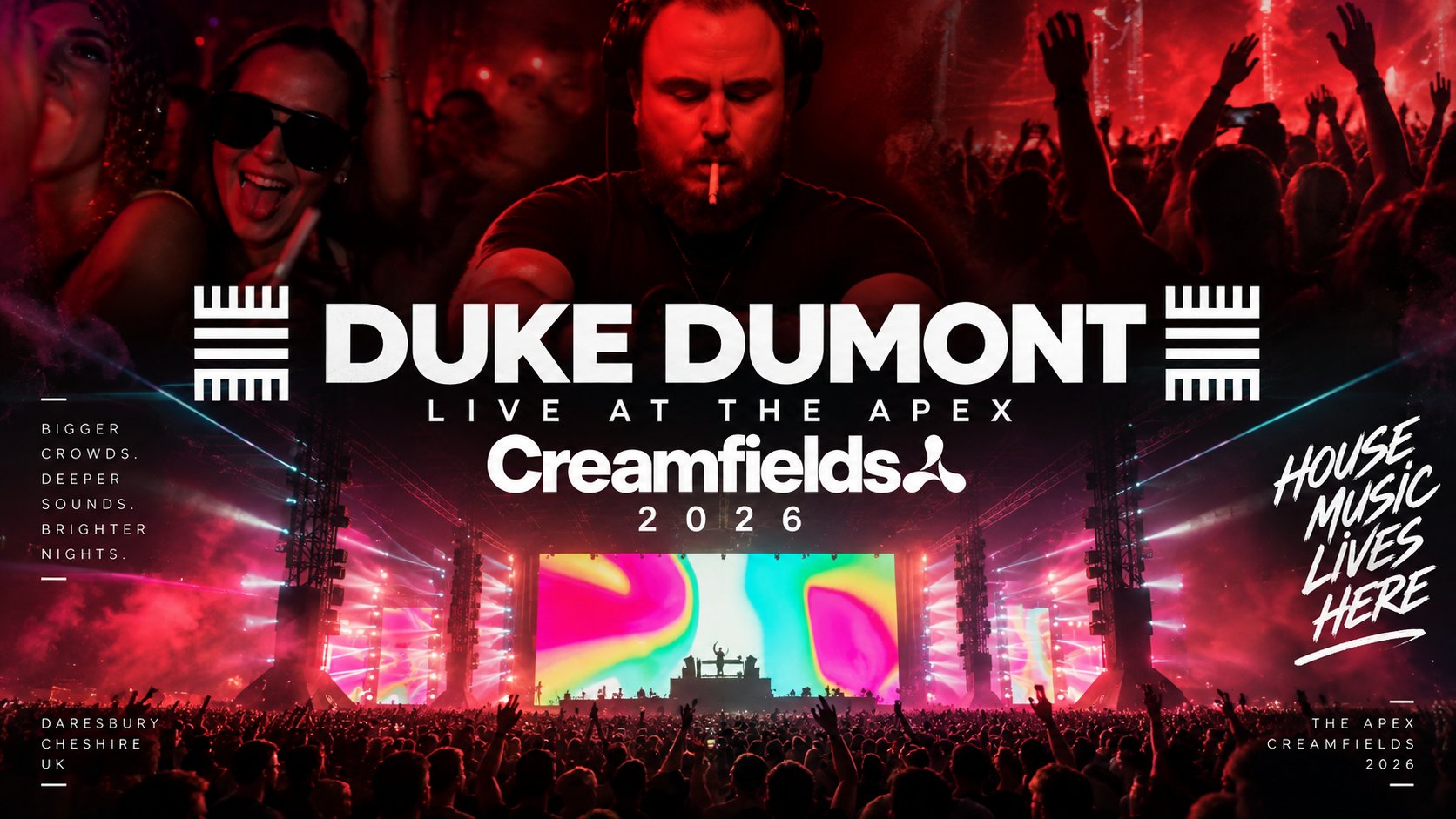
His Sunday performance inside APEX was built for scale. Creamfields officially lists the indoor superstructure at approximately 30,000 capacity and has billed it as the world’s largest indoor festival main-stage structure. The festival’s 2026 livestream schedule placed Dumont in APEX from 6:30 p.m. to 8 p.m., following Danny Howard and preceding Ewan McVicar, during a weekend in which the arena also hosted major electronic acts including Swedish House Mafia, Armin van Buuren and FISHER.
Dumont used that enormous room accordingly. Instead of approaching Creamfields like an oversized version of a nightclub, he constructed the performance around the dramatic tension required to move an arena sized audience: long vocal builds, muscular low-end, flashes of melodic house, darker club passages and carefully rationed appearances from the records everyone knew were eventually coming. The result was less a nostalgic Duke Dumont greatest hits set than a demonstration of how an artist associated with one era of UK house music has adapted to a considerably harder, faster and more aggressive festival landscape.
APEX Is Almost Absurdly Well Suited to Duke Dumont
Creamfields introduced the APEX concept in 2024 as part of a major investment in the Daresbury festival site. The structure was designed to hold approximately 30,000 people under one roof, giving Creamfields an indoor main stage capable of delivering arena-scale production without surrendering the enclosed atmosphere that makes club music feel physically overwhelming. By 2026, APEX had become one of the festival’s defining spaces, combining giant visual displays, concentrated lighting and the kind of sound system necessary to make low frequencies feel architectural.
Dumont’s music benefits enormously from that environment because so much of his production is built around contrast. His records frequently juxtapose emotionally direct vocals or melodic piano passages against heavy club drums, allowing a track to feel expansive without sacrificing the physical mechanics of house music. Inside APEX, those contrasts become exaggerated. Breakdowns create enormous empty space before the kick returns, vocal passages hang over thousands of people and relatively simple basslines become something audiences feel as much as hear.
The production surrounding the set amplifies that effect without overwhelming it. Massive LED sequences, strobes and tightly synchronized lighting cues accompany the larger transitions, while the enclosed structure allows the visual production to remain effective even before darkness fully settles outside. APEX essentially gives a festival DJ the environmental control of an arena show while preserving the density and collective energy of a rave. For Dumont, that is close to ideal territory.
This Is Not the Duke Dumont of 2014
Anyone approaching the set expecting 90 minutes of polished commercial deep house would be several years behind the artist. Dumont’s catalog may still contain some of the defining crossover house records of the 2010s, but his contemporary club sound has steadily become tougher, faster and more percussive. The Creamfields performance makes that evolution unmistakable, moving between vocal house, driving tech house rhythms, heavier club material and large melodic breakdowns without sounding as though the DJ is jumping randomly between genres.
That progression is particularly interesting because Dumont has never completely abandoned melody. At a time when festival house has increasingly moved toward stripped down percussion, harder basslines and rapid-fire drops, he continues to leave significant space for vocals and traditional songwriting. The difference is what now surrounds those elements. A melodic passage that might once have resolved into a relatively restrained deep house groove can now explode into something considerably heavier. That gives the Creamfields set an unusual balance. It has enough aggression to work inside one of Europe’s largest electronic music festival environments, but enough musical identity to avoid becoming interchangeable with the hundreds of tech house sets filling festival schedules around the world.
“Ain’t No Game” Arrives at Exactly the Right Moment in His Evolution
The timing of Creamfields was particularly significant because Dumont had just released “Ain’t No Game” through his Club Blasé imprint on August 21, 2026, days before the festival. Beatport lists the extended version at 136 BPM, considerably illustrating how far his contemporary club material has traveled from the slower house tempos many listeners still associate with his early crossover period.
“Ain’t No Game” combines an insistent house foundation with soulful vocals and prominent piano, retaining the emotional immediacy associated with Dumont while pushing the record firmly toward modern peak time dance floors. Its placement around Creamfields effectively turned the festival appearance into one of the first major showcases for the new release, allowing the record to exist in the environment for which its extended club version was clearly constructed.
The track also provides a useful snapshot of Dumont’s current position. He does not need to imitate the latest generation of tech-house producers because his strongest advantage remains the ability to write a hook. At the same time, he clearly understands that the physical intensity of festival house has changed dramatically. “Ain’t No Game” attempts to satisfy both requirements: recognizable musicality on top, considerably more force underneath.
That combination matters in APEX. A 30,000 person room can expose weak arrangements mercilessly. Tracks without enough low-end disappear into the space, while overly complicated productions can become muddy when pushed through enormous systems. Dumont’s strongest material survives because the architecture of the records is generally straightforward: establish the hook, create tension, remove elements and then return with force.
The Classics Still Hit, But Dumont Does Not Depend on Them
Dumont possesses a luxury many electronic artists never acquire: multiple records capable of triggering recognition almost immediately. “Need U (100%),” featuring AME, reached No. 1 on the UK Singles Chart in 2013 and became one of the records associated with the resurgence of British house music in the mainstream. “I Got U,” featuring Jax Jones, followed with another UK No. 1 in 2014, while “Ocean Drive” became perhaps his most durable international crossover record after arriving in 2015.
Those songs could easily become a trap. An artist with several massive records can spend the remainder of a career touring around them, waiting for the familiar vocal to generate the night’s biggest reaction. Dumont’s Creamfields performance is stronger because the classics function as landmarks rather than the entire destination. They give the audience recognizable emotional peaks, but the surrounding set remains rooted in his current club identity.
“Ocean Drive” is particularly effective in that context. The record’s atmosphere is almost the opposite of the hardest portions of the Creamfields performance: smooth, nocturnal and melodic rather than confrontational. That contrast gives it additional power. Instead of attempting to maintain maximum intensity continuously, Dumont can temporarily pull the room toward something more emotional before rebuilding the pressure. That is basic DJ programming, but it is frequently lost on enormous festival stages where performers can become obsessed with making every record bigger than the one preceding it. Ninety minutes of constant climax eventually stops feeling climactic. Dumont understands the usefulness of restraint.
“Red Light Green Light” Connects the Two Versions of Duke Dumont
If “Ocean Drive” represents Dumont’s crossover songwriting instincts, “Red Light Green Light” represents the bridge toward his harder club identity. Released in 2019 as part of his “For Club Play Only” series, the track is considerably more functional and deliberately repetitive, constructed around a vocal command and a driving groove rather than the traditional song structure associated with his biggest radio records.
That distinction helps explain the longevity of his live sets. Dumont has effectively maintained two overlapping catalogs: records designed to function as songs and records designed to function as tools for DJs. Creamfields allows him to use both. A recognizable vocal anthem can produce an emotional response, while a stripped-down club record can maintain momentum for several minutes without demanding the audience’s attention in the same way.
The ability to move between those modes becomes increasingly valuable across a long festival performance. A DJ cannot realistically ask tens of thousands of people to scream through every transition. Some portions of a successful set need to function almost subconsciously, establishing a groove that allows the audience to settle before the next major payoff. Dumont repeatedly demonstrates that discipline inside APEX.
The IDs Matter Because They Keep the Set From Becoming a Museum Piece
Another important element is the unreleased material circulating through the performance. Rather than attempting to assign definitive titles to every unidentified track, some of the records are better understood simply as Club Blasé IDs until Dumont officially releases or identifies them. That distinction matters journalistically because fan generated tracklists frequently transform guesses, vocal phrases and working titles into supposedly official songs long before the artists confirm anything.
Artistically, however, the purpose of those IDs is obvious. They prevent the set from becoming predictable. Electronic music has always depended on the possibility that the most interesting record of the night might be one nobody can immediately identify. Before streaming services, Shazam and online tracklists made almost every song discoverable within seconds, that mystery was fundamental to club culture. DJs built reputations partly around possessing records other people could not find.
Dumont preserves some of that tradition at Creamfields. The recognizable records establish trust, and the unknown records use that trust to move the audience somewhere else. When “Ocean Drive” or “Need U (100%)” eventually appears, the crowd receives the expected payoff. Between those moments, Dumont has considerably more freedom.
The Production Is Huge, but the Set Still Depends on DJ Fundamentals
It would be easy to describe APEX primarily through its technical spectacle. The structure is enormous, the screens are enormous and the sound system is designed to overwhelm. Yet the production works because it remains synchronized with the musical architecture rather than simply firing continuously. Lighting expands during builds, visual sequences intensify around drops and darker sections allow the room itself to disappear before the next release.
The basic mechanics remain surprisingly traditional. Dumont establishes a rhythm, gradually adds tension, removes the low frequencies during a breakdown and allows the audience to anticipate their return. The scale has changed dramatically, but the psychological principle is the same one DJs have used in clubs for decades.
That may be the most interesting thing about watching electronic music inside a structure capable of holding 30,000 people. Technology has transformed virtually everything surrounding the DJ, the screens, lighting, lasers, sound systems, software and scale, while the fundamental relationship between tension and release remains almost primitive. People know the bass is coming back. The DJ knows they know. The entire performance is built around deciding exactly how long to make them wait. Duke Dumont is very good at making them wait.
Creamfields Shows Why Duke Dumont Has Lasted
Dance music can be brutally unforgiving toward artists associated with a particular moment. Genres change quickly, audiences get younger, production standards evolve and sounds that dominated festivals five years earlier can suddenly feel dated. Dumont has survived several of those cycles since “Need U (100%)” turned him into an international name in 2013.
His Creamfields 2026 performance provides a fairly convincing explanation why. He has not attempted to preserve his early-2010s sound in amber, but he has not discarded the musical qualities that made those records successful either. The drums have become harder, the tempos have accelerated and the club material has become more aggressive, yet melody, vocals and carefully constructed tension remain central to his work.
That puts Dumont in an increasingly interesting position within electronic music. He is now established enough to possess a catalog capable of carrying an entire festival set, but contemporary enough that he does not have to rely on nostalgia to fill the room. “Ain’t No Game” arriving immediately before Creamfields reinforces that point. More than a decade after his commercial breakthrough, he is still releasing records specifically designed for the dance floor rather than simply touring behind the old ones.
Inside APEX, surrounded by 30,000 person scale, enormous screens and enough low-end to turn an indoor structure into something resembling a pressure chamber, the strategy makes sense. Duke Dumont does not need to choose between the producer responsible for “Ocean Drive” and the DJ pushing harder Club Blasé material in 2026. The effectiveness of the Creamfields set comes from allowing both versions to exist at once. The hits provide the memories. The new records provide the momentum. The IDs provide the uncertainty. And APEX provides enough sound and production to make all three feel enormous.
For an artist approaching a decade and a half since his breakthrough, that may be the strongest statement Duke Dumont could make at Creamfields: he is not there merely to remind people what he did. He is still building the next version of it.

Sources & Further Reading
Creamfields — Official APEX Stage Information
Creamfields — Official 2026 Livestream and APEX Schedule
Beatportal — Creamfields 2026 Livestream and Stage Guide
Duke Dumont — Official Website and Current Releases
Beatport — Duke Dumont “Ain’t No Game” Extended Mix
Beatport — Duke Dumont Releases and 2026 Catalog














































Want to join the conversation?
Create an account or sign in to share your thoughts, vote,
and reply to other readers.
Showing 0 of 0 comments
Don't have an account?
Already have an account?