
Tiësto Goes Back to Trance at Creamfields 2026 With a Stunning Steel Yard Closing Set
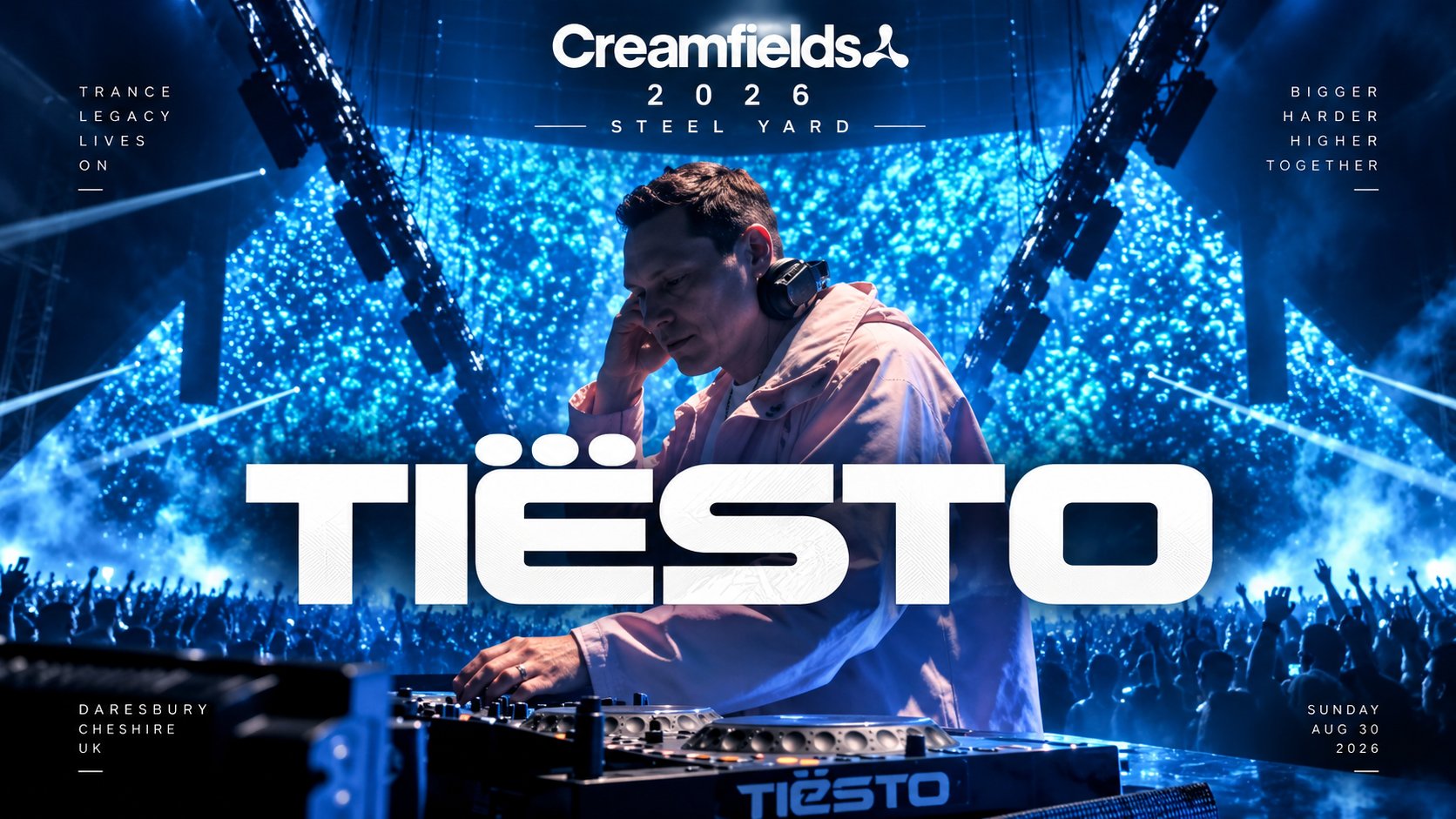
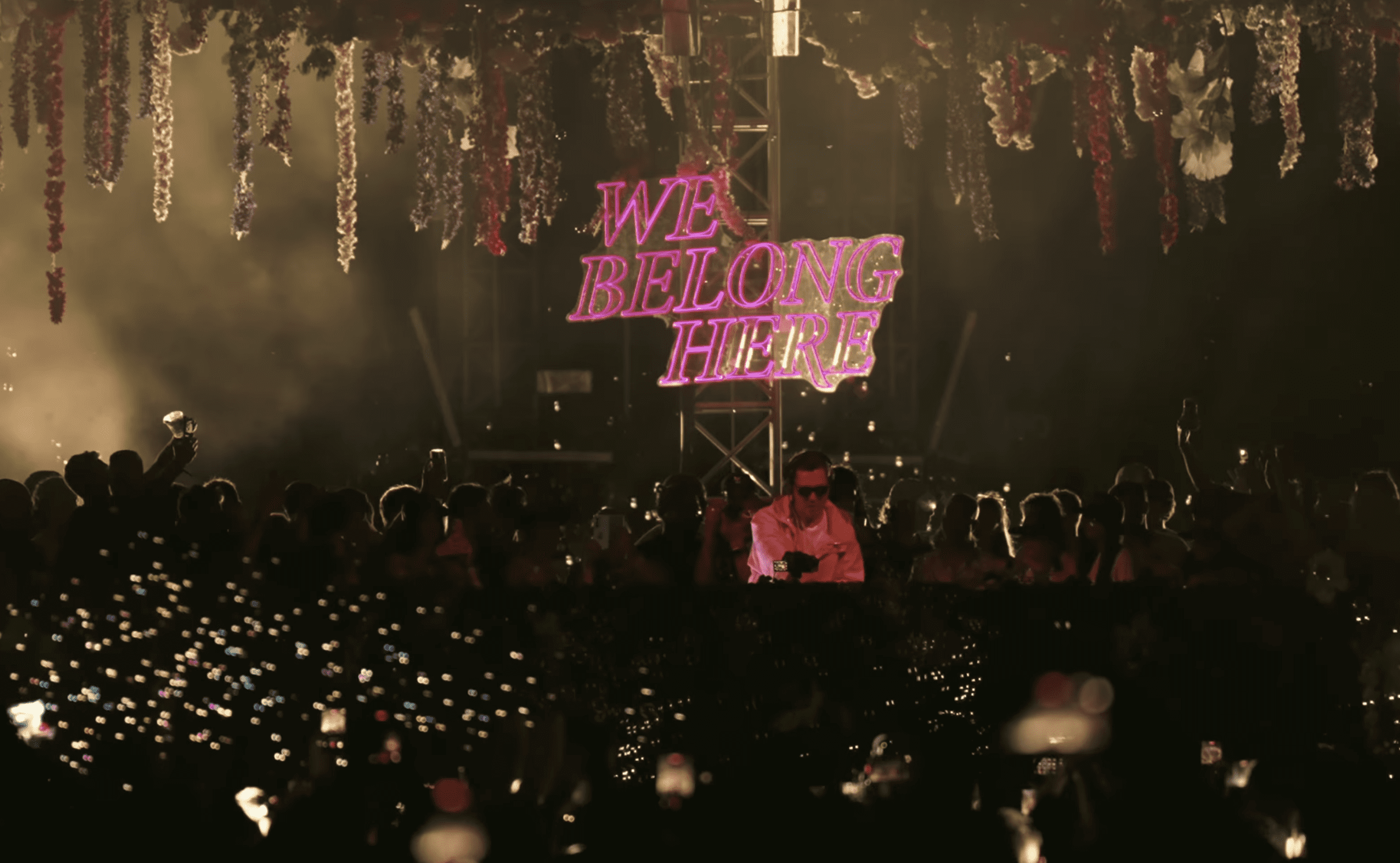
For an artist whose career has stretched from underground trance and progressive house to electro, big room EDM and global pop, going backward can sometimes be the most interesting way to move forward. At Creamfields 2026, Tiësto did exactly that. Closing the Steel Yard on Sunday, August 30, the Dutch electronic music icon delivered a performance that leaned deliberately into the sound that first established him as one of the world’s most influential DJs, surrounding classic trance records with contemporary reworks, harder percussion and the production power of a modern festival.
The direction was not accidental. When Creamfields announced Tiësto’s return in December 2025, organizers specifically promised an “all new sound inspired by his trance roots.” The festival’s official 2026 schedule placed him in the Steel Yard from 9:30 p.m. until 11 p.m. on the final night, although the subsequently released video of the performance runs approximately 76 minutes. Rather than a conventional greatest hits set, the recording captures Tiësto taking the melodic architecture of his past and rebuilding it for a faster, harder generation of electronic music.
Creamfields Got the Tiësto Trance Fans Had Been Waiting For
The significance of the performance becomes clearer when viewed against Tiësto’s extraordinary career. Long before Las Vegas residencies, pop collaborations and enormous commercial festival records, he was one of the central figures in trance’s transformation from European club music into a global phenomenon. His Magik and In Search of Sunrise mix series, relentless international touring and records such as “Lethal Industry” helped establish an era of electronic music that continues to command an unusually devoted audience.
For much of his later career, however, fans hoping for a substantial return to that sound generally received individual classics or brief trance passages inside sets dominated by more contemporary material. Creamfields was different. Tiësto’s track selection was constructed around trance rather than merely acknowledging it, allowing older melodies, updated versions of classics and new productions influenced by that period to drive the performance.
The recorded set establishes that intention almost immediately. Tiësto opens with his Olivia Sebastianelli collaboration “Don’t Lose Your Head” before moving into his rework of Three Drives’ “Greece 2000,” followed by Solarstone vs. Sirocco’s “Destination” in an Effen remix and Tiësto’s reworking of Guru Josh’s “Infinity.” From there, the performance continues through material including Elysian’s “Now We Are Free,” Plummet’s “Damaged,” Delerium featuring Sarah McLachlan’s “Silence,” “Lethal Industry,” CRW’s “I Feel Love” and N-Trance’s “Set You Free.” Within minutes, the purpose of the night is unmistakable: Tiësto is speaking the musical language of trance again.
Steel Yard Was Built for This Kind of Music
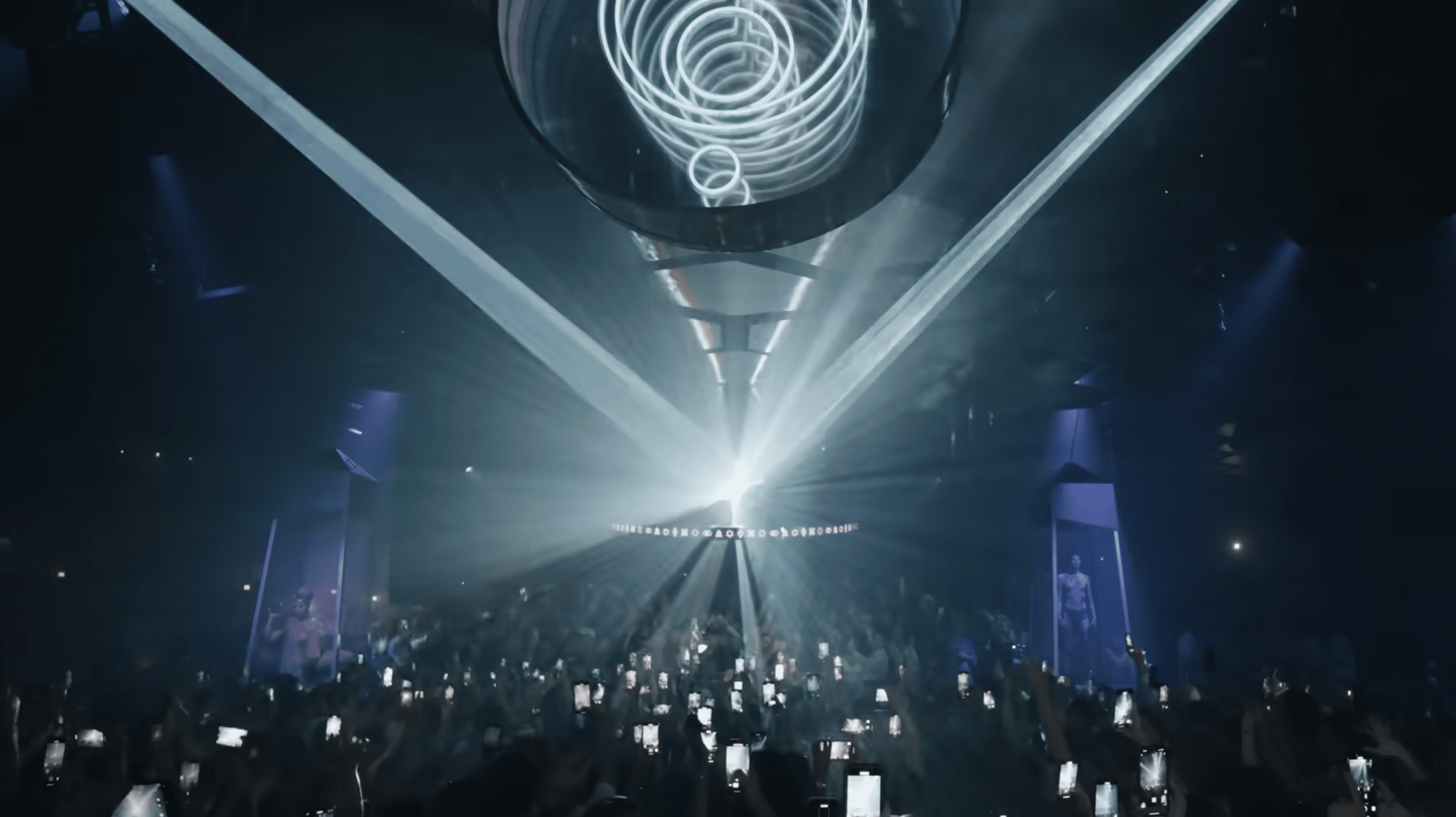
The choice of Steel Yard made the return even more effective. Creamfields introduced the superstructure in 2016 after a year of planning and construction, describing it at launch as the first and largest structure of its kind in Europe. Creamfields’ own historical material lists the structure at 20 meters high with a capacity of approximately 20,000 people, not 15,000, as has sometimes been reported elsewhere, making the venue considerably larger than a traditional festival tent.
Trance benefits enormously from that environment. Where contemporary tech house can derive much of its power from repetition and stripped-down rhythm, classic trance frequently depends on scale, melody and anticipation. Extended synth passages need space to develop, breakdowns need darkness and the return of the kick drum needs enough physical force to make the emotional buildup worthwhile. Steel Yard provides exactly those conditions, concentrating lighting, sound and thousands of people beneath an enormous industrial roof.
Tiësto uses that environment rather than fighting it. Faster rhythms maintain the physical momentum of a contemporary festival set, while melodic passages repeatedly open enormous spaces between the harder sections. The combination makes the performance feel simultaneously historical and current: the musical vocabulary comes partly from trance’s past, but the physical impact unmistakably belongs to 2026.
“Greece 2000” Establishes the Mission Almost Immediately
Dropping Three Drives’ “Greece 2000” near the beginning of the performance functions almost as a declaration of intent. The 1997 original is one of the defining records of classic trance, and placing Tiësto’s modern rework immediately after his opening track removes any uncertainty about where he intends to take the audience. Importantly, he does not simply play 90 minutes of untouched classics. Much of the material has been remixed, edited, mashed together or reinforced for contemporary festival systems. That distinction prevents Creamfields from becoming a retro performance. The melodies remain recognizable, but they are surrounded by harder drums, more aggressive transitions and substantially greater low-end pressure than listeners would have encountered during trance’s original commercial ascent.
The opening sequence makes that approach particularly clear. “Greece 2000” leads into “Destination,” Tiësto’s “Infinity” remix and a mashup combining elements associated with Cygnus X, Ummet Ozcan, Rozalla, Crossnaders and Olive. Instead of presenting dance-music history chronologically, Tiësto treats it as material that can be disassembled and reconstructed for a modern room. It is classic trance after decades of technological and stylistic evolution.
“Silence” and “Lethal Industry” Connect the Set Directly to Tiësto’s History
Few records carry more historical significance for longtime Tiësto listeners than Delerium and Sarah McLachlan’s “Silence.” Tiësto’s original In Search of Sunrise remix became one of the defining trance recordings of its era, and the Creamfields tracklist features an updated “In Search of Sunrise 2025 Remix.” Its appearance gives the performance a direct connection to the period in which Tiësto’s reputation was built while also reinforcing the central idea behind the entire set: this is not simply an archive being reopened.
The transition into “Lethal Industry” pushes that point even further. Originally released during Tiësto’s early 2000s trance period, the instrumental remains one of the most immediately recognizable productions from his pre-EDM career. Inside Steel Yard, its distinctive melodic identity is surrounded by the weight and speed of contemporary festival production, allowing a record more than two decades old to function alongside new music without feeling like an obligatory nostalgia drop. Those moments are important because Tiësto’s history gives him an advantage that younger artists participating in the current trance revival cannot reproduce. New producers can borrow the sonic vocabulary of late ’90s and early 2000s trance. Tiësto can reach directly into the period itself.
The Set Shows Why Trance Is Finding New Life
Tiësto’s renewed interest in trance arrives during a broader resurgence of faster electronic music. Across European clubs and festivals, tempos that would have appeared unusually aggressive during the mainstream house era have returned, while younger producers have embraced trance leads, hard-house drums, rave stabs and late 1990s dance aesthetics. That makes Tiësto’s return particularly compelling. He does not have to imitate the revival because he helped shape the music being revived.
Creamfields also follows a broader trance-oriented stretch in Tiësto’s 2026 performances, including his UNVRS Ibiza Sunrise residency and his Atomium appearance in Brussels. The Steel Yard performance therefore looks less like an isolated throwback than part of a deliberate exploration of his earlier musical identity through contemporary production.
The result demonstrates why trance’s resurgence makes sense in the current festival environment. Modern sound systems can reproduce enormous low frequencies with a physicality unavailable during much of the genre’s first peak, while contemporary lighting and visual production make trance’s long breakdowns particularly effective on large stages. The emotional mechanics of the music remain familiar, but the technology surrounding them has dramatically improved.
Old Records and New Festival Culture Collide
One of the strongest aspects of the Creamfields set is Tiësto’s refusal to treat old and new dance music as separate categories. His edit of Plummet’s “Damaged” sits comfortably alongside an unreleased collaboration with Benwal. Soul Central featuring Kathy Brown’s “Strings of Life (Stronger on My Own)” appears through a JIP HART remix, while KETTAMA’s “Comes and Goes” and Tiësto’s remix of Cassö, RAYE and D-Block Europe’s “Prada” move the performance firmly into contemporary territory.
The “Prada” remix is particularly useful because it provides an instantly recognizable modern crossover moment without forcing Tiësto to abandon the faster framework of the set. Rather than suddenly dropping into a conventional commercial EDM sequence, he incorporates contemporary material into the musical environment he has already established.
The middle portion also includes the unreleased Tiësto and Benwal collaboration noted by DJ Mag, offering evidence that his current trance direction involves new production rather than simply revisiting old records. That distinction may ultimately determine whether this period becomes a genuine new chapter in Tiësto’s career or remains a temporary celebration of his history. Creamfields strongly suggests the former is possible.
Mashups Allow Several Generations of Dance Music to Occupy the Same Room
Tiësto’s use of mashups becomes one of the most effective tools for connecting those generations. Rather than treating a classic melody as something sacred that must remain untouched, he combines recognizable records with newer vocals, harder instrumentals and contemporary production. One of the clearest examples arrives late in the performance with Tiësto’s mashup of his own “Suburban Train” and John Summit and HAYLA’s “Shiver.” The pairing effectively compresses decades of dance-music evolution into a single festival moment, combining material tied to Tiësto’s trance history with a song associated with a much newer generation of electronic-music fans.
That generational crossover is crucial to understanding why the performance works. A significant percentage of the 2026 Creamfields audience did not experience Tiësto’s original trance era firsthand. Records that generate intense nostalgia for longtime listeners can sound almost new to younger fans encountering them through contemporary edits. Electronic music operates cyclically, and enough time has now passed for many sounds once considered dated to become exciting again. Tiësto occupies the unusual position of being both a participant in the original movement and an active artist during its revival.
Tiësto Still Understands the Power of Melody
Perhaps the most striking contrast between this performance and many modern festival sets is the amount of space Tiësto allows for melody. Contemporary electronic music can be devastatingly effective with relatively minimal ingredients, a vocal phrase, kick drum and bassline can carry an entire record, but Tiësto’s trance history comes from a tradition in which melodies frequently serve as the emotional center of the production.
Steel Yard gives those melodies somewhere to go. When percussion disappears during the larger breakdowns, the audience is not merely waiting for another bass drop. The synthesizer itself becomes the event. Tension comes from harmonic progression as much as rhythmic absence, and when the drums finally return, the release feels earned because something musical has happened during the space between them. That dynamic helps explain the extraordinary loyalty classic trance continues to inspire. At its best, the genre manages to be simultaneously physical and emotional, dance music engineered for enormous rooms but completely unembarrassed about attempting to make the audience feel something equally enormous.
“Adagio for Strings” Remains One of Dance Music’s Great Closing Records
Few tracks illustrate that philosophy better than Tiësto’s “Adagio for Strings,” which appears at the end of the documented Creamfields tracklist. Based on Samuel Barber’s famous composition, Tiësto’s interpretation became one of the defining records of his trance era by transforming one of the 20th century’s most emotionally recognizable orchestral melodies into a towering electronic crescendo. More than two decades after Tiësto’s version first emerged, it remains uniquely suited to the closing moments of a trance-focused performance. By the time the melody arrives in Steel Yard, the audience has traveled through multiple generations of electronic music, from “Greece 2000,” “Silence” and “Lethal Industry” to contemporary productions, unreleased material and modern festival reworks. For longtime Tiësto fans, the symbolism is impossible to miss. A career that traveled far beyond trance comes full circle beneath one of Creamfields’ most imposing roofs.
This Wasn’t Tiësto Pretending the Last 20 Years Never Happened
The smartest aspect of the Creamfields performance is that Tiësto does not attempt to erase his mainstream career in order to reconnect with trance. He does not need to. His evolution through progressive house, electro, EDM and pop brought him an enormous international audience and helped make him one of electronic music’s most commercially successful and durable performers. Steel Yard instead presents that career as a continuum. The DJ who built his reputation playing “Greece 2000” and “Silence” is the same artist capable of remixing “Prada” for a contemporary festival crowd. The producer who helped define trance’s international expansion is also a performer with decades of experience learning how modern main stages, festival crowds and enormous sound systems operate.
At Creamfields, those experiences finally begin feeding back into one another. That is why the performance feels more convincing than a conventional classics set. Tiësto is not attempting to recreate a vanished nightclub or pretend it is 2001 again. He is using everything learned during the decades since then to determine how those musical ideas should function now.
Creamfields Offers a Glimpse of Tiësto’s Next Era
Tiësto has reinvented himself too many times to assume that one performance permanently defines his next direction, but Creamfields 2026 provides compelling evidence that trance has again become a serious part of his artistic identity. The festival itself promoted his appearance around his trance roots, his track selection fulfilled that promise and the presence of unreleased material suggests the project extends beyond nostalgia.
Most importantly, the music works. Inside Steel Yard, surrounded by thousands of people beneath a 20-meter-high industrial structure, the combination of faster tempos, harder modern drums and enormous trance melodies feels less like a retrospective than a rediscovery. For years, a portion of Tiësto’s original audience has wondered what would happen if one of electronic music’s most famous DJs truly embraced the sound that made him famous again. Creamfields offered an answer.
It would not sound exactly like 1999, 2001 or 2004 and it shouldn’t. Instead, it sounds like Tiësto taking the emotional machinery of classic trance, rebuilding it with modern production and turning Steel Yard into the kind of room those records were always designed to fill. After decades of reinvention, perhaps the most remarkable thing about Tiësto’s Creamfields 2026 performance is how naturally he still fits behind them.

Sources & Further Reading
- Creamfields — The Legendary Tiësto to Return for a Steel Yard Takeover
- Creamfields — Official 2026 Livestream Schedule
- DJ Mag — Watch Tiësto’s Full Creamfields 2026 Set
- Creamfields — History of the Steel Yard Superstructure
- We Rave You — Tiësto Uploads Full Creamfields Steel Yard 2026 Set
- Tiësto Tracklists — Creamfields Steel Yard 2026 Tracklist










































Want to join the conversation?
Create an account or sign in to share your thoughts, vote,
and reply to other readers.
Showing 0 of 0 comments
Don't have an account?
Already have an account?