

John Malkovich Reflects on 50 Years in Hollywood, Losing His Fortune to Bernie Madoff, and the Art of Not Taking Himself Too Seriously
In a revealing 60 Minutes interview, the legendary actor revisits his extraordinary career, the financial catastrophe that nearly wiped him out, his unforgettable roles in some of Hollywood’s most iconic films, and why he refuses to follow the rules of traditional acting.
Few actors in Hollywood have built a career quite like John Malkovich. With his unmistakable voice, unnerving intensity, dry humor, and extraordinary ability to transform himself into unpredictable characters, Malkovich has spent nearly five decades occupying a unique position in American entertainment. He has played aristocratic manipulators, dangerous criminals, troubled intellectuals, and even a fictional version of himself, earning critical acclaim while maintaining an almost complete indifference to Hollywood’s conventional expectations.
In a fascinating November 16, 2026, interview with CBS’s 60 Minutes, Malkovich reflected on the remarkable journey that took him from Chicago’s experimental theater scene to international stardom, including his experiences working alongside some of the industry’s most celebrated filmmakers. But the conversation also revealed a surprisingly pragmatic man who lost virtually his entire life savings in Bernie Madoff’s notorious Ponzi scheme and managed to emerge from the financial disaster without allowing it to define him.
Conducted at the restored Cherry Lane Theatre in New York City’s Greenwich Village, where Malkovich made a significant early career breakthrough in 1982, the interview explored the actor’s unusual approach to his craft, his reluctance to embrace celebrity, and his continued fascination with storytelling. From the theatrical brilliance of Dangerous Liaisons to the unapologetic Hollywood spectacle of Con Air and the surreal comedy of Being John Malkovich, his career has consistently defied easy categorization. Now, with a role in filmmaker Martin McDonagh’s dark comedy Wild Horse Nine, Malkovich remains as intellectually curious and creatively restless as ever, offering a perspective on fame, money, and artistic success that is refreshingly different from the carefully managed public personas typically associated with Hollywood stars.
From Chicago Theater to a New York Stage Filled With Legends
Malkovich’s career began far from Hollywood’s red carpets, in the fiercely collaborative world of Chicago theater. As a founding member of the influential Steppenwolf Theatre Company, he helped develop an approach to performance built around intense ensemble work, emotional authenticity, and a willingness to take creative risks. That foundation eventually brought him to New York in 1982, when he appeared alongside fellow Steppenwolf actor Gary Sinise in Sam Shepard’s True West at the Cherry Lane Theatre.
The production became a major breakthrough, attracting extraordinary attention from New York’s cultural elite. During the 60 Minutes interview, Malkovich recalled looking into the audience and seeing figures such as Andy Warhol, Mick Jagger, David Bowie, and Jack Nicholson watching the performance. For an actor emerging from Chicago’s theater community, the experience represented an extraordinary introduction to the intersection of serious dramatic art and international celebrity.
Yet Malkovich’s recollection was notably free of the self congratulation that often accompanies Hollywood success stories. He discussed the experience as another chapter in a career shaped by interesting material and talented collaborators rather than a calculated pursuit of fame. Unlike many performers who treat theater as a steppingstone to film, Malkovich has continued returning to the stage throughout his career, viewing live performance as an essential part of his artistic identity. The Cherry Lane Theatre itself provided a fitting setting for the conversation, allowing him to reflect on how much the entertainment industry has changed over more than four decades while considering how little his own approach to acting has fundamentally evolved.
Why John Malkovich Rejects Method Acting and Refuses to Explain His Process
One of the interview’s most revealing discussions concerned Malkovich’s approach to acting, which stands in sharp contrast to the elaborate preparation methods associated with some of Hollywood’s most celebrated performers. While certain actors immerse themselves in their characters for months, adopt elaborate psychological exercises, or remain in character between takes, Malkovich described a far more instinctive and immediate process.
Rather than following a rigid system, he approaches characters incrementally, discovering their personalities through the material and the circumstances of individual scenes. He does not believe that every role requires an exhaustive psychological investigation or that an actor must personally experience a character’s suffering to portray it convincingly. For Malkovich, performance is less about constructing an elaborate private mythology and more about responding intelligently and honestly to the work in front of him.
When asked whether his distinctive approach could be taught to aspiring performers, Malkovich rejected the idea that he possesses some secret formula for success. He suggested that there is no recognizable Malkovich method and that attempting to imitate his personal process would be of little practical value. That philosophy helps explain the extraordinary variety of his performances, which can shift from deeply unsettling to absurdly funny or emotionally restrained without the actor appearing particularly concerned about maintaining a consistent public image.
In an industry increasingly fascinated by celebrity branding and the mythology of artistic genius, Malkovich’s refusal to turn his craft into a marketable philosophy is striking. His characters often share his recognizable voice and physical presence, but the emotional logic behind them can be radically different. Rather than spending his time explaining the mechanics of his talent, he appears far more interested in doing the work itself.
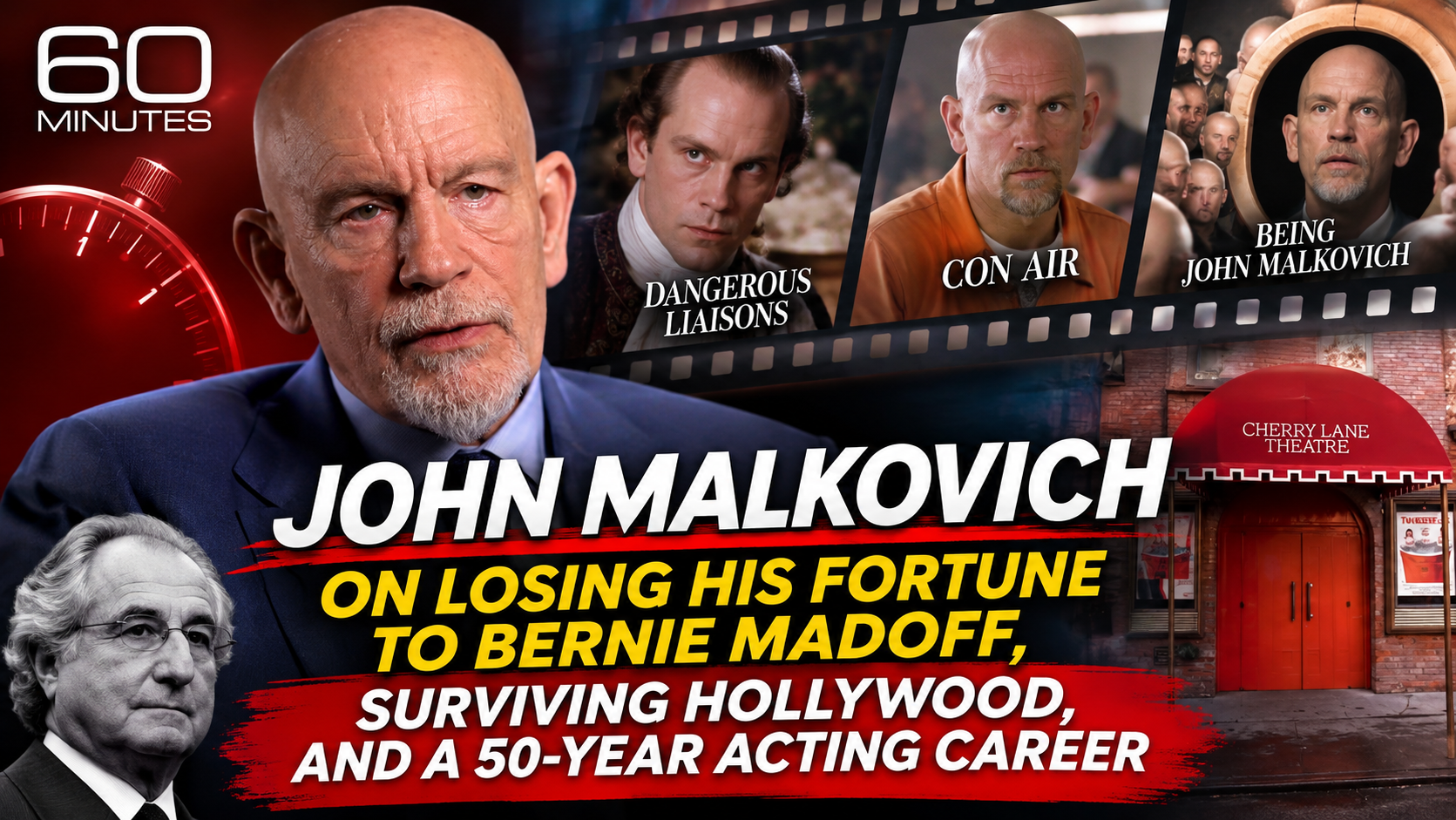
Dangerous Liaisons, Con Air, and the Career That Defied Hollywood Expectations
Malkovich’s transition from theater to film came quickly after his New York breakthrough. In 1984, he earned his first Academy Award nomination for his performance in Places in the Heart, portraying a blind World War I veteran in a Depression-era drama starring Sally Field. The recognition established him as a formidable screen actor and opened the door to an unusually diverse collection of film roles.
One of his most celebrated performances arrived in 1988 with Dangerous Liaisons, in which he portrayed the manipulative Vicomte de Valmont opposite Glenn Close and Michelle Pfeiffer. The film’s intricate screenplay, adapted from Christopher Hampton’s stage play, gave Malkovich the opportunity to explore a character whose charm, cruelty, intelligence, and emotional vulnerability were constantly in conflict. During the 60 Minutes interview, Malkovich described Dangerous Liaisons as one of the relatively few truly exceptional screenplays he has encountered during his career, a revealing observation from an actor who has appeared in an enormous range of productions.
But Malkovich has never limited himself to prestigious literary adaptations or critically acclaimed dramas. His appearance as the villain Cyrus “The Virus” Grissom in the 1997 action blockbuster Con Air demonstrated his willingness to embrace the excesses of mainstream Hollywood entertainment. When asked about his first impression of the screenplay, Malkovich joked that he immediately recognized its enormous commercial potential. The premise of hundreds of dangerous convicts aboard an airplane struck him as the kind of spectacular Hollywood concept that could generate hundreds of millions of dollars at the box office.
The joke reflected a larger philosophy that has shaped his career. Malkovich does not appear particularly interested in the cultural hierarchy that places experimental theater and literary drama above action movies. Whether working with the writing of Harold Pinter and William Faulkner or appearing in an extravagant Nicolas Cage blockbuster, he approaches the material as an opportunity to create something entertaining, interesting, or memorable. That openness has extended beyond acting into fashion design, winemaking, and collaborations involving classical music, reinforcing his reputation as an artist whose interests are too varied to fit comfortably within the traditional boundaries of a Hollywood career.
Being John Malkovich: The Movie That Turned His Identity Into a Hollywood Experiment
Of all the films in Malkovich’s career, perhaps none is more unusual than the 1999 surreal comedy Being John Malkovich, directed by Spike Jonze and written by Charlie Kaufman. The film follows a struggling puppeteer who discovers a mysterious portal allowing people to enter Malkovich’s consciousness for 15 minutes, transforming the actor’s identity into the central premise of one of the most inventive movies of its era.
For Malkovich, however, the idea of starring in a movie built entirely around his own identity was initially uncomfortable. During the interview, he explained that his family’s deeply ingrained modesty made him reluctant to participate in a project that appeared to revolve around his celebrity. He even suggested that Jonze should consider using Tom Cruise instead, believing another famous actor might be a more appropriate subject for the bizarre concept.
Jonze ultimately persuaded him to participate, resulting in a performance that became one of the defining moments of Malkovich’s career. The actor emphasized that the fictional John Malkovich portrayed in the film bore little resemblance to his actual personality, an observation that became particularly amusing when he recalled receiving direction from Jonze about how the character John Malkovich should behave. At one point, according to Malkovich, the director informed him that his performance was acceptable but that the real John Malkovich would not behave that way.
The absurdity of a filmmaker explaining to John Malkovich how John Malkovich should act perfectly captured the strange creative territory the movie occupied. The film went on to receive three Academy Award nominations, including Best Director for Jonze and Best Original Screenplay for Kaufman. More than a quarter century later, it remains an extraordinary example of Hollywood’s occasional willingness to embrace genuinely unconventional storytelling, while also demonstrating Malkovich’s ability to laugh at himself in an industry where celebrities carefully manage their images and public reputations.
Bernie Madoff Wiped Out His Life Savings, but Malkovich Refused to Let the Loss Destroy Him
Perhaps the most surprising portion of the interview concerned Malkovich’s experience as a victim of Bernie Madoff, the disgraced financier whose massive Ponzi scheme collapsed in 2008 and exposed one of the largest investment frauds in American history. Malkovich revealed that he lost virtually his entire life savings when Madoff’s operation unraveled, leaving the actor confronting the possibility that much of the wealth he had accumulated throughout decades of successful work in theater, television, and film was gone.
He recalled learning about the disaster after returning from Mexico City, where he had been directing a theatrical production. Rather than responding with an explosive confrontation or an emotional breakdown, Malkovich described quietly informing his wife that they had a financial problem before stepping outside for a cigarette. His reaction was remarkably restrained, particularly considering the scale of the loss. While many victims of Madoff’s fraud experienced devastating financial and emotional consequences, Malkovich said he made a conscious decision not to become consumed by resentment or self-pity.
He reasoned that even after losing a substantial fortune, he had enjoyed opportunities and financial privileges that most people in human history would never experience. Dwelling on the money would not bring it back, and blaming himself or others indefinitely would accomplish little. That perspective did not minimize the seriousness of Madoff’s crimes, which destroyed retirement savings, damaged charitable organizations, and devastated individuals who had trusted the financier with their financial futures. Madoff ultimately pleaded guilty to federal crimes and received a 150 year prison sentence in 2009 before dying in federal custody in 2021.
For Malkovich, however, the experience became another example of his practical approach to life’s uncertainties. Rather than allowing the financial disaster to define his future, he continued working, creating, and pursuing projects that interested him. His response offered a striking contrast to Hollywood’s frequent obsession with wealth, status, and financial success. Having accumulated a fortune and then watched much of it disappear, Malkovich appeared to regard money as something useful but ultimately incapable of determining the value of his life.
Losing Millions Changed His Finances, Not His Identity
The Madoff scandal exposed a particularly uncomfortable reality about financial security: Even highly successful individuals with substantial resources can become victims of sophisticated fraud. Madoff maintained an elaborate illusion of legitimacy through fabricated investment statements, a prestigious financial reputation, and relationships with wealthy investors and institutions. For someone like Malkovich, whose professional life had been devoted primarily to acting rather than financial management, the deception demonstrated how easily trust can be exploited when an investment operation appears credible.
Yet Malkovich’s account suggested that his sense of identity had never been particularly dependent on the size of his bank account. His career began in experimental theater, where artistic ambition often mattered far more than financial reward, and he continued approaching his work with that same underlying philosophy after the fraud. The actor’s ability to recover professionally also reflected an advantage unavailable to many other victims: He possessed an established international career and could continue earning money through acting, directing, and other creative pursuits.
That distinction does not diminish the magnitude of his financial loss, but it provides important context for understanding why his response differed from those of victims who lost retirement funds or had limited opportunities to rebuild. Rather than presenting himself as a tragic figure, Malkovich treated the episode as a painful but survivable chapter in a much larger life, refusing to let financial catastrophe overshadow the opportunities and accomplishments that remained ahead.
Wild Horse Nine Brings Malkovich Into Martin McDonagh’s Dark World
Malkovich’s latest project brings him together with acclaimed playwright and filmmaker Martin McDonagh, whose work includes In Bruges, Three Billboards Outside Ebbing, Missouri, and The Banshees of Inisherin. In Wild Horse Nine, Malkovich portrays Chris, a spy burdened by memories of past assassinations and morally troubling assignments. The story unfolds on Easter Island against the backdrop of political tensions preceding the 1973 Chilean military coup, combining espionage, psychological conflict, and McDonagh’s distinctive brand of dark comedy.
The historical setting is significant. The September 1973 overthrow of Chilean President Salvador Allende brought General Augusto Pinochet to power and ushered in a military dictatorship associated with widespread political repression, torture, disappearances, and human rights abuses. Placing a story about intelligence operations and moral responsibility within that period provides a potentially powerful backdrop for McDonagh’s exploration of violence, guilt, and human behavior.
During the interview, Malkovich praised McDonagh’s extraordinary ability to move between emotional devastation and absurd humor, sometimes within a single moment. That quality has become a defining characteristic of the filmmaker’s work, where characters frequently confront grief, violence, and moral contradictions through conversations that can be simultaneously disturbing and hilarious. The collaboration appears particularly well suited to Malkovich, whose career has repeatedly involved portraying complicated individuals capable of shifting between menace, vulnerability, and dark comedy.
Rather than approaching the role as another opportunity to demonstrate his reputation as a serious actor, Malkovich spoke about the pleasure of working with exceptional writing and exploring material that refuses to provide easy emotional answers. His enthusiasm for the project suggested that, even after decades of success, the opportunity to collaborate with an inventive storyteller remains one of his strongest professional motivations.
A Career Built on Curiosity Rather Than Celebrity
One of the most striking aspects of the 60 Minutes interview was how little Malkovich appeared interested in presenting his career as a carefully constructed journey toward greatness. Despite his Academy Award nominations, acclaimed theatrical performances, iconic film roles, and decades of international recognition, he discussed his accomplishments with a mixture of intellectual curiosity, self-deprecating humor, and emotional detachment.
That attitude may explain why he has remained creatively active for so long. While many actors become closely associated with a particular type of role, Malkovich has moved freely between independent films, major studio productions, experimental theater, fashion, music, and other artistic ventures. He has portrayed sympathetic characters and villains, appeared in prestigious literary adaptations and unapologetically commercial action movies, and participated in projects that deliberately make fun of his own celebrity.
The common thread is not a particular genre or performance style, but an apparent willingness to explore interesting material without worrying excessively about how it fits into a larger career narrative. His comments about acting also suggested that experience has not made him more rigid. Rather than developing an elaborate philosophy that he expects younger performers to follow, he remains skeptical of the idea that artistic success can be reduced to a teachable formula.
For an actor who has spent nearly five decades being recognized for his distinctive presence, that refusal to define himself may be one of his most important creative strengths. He has managed to remain recognizable without becoming predictable, building a career in which audiences often have little idea what kind of character or performance they will encounter next.
John Malkovich’s Greatest Talent May Be His Ability to Keep Everything in Perspective
The most revealing lesson from Malkovich’s conversation with 60 Minutes was not necessarily about acting, Hollywood, or even the extraordinary financial disaster he experienced during the Madoff scandal. It was about perspective. Here is an actor who has performed before some of the most famous cultural figures of the twentieth century, earned major industry recognition, starred in internationally successful films, and watched a substantial personal fortune disappear through circumstances largely outside his control. Yet his reflections rarely suggested that fame, wealth, or professional prestige had become the defining measures of his existence.
Instead, Malkovich repeatedly returned to the importance of interesting work, creative independence, and the ability to move forward when circumstances change. His experiences with Madoff reinforced the limits of financial security, while his acting philosophy demonstrated an unusual willingness to accept uncertainty rather than attempting to control every detail of a performance. The result was a portrait of an artist who has achieved extraordinary success without appearing particularly impressed by the mythology surrounding it.
At a time when Hollywood celebrity culture increasingly revolves around personal branding, social media influence, and carefully cultivated public identities, Malkovich represents something different: a performer whose work remains more interesting than his attempts to explain himself. And perhaps that is why, after nearly five decades in entertainment, John Malkovich remains one of the most compelling actors working today. He does not appear particularly concerned with being understood, admired, or imitated. He simply keeps finding interesting things to do.

Sources & Further Reading
- CBS News / 60 Minutes — John Malkovich: The 60 Minutes Interview (November 16, 2026)
https://www.youtube.com/watch?v=Z78YmrlClAc - CBS News — 60 Minutes Official Coverage
https://www.cbsnews.com/60-minutes/ - Academy Awards — 1985 Ceremony and Places in the Heart
https://www.oscars.org/oscars/ceremonies/1985 - Academy Awards — 2000 Ceremony and Being John Malkovich
https://www.oscars.org/oscars/ceremonies/2000 - U.S. Department of Justice — Bernie Madoff Fraud Case
https://www.justice.gov/usao-sdny/press-release/file/1189686/dl - Steppenwolf Theatre Company — Official Website
https://www.steppenwolf.org/ - SFL Media — Entertainment, Film, and Culture
https://sfl.media/














Loading comments…