
When Rock ‘N’ Roll Crossed the Line: The Sexual Misconduct Scandals Behind Some of Music’s Biggest Stars
Rock ‘n’ roll has always sold itself as rebellion, excess and living by your own rules. But behind the drugs, packed arenas and legendary backstage stories was another side of the culture that has received considerably more scrutiny in recent years. And that is the relationships between famous adult musicians and teenage girls, along with allegations of sexual assault and abuse.
Some of the most famous names in rock history have been connected to disturbing allegations or documented cases involving underage girls. In some instances, the musicians denied wrongdoing. In others, the relationships were openly acknowledged at the time. And in a few cases, musicians were actually convicted of criminal offenses. Looking back decades later, the stories paint a complicated picture of an industry where fame and access often gave powerful performers extraordinary access to young fans.
Steven Tyler of Aerosmith
Aerosmith frontman Steven Tyler is currently at the center of one of the most prominent legal cases involving a classic-rock musician. Julia Misley, who was known as Julia Holcomb during the 1970s, has accused Tyler of sexual assault and sexual battery stemming from a relationship that began when she was 16 and Tyler was in his mid-20s.
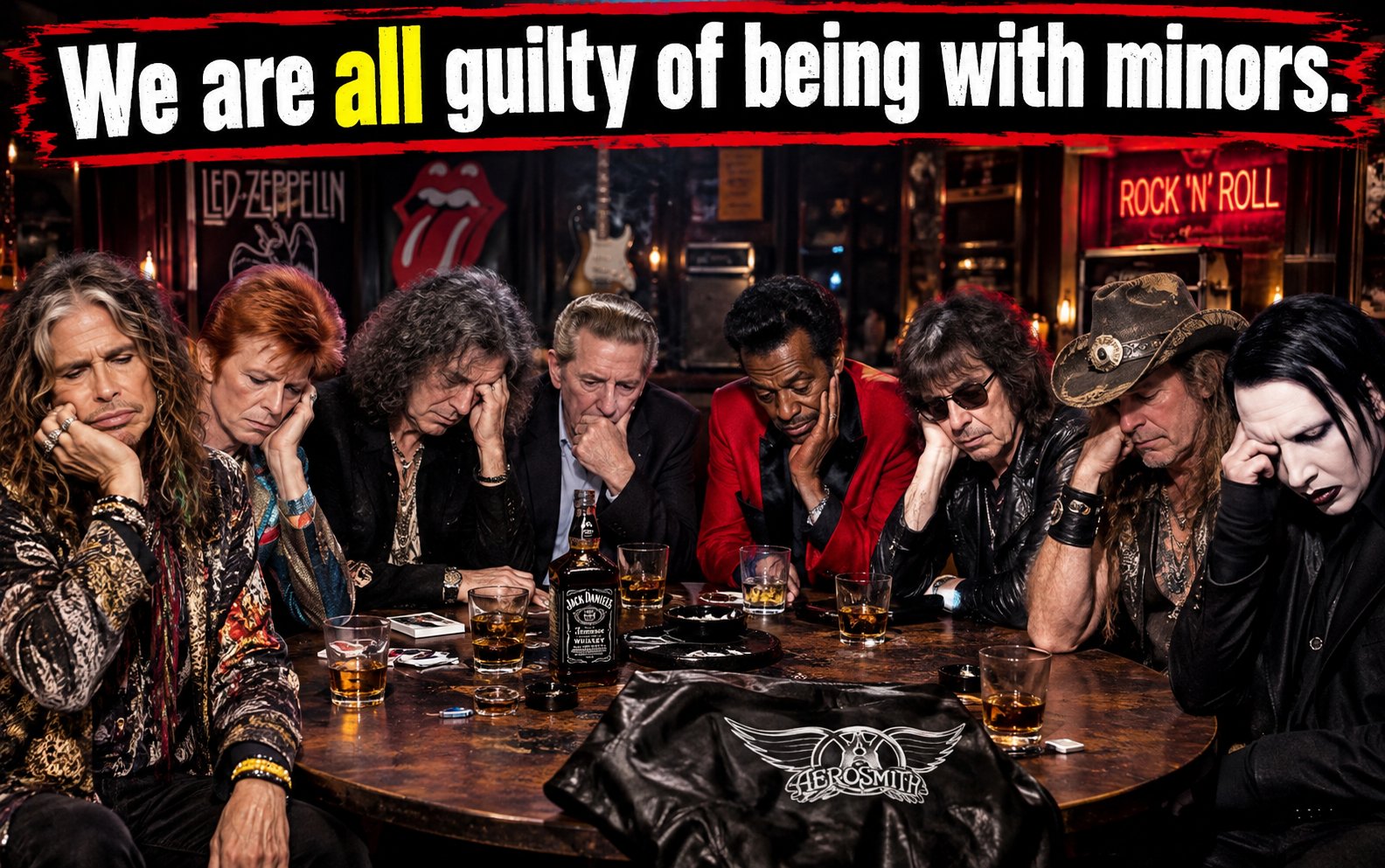
Misley has said Tyler became her legal guardian after obtaining permission from her mother, allowing him to take her across state lines while he toured. She has also alleged that she became pregnant during the relationship and that Tyler pressured her to have an abortion.
The relationship itself is not simply a decades-old rumor. Tyler discussed a relationship with a teenage girl (not named) in his 2011 memoir, describing himself as 26 and the girl as 16. Misley later identified herself as that girl and filed suit in 2022. Tyler has denied her allegations and has argued that their relationship was consensual and that he had legal guardianship.
The legal situation remains active in 2026. Most of Misley’s claims were dismissed earlier this year, but one claim involving alleged sexual acts when she was 16 remains. A jury trial had been scheduled for September 28th, although the judge assigned to the case recently recused herself, forcing the case to be reassigned.
Tyler has also faced a separate lawsuit from Jeanne Bellino, who alleged that he sexually assaulted her in 1975 when she was 17. Bellino’s lawsuit described an alleged assault in Manhattan and at the Warwick Hotel. Tyler has denied wrongdoing in the allegations against him.
Jimmy Page of Led Zeppelin
Led Zeppelin guitarist Jimmy Page has long been associated with the darker side of the 1970s rock-groupie culture.
One of the best-known cases involves Lori Mattix, who has said she was 14 when she began a sexual relationship with Page, who was in his late 20s. Mattix had previously said that she lost her virginity to David Bowie at 14 before becoming involved with Page.
Mattix has spoken positively about her relationship with Page and has said she did not consider herself abused by him. However, she has also acknowledged that she was below the age of consent and that her perspective on the relationship changed as she grew older. The Guardian reported that Mattix said she would not want a teenage girl today to have such a relationship with an adult man.
The relationship has also been documented by rock historians. The New Yorker, reviewing Led Zeppelin biographies, described Page’s relationship with Mattix and noted the broader presence of extremely young girls around the band’s Los Angeles scene.
Page has never been criminally convicted over the relationship with Mattix.
David Bowie
David Bowie is another major rock icon whose history with teenage girls has come under renewed scrutiny.
Lori Mattix has said she was 14 when she had sex with Bowie. Her account has been widely reported, including by The Guardian. Mattix has described the relationship as consensual from her perspective, but she was legally a minor.
Bowie’s name also appeared in accounts surrounding the 1970s Los Angeles “baby groupie” scene. Sable Starr, another famous figure from that scene, claimed relationships with several major rock musicians.
These stories are important because they illustrate the broader environment of the era. Teenagers could enter clubs and backstage areas, encounter musicians decades older than themselves and become sexually involved with people whose fame and power dwarfed their own.
Jerry Lee Lewis
Jerry Lee Lewis presents one of the most famous and controversial cases in early rock ‘n’ roll history.In 1957, Lewis married Myra Gale Brown, who was only 13 years old. She was also his first cousin once removed. Lewis was 22.
The marriage became a major scandal when the relationship became public, particularly during Lewis’ 1958 tour of Britain. His career suffered an enormous backlash, with radio stations refusing to play his music and concert bookings collapsing. Brown later reflected on the relationship throughout her life. In an interview with the Los Angeles Times after Lewis’ death in 2022, she recalled being only 13 when they married and described herself as a child placed into an adult relationship.
The Lewis story is different from some of the later allegations because the marriage itself was a matter of public record. The controversy centered not on whether the relationship existed, but on the fact that Lewis had married a 13-year-old girl who was also a relative.
Chuck Berry
Chuck Berry, one of the architects of rock ‘n’ roll, actually faced a criminal conviction involving a teenage girl.
In 1959, Berry was charged under the federal Mann Act after transporting 14-year-old Janice Escalanti from El Paso, Texas, to St. Louis. Berry maintained that he had brought her to work at his nightclub and denied having sexual relations with her. His first conviction was overturned because of problems involving the judge’s conduct. Berry was retried and convicted again. In 1961, he received a three-year prison sentence and a $5,000 fine. The conviction was upheld on appeal.
Berry ultimately served time in federal prison. His case is therefore one of the clearest examples on this list of a rock star actually being convicted in connection with a sexual-related offense involving a minor.
Bill Wyman of the Rolling Stones
Rolling Stones bassist Bill Wyman had a relationship with Mandy Smith that began when she was only 13 and he was 47.
The relationship continued for years, and the couple eventually married in 1989, when Smith was 19. Contemporary reporting documented that they had begun their relationship six years earlier, when Smith was 13. Their eventual marriage makes the story particularly striking because the relationship began while Smith was still a child. The couple divorced after only a few years.
Ted Nugent
Ted Nugent has also been connected to one of the more unusual stories from the era. Nugent has acknowledged having relationships with very young women, while disputing some specific allegations about how those relationships were arranged.
One particularly famous account involves Pele Massa, who said she was 17 when she met Nugent, who was 30. Massa claimed that Nugent arranged a guardianship agreement with her parents that allowed their relationship to continue. Nugent has denied that such a document existed, although he has acknowledged that Massa was 17 when they met and 18 when she moved in with him. The Washington Post documented both Massa’s account and Nugent’s denial in a lengthy profile of the guitarist.
Gary Glitter
Gary Glitter takes the story considerably further because this was not simply a controversial teenage relationship.
The British glam-rock star, whose real name is Paul Gadd, was convicted in 2015 of six child-sex offenses involving three girls between the ages of 8 and 13. The offenses included the attempted rape of an eight-year-old child and unlawful sex with a 12-year-old girl.
Glitter was sentenced to 16 years in prison. He had also previously been convicted in Vietnam of sexually abusing two girls aged 11 and 12. Glitter’s case therefore stands apart from the disputed or controversial relationships involving some other musicians because criminal courts found him guilty of multiple child-sex offenses.
Marilyn Manson
A much more modern example is Marilyn Manson, whose real name is Brian Warner.
In 2021, actress Evan Rachel Wood and several other women publicly accused Manson of sexual and psychological abuse. Wood said Manson had groomed her when she was a teenager, although the two did not begin dating until she was 19.
Other women subsequently accused Manson of sexual assault, sexual battery, domestic violence and other forms of abuse. The allegations prompted an investigation by the Los Angeles County Sheriff’s Department and lawsuits from several women. Manson has repeatedly denied the allegations, describing them as false or distortions of consensual relationships.
Because these cases involve allegations rather than convictions for the alleged conduct, they should be distinguished from the criminal convictions involving figures such as Gary Glitter and Chuck Berry.
The Bigger Story: The “Baby Groupie” Era
Perhaps the most disturbing part of this history is that these stories were not isolated incidents. During the late 1960s and 1970s, a subculture of extremely young female fans became known as “baby groupies.” Some were teenagers barely into adolescence when they began attending concerts, clubs and backstage parties frequented by famous musicians.
The 2021 documentary Look Away examined that culture through interviews with women who said they were exploited by musicians, managers and other people in the music business. Among those interviewed was Julia Holcomb, who described her relationship with Steven Tyler when she was 16.
Accounts from that era have also included allegations involving members of Led Zeppelin, the Rolling Stones, David Bowie, Iggy Pop and other major performers. But the evidence is not equally strong in every case. Some stories are based on firsthand accounts, some on biographies or interviews, some on lawsuits, and others on allegations that were never tested in court.
That distinction matters.
There is a tendency today to lump every controversial rock-star story into one giant bucket labeled “sexual predator.” History is messier than that. Some musicians were convicted of crimes. Some faced civil lawsuits. Some acknowledged relationships with teenagers that would be considered profoundly unacceptable today. Others have been accused of misconduct and denied it.
What can be said with considerably more certainty is that the old rock ‘n’ roll culture created an environment where enormous celebrity, money, drugs, alcohol and access to young fans frequently collided with remarkably few safeguards. For decades, much of that behavior was treated as part of the mythology of being a rock star. The mythology has not aged particularly well.

















































Want to join the conversation?
Create an account or sign in to share your thoughts, vote,
and reply to other readers.
Showing 0 of 0 comments
Don't have an account?
Already have an account?