
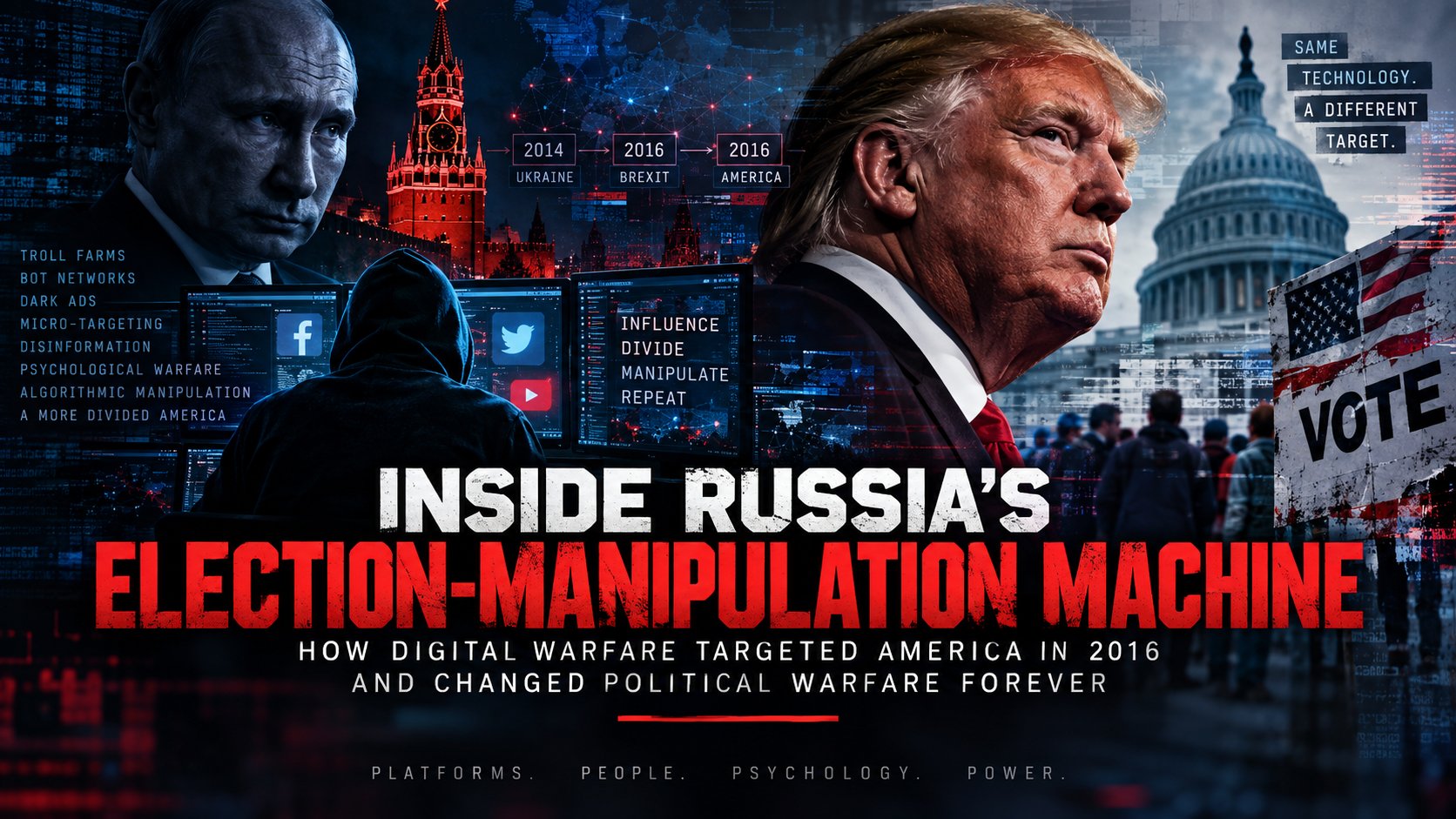
The Technology That Targeted America in 2016 Never Went Away, It Just Got Smarter…
Russia Did Not Need to Hack America’s Voting Machines. It Learned How to Attack the Information Environment Around Voters, and Today Artificial Intelligence Is Making the Same Basic Playbook Faster, Cheaper and Harder to Detect
Nearly a decade after the 2016 presidential election, one of the most consequential lessons from that campaign remains widely misunderstood. Russia did not need to break into American voting machines and secretly change millions of ballots to attack the election, and there is no evidence that it did. What Russian operatives demonstrated instead was potentially more important: in a country increasingly living through social-media feeds, search results, smartphones and algorithmically curated news, manipulating the information surrounding voters could be attempted without touching the machinery that counted their votes.
The Russian campaign was not one technology, one Facebook advertising campaign or one room filled with “bots.” It was a layered operation combining cyberespionage, stolen documents, fake American identities, social media communities, political advertisements, fabricated grassroots activism and the enormous amplification power of platforms engineered to reward engagement. At roughly the same time, American political consultants were experimenting with an entirely separate but revealing revolution in voter profiling, using enormous quantities of Facebook data to model personalities and target political messages with increasing precision.
Those operations should not be conflated. Cambridge Analytica was not Russia’s Internet Research Agency, and investigators did not establish that Donald Trump or his campaign secretly directed Russia’s influence operation. Special Counsel Robert Mueller’s investigation did not establish that members of the Trump campaign conspired or coordinated with the Russian government in its election-interference activities. A subsequent bipartisan Senate Intelligence Committee investigation nevertheless established an extensive Russian campaign to interfere in the election and concluded that the Internet Research Agency’s social media activity overwhelmingly favored Trump while attacking Hillary Clinton.
The result was an extraordinary collision between foreign intelligence operations and an American technology industry that had built perhaps the most powerful behavioral-targeting and information-distribution infrastructure in history without fully appreciating how easily those systems could be exploited by hostile actors. The most unsettling part of the 2016 story, however, is what happened afterward: the technologies did not disappear. They evolved.
What required teams of human propagandists, graphic designers, hackers, translators and fake-account operators in 2016 can increasingly be accelerated with artificial intelligence. Synthetic photographs can be created in seconds, video can be generated or manipulated, voices can be cloned, and large language models can produce political messages in multiple languages while generating enormous volumes of individualized content. Automated systems can test messages, identify engagement patterns and continuously adapt. The fundamental objective remains remarkably familiar: influence what people see, what they believe other people believe, which subjects dominate their attention and, ultimately, the information environment in which they make political decisions.
The technology that targeted America in 2016 was not the endpoint. It was an early version of what was coming.
Before America, Russia Had Already Learned That Information Could Be a Weapon
The digital attack on the 2016 election did not emerge from nowhere. Russia had spent decades using what intelligence services call “active measures”: propaganda, covert influence, deception and political manipulation intended to weaken adversaries without requiring conventional military confrontation. The internet transformed the economics and reach of those operations. Instead of persuading a newspaper editor, infiltrating a political organization or broadcasting propaganda through an identifiable government outlet, an influence operator could impersonate an ordinary citizen and enter another country’s political conversation directly.
Russia’s 2014 seizure of Crimea and the broader conflict in Ukraine demonstrated the power of combining military operations with information warfare. Russian officials and aligned media promoted competing narratives, disputed established facts, amplified sympathetic voices and exploited the speed of online communication as Moscow denied that its forces were operating in Crimea before later acknowledging Russian military involvement.
The strategic value was not necessarily convincing everyone that Moscow’s version of events was true. Confusion itself could be useful. If citizens could be made uncertain about what was happening, distrustful of institutions and suspicious of one another, an information operation could produce strategic effects without establishing one universally accepted alternative reality.
Social media dramatically expanded that model because propaganda no longer had to look like propaganda. It could look like your neighbor, an activist, a veterans organization, a Black political group, a conservative immigration page, a religious community or a local American patriot angry about Washington.
By 2014, according to federal prosecutors, Russia’s Internet Research Agency had established a U.S. focused operation. Two alleged operatives traveled through several American states gathering intelligence, while the organization studied U.S. social media and political audiences and eventually constructed an operation that prosecutors said employed hundreds of people across departments responsible for graphics, search engine optimization, information technology, finance and other functions. By July 2016, according to the Justice Department, more than 80 employees were assigned to the IRA’s U.S. focused “translator project.”
This was not someone posting memes from a laptop. It was an organization built to operate at scale.
Project Lakhta: Building Americans Who Did Not Exist
The Internet Research Agency’s operation was part of a broader Russian effort known as Project Lakhta, and its American component displayed one of the central innovations of modern information warfare: creating synthetic political identities convincing enough to attract genuine human beings.
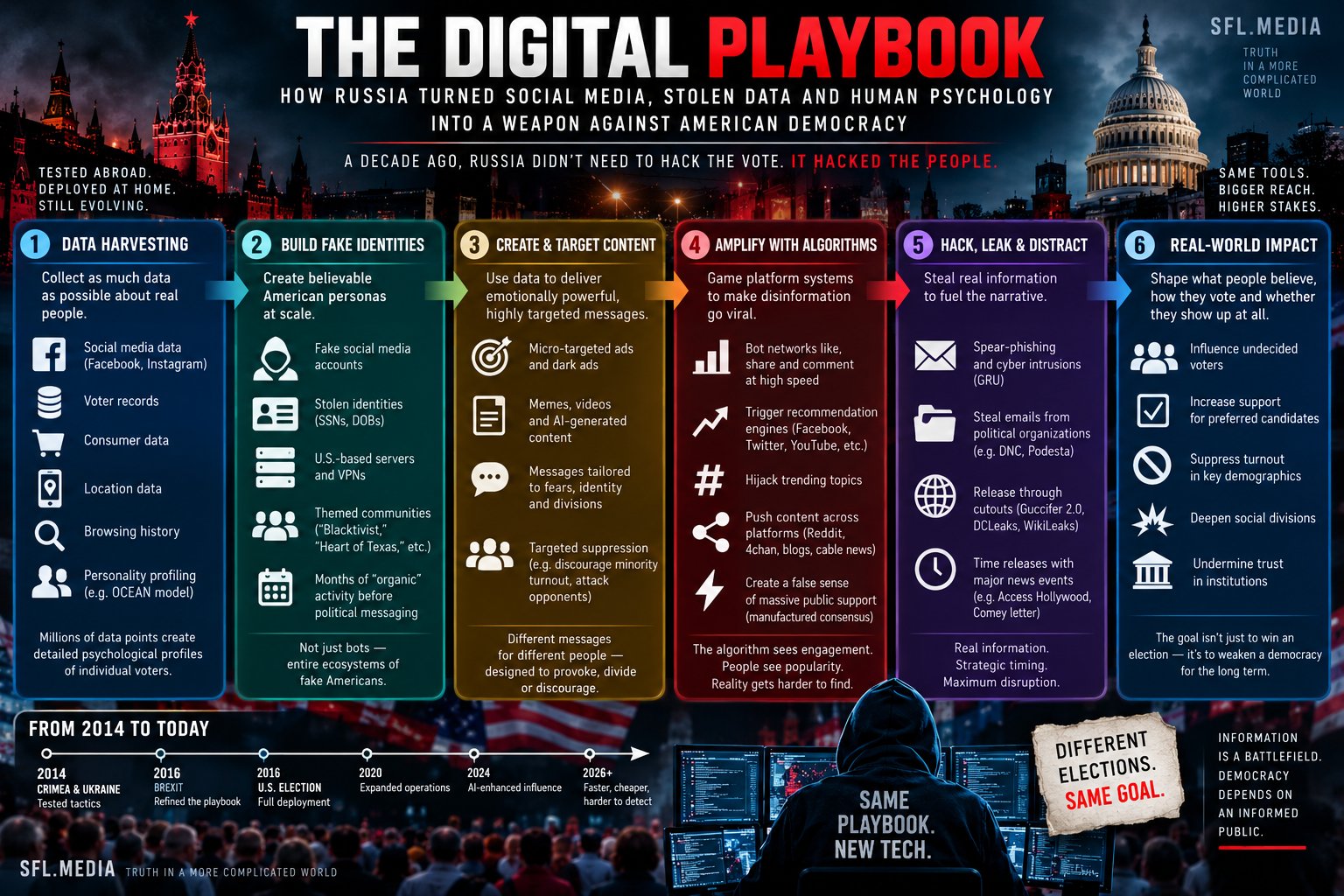
According to the Justice Department, Russian operators purchased space on computer servers inside the United States and used that infrastructure to establish virtual private networks that concealed the Russian origin of their activity. They created hundreds of social-media and email accounts, used fictitious personas and obtained stolen identities belonging to real Americans. Prosecutors alleged that stolen Social Security numbers and dates of birth were used to create accounts and identification documents as the operation attempted to make Russian controlled personas appear authentically American.
That technical infrastructure solved an important problem. A Russian government account behaving like a Russian government account is recognizable propaganda. An account apparently operating from the United States, speaking fluent American political language and surrounded by thousands of genuine American followers can look like something entirely different: a grassroots movement.
IRA controlled identities built communities around subjects Americans already cared deeply about. Among the best-known operations were pages and accounts including “Blacktivist,” “Heart of Texas” and “Being Patriotic.” The Russians did not invent American racial conflict, immigration disputes, distrust of government, arguments over policing or resentment between political factions. They did not need to. They identified fractures that already existed and attempted to widen them.
That distinction remains critical to understanding modern information warfare. Effective propaganda frequently does not manufacture a social conflict from nothing. It discovers a genuine conflict, identifies the audiences most emotionally invested in it and increases the temperature.
The bipartisan Senate Intelligence Committee ultimately concluded that African Americans were targeted more heavily than any other demographic by the IRA operation. Russian controlled accounts focused extensively on racial issues and attempted to deepen distrust and division, while other accounts targeted conservatives, Christians, immigration opponents, gun rights supporters and other politically engaged communities. Different Americans could therefore encounter completely different versions of the same foreign influence operation without realizing that the messages originated from the same organization thousands of miles away.
That was one of the technological breakthroughs of the operation: propaganda was becoming personalized.
The Russians Did Not Just Create Fake Americans, They Recruited Real Ones
The operation eventually crossed the boundary separating digital manipulation from physical political activity. Federal prosecutors alleged that Russian operators, while pretending to be American activists, communicated with unsuspecting Americans, recruited people to assist with political activities and helped organize rallies inside the United States. Some Americans were paid to participate without knowing they were dealing with Russian operatives, and the Senate Intelligence Committee separately documented IRA efforts to move activity beyond social media and into real-world organizing.
The psychological and technological implications were significant because once an artificial movement recruits genuine participants, the distinction between “fake” and “real” begins breaking down. A foreign operator can create the account, but an American can share the post. A Russian troll can announce the rally, but Americans can physically attend it. An intelligence operation can introduce the narrative, but genuine activists, political commentators and eventually news organizations can carry it much further than the original operator ever could.
The operation no longer needs to manufacture every interaction. It needs to manufacture the spark. Real people can provide the distribution.
Facebook Had Built an Extraordinary Political Distribution Machine
Facebook’s role in 2016 was not that the company secretly decided to help Russia elect Donald Trump. The more consequential problem was structural. Facebook had built an advertising and recommendation system whose commercial purpose was to understand people well enough to keep them engaged and deliver relevant messages to increasingly precise audiences. That capability was enormously valuable to advertisers and political campaigns, and it was also potentially valuable to covert influence operations.
Facebook told Congress that 120 Russian backed pages had accumulated more than 3.3 million followers and that approximately 80,000 organic, unpaid posts from those pages reached an estimated 126 million people. That figure does not mean 126 million Americans were persuaded by Russian propaganda, and it should never be presented that way. Reach measures potential exposure, not behavioral impact. But it demonstrated the extraordinary distribution power available to an operation whose content production costs were tiny compared with television advertising or traditional political organizing.
The Russians had exploited something fundamental about the emerging attention economy: an operator did not necessarily need to purchase an audience if it could persuade the audience to distribute material itself. A provocative political post generated comments, arguments and shares. Those interactions created additional opportunities for distribution, while users carried material into their own networks, where friends and relatives could encounter it through someone they already knew or trusted.
The platform therefore became more than a website hosting propaganda. It became an enormous distribution architecture through which ordinary people could unknowingly become secondary distributors of a foreign influence campaign. The most valuable account in such an operation was not necessarily the fake Russian account. It could be the real American who hit “share.”
The Algorithm Did Not Need a Political Ideology
One of the enduring misconceptions about algorithmic political manipulation is that a recommendation system must itself “support” a political candidate for the system to produce political consequences. It does not. A commercial recommendation algorithm can be politically agnostic while still creating a political environment that sophisticated actors attempt to exploit.
Its objective may simply be predicting what users are most likely to click, watch, share or discuss. But political material capable of provoking fear, outrage, tribal identification or moral anger can perform strongly in an engagement-driven environment, creating an exploitable vulnerability. An influence operator does not necessarily need to hack the recommendation algorithm; it can study what the algorithm rewards and manufacture content optimized for those signals.
The principle resembles search- ngine optimization. A company does not hack a search engine merely because it structures a webpage to perform better in search results. It learns the system’s incentives and adapts its content accordingly. Political influence operators can attempt the same basic strategy with social media systems: identify emotionally powerful subjects, create content around them, build or infiltrate interested communities, generate interaction, measure the response, abandon what fails and scale what works.
At that point, propaganda begins behaving less like a traditional government communications office and more like a digital marketing operation conducting continuous experiments on an audience.
Cambridge Analytica Exposed Another Side of the Same Technological Revolution
While Russian operatives were building fake American political communities, another controversy was revealing just how much personal information political consultants believed could be extracted from social media.
Cambridge Analytica became synonymous with the darker possibilities of political microtargeting after revelations concerning Facebook information collected through Aleksandr Kogan’s personality application. The Federal Trade Commission later alleged that Kogan’s application collected information from people who used it and, under Facebook’s platform rules at the time, information associated with tens of millions of their Facebook friends.
Cambridge Analytica and its partners were interested in research suggesting that Facebook activity could help predict personality characteristics using models including the so called OCEAN traits: openness, conscientiousness, extraversion, agreeableness and neuroticism. According to the FTC, information collected through Kogan’s application was used to train an algorithm that generated personality scores. Cambridge Analytica then matched those scores with U.S. voter records and used the resulting information for voter profiling and targeted advertising services.
The scale was substantial. The FTC alleged that the application collected Facebook profile information from roughly 250,000 to 270,000 U.S. users of the application and another 50 million to 65 million of their Facebook friends, including at least 30 million identifiable U.S. consumers.
The significance was bigger than Cambridge Analytica itself. Political campaigning had historically segmented voters into relatively broad groups: union households, suburban women, veterans, seniors, young voters, evangelical Christians, Black voters, Latino voters or residents of particular precincts. Digital behavioral data suggested a different future. Why target an entire neighborhood when technology could target increasingly narrow groups of individuals? Why show hundreds of thousands of voters the same advertisement when software could divide audiences according to the issues, behaviors or characteristics believed most likely to generate a response?
The Cambridge Analytica scandal became surrounded by exaggerated claims about almost magical psychological manipulation, and evidence that its psychographic methods possessed the extraordinary persuasive power the company promoted remains contested. But the underlying technological transformation was real. Political organizations were learning to combine voter files with consumer information, online behavior and increasingly sophisticated predictive models. Politics was becoming computational.
Three Different Stories Collided in 2016
This is where the history becomes easy to distort. There were at least three major technological stories unfolding simultaneously: the Internet Research Agency was conducting a covert social-media influence operation; Russian military intelligence was conducting cyber intrusions followed by a hack and release operation; and American political campaigns and consultants were developing increasingly sophisticated digital advertising and voter-targeting systems.
Those systems sometimes occupied the same platforms and information environment, but that does not establish that they constituted one coordinated conspiracy. Mueller’s investigation documented numerous contacts between people associated with Trump’s campaign and individuals with Russian connections, but it did not establish that members of the Trump campaign conspired or coordinated with the Russian government in its election-interference activities.
The Senate Intelligence Committee later conducted a separate bipartisan investigation involving hundreds of witness interviews and an enormous documentary record. Among its most serious findings were counterintelligence concerns involving former Trump campaign chairman Paul Manafort and Konstantin Kilimnik. The committee described Kilimnik as a Russian intelligence officer and concluded that Manafort’s access to the campaign, combined with his willingness to share information with Kilimnik and others closely associated with Russian intelligence services, represented a “grave counterintelligence threat.”
Those findings are significant. They are also different from proving that the Trump campaign controlled Russia’s election interference operation. Professional reporting requires keeping both realities in the same story.
Then Came the Hack and Leak Operation
While the IRA was fighting an information war in public, Russian military intelligence was conducting another operation behind the scenes. In 2018, federal prosecutors charged 12 officers of Russia’s GRU military intelligence service with participating in hacking operations targeting the Democratic Congressional Campaign Committee, Democratic National Committee and Hillary Clinton’s presidential campaign.
The operation included spear phishing and other cyber techniques used to steal credentials and penetrate computer systems. According to the Mueller investigation, GRU units stole hundreds of thousands of documents from compromised accounts and networks before releasing stolen material through identities including DCLeaks and Guccifer 2.0 and later through WikiLeaks.
The Mueller report concluded that the release of the documents was designed and timed to interfere with the election and undermine the Clinton campaign. The Senate Intelligence Committee subsequently concluded that Russian President Vladimir Putin ordered the effort to hack Democratic networks and accounts and leak information damaging to Clinton, with Moscow seeking to harm her campaign, assist Trump after he became the presumptive Republican nominee and undermine the U.S. democratic process.
This created one of the most powerful structures in modern information warfare: steal information, release it strategically, allow political and social networks to amplify it, generate legitimate news coverage around it, and then amplify the coverage again. The first stage was cyberespionage. The second was information warfare. The third involved something Russia did not control: the American media ecosystem.
Once authentic stolen documents became public, legitimate journalists had legitimate reasons to report on them. Political activists reacted, cable television debated the revelations, social media users shared the coverage, search engines indexed it and recommendation systems circulated it. Every new reaction could become the subject of another story, post or broadcast.
The original act of theft could consequently trigger an information cascade exponentially larger than the infrastructure required to conduct the initial intrusion. This was one of the most important lessons of 2016: a modern information operation does not have to manufacture false information. Genuine information, selectively stolen and strategically released, can be extraordinarily powerful.
October 2016 Became an Information Perfect Storm
The final month of the election demonstrated how cyber operations, political scandals, traditional journalism and social media amplification could collide. On October 7, 2016, The Washington Post published the Access Hollywood recording containing Trump’s vulgar comments about women. That same day, WikiLeaks began publishing emails stolen from Clinton campaign chairman John Podesta.
Then, on October 28, FBI Director James Comey informed Congress that investigators had discovered additional emails potentially relevant to the previously closed Clinton email investigation. The announcement immediately became dominant national news. Days later, the FBI said its review had not changed the earlier conclusion that Clinton should not face criminal charges.
The electoral significance of those events has been debated ever since, but technologically the period demonstrated something that would become central to modern politics: the feedback loop between breaking news, partisan media, social networks, influencers, automated accounts and recommendation algorithms. A political story no longer traveled simply from a newspaper or television network to its audience. It ricocheted through an interconnected information system.
A development could become a television segment, a tweet, a meme, a Facebook post, a YouTube video, a Reddit discussion, another television segment and thousands of social media reactions within hours. Every stage generated new content, and every reaction could become material for another reaction. The information system had learned to feed on itself.
Manufactured Consensus: When Popularity Becomes Part of the Message
Perhaps the most psychologically interesting weapon available to digital political operations is not misinformation at all. It is perceived consensus. Human beings routinely use other people’s behavior as information. A restaurant with a line outside appears desirable. A product with thousands of positive reviews appears trustworthy. A post with enormous engagement appears important. Social platforms transformed those social cues into visible numbers: followers, likes, shares, views, comments and trending topics.
Those metrics were designed to measure engagement, but they can also become part of the persuasive content itself. If coordinated networks artificially increase the apparent popularity of a narrative, users may encounter two messages simultaneously: the political claim itself and the apparent evidence that enormous numbers of other people agree with it.
That second message can matter even when the first one is weak. This is why fake engagement, coordinated posting and synthetic accounts are attractive to influence operators. The objective is not always to persuade someone through argument. It can be to manipulate the perception of what everyone else is discussing, what appears popular and what appears socially acceptable. The target is not simply belief. It is attention and perceived social reality.
Did Russia Actually Change the Result of the 2016 Election?
This is where certainty ends. The documented Russian operation was real. Its objective was real. Its infrastructure was real. The hacking was real. The fake identities were real. The social media campaigns were real. What researchers cannot scientifically establish is how many Americans changed their votes because of them or whether the operation altered the ultimate outcome.
The 2016 presidential election was extraordinarily close in the states that determined the Electoral College. That fact understandably creates an enormous temptation to compare narrow margins with the millions of Americans potentially exposed to Russian material and conclude that the interference must have decided the election. But exposure is not persuasion. A person seeing propaganda does not establish that the propaganda changed that person’s vote.
A major peer reviewed study published in Nature Communications examining Twitter exposure found that IRA material was highly concentrated among a relatively small group of users. Just 1 percent of users in the study accounted for 70 percent of exposures, while strongly Republican users encountered substantially more Russian material than Democrats or independents. Researchers found no evidence of a meaningful relationship between exposure to Russian influence accounts and changes in political attitudes, polarization or voting behavior. They also found that participants were exposed to vastly more material from domestic news organizations and American politicians than from Russian influence accounts.
Those findings do not prove that Russia’s operation had zero effect, nor can one Twitter based study measure every pathway through which the broader operation might have influenced the election. They demonstrate why proving a decisive effect is extraordinarily difficult.
Elections contain thousands of interacting variables: candidates, economic conditions, scandals, campaign advertising, debates, news coverage, turnout operations, partisan identity, local conditions, third party candidates and millions of individual decisions. A foreign information operation becomes one variable inside that enormous system. Its existence can be established. Its exact causal effect may never be.
And No, Russia Was Not Proven to Have Changed the Votes
This distinction is essential. The Senate Intelligence Committee found extensive Russian activity directed at American election infrastructure, including state and local systems. Russian actors scanned databases for vulnerabilities, attempted intrusions and in a small number of cases successfully penetrated voter registration infrastructure. But the committee reported that it found no evidence that vote tallies were manipulated or that voter registration information was deleted or modified.
Describing 2016 as a proven theft of vote totals would therefore be inaccurate. The documented attack was against America’s political, cyber and information systems, not a demonstrated successful alteration of the ballots themselves. That may initially sound less dramatic. It should not.
Changing votes inside protected election infrastructure requires penetrating the systems that administer an election. Manipulating the information environment requires penetrating the places where citizens form opinions before they ever reach the voting booth.
In 2016, those places increasingly included Facebook, Twitter, Instagram, YouTube and Google. Today they also include short form recommendation feeds, podcasts, encrypted messaging networks, synthetic media and artificial-intelligence systems capable of producing enormous quantities of humanlike communication.
The Most Important Number in the Next Information War May Be the Cost of Producing One More Message
This is what makes artificial intelligence so consequential to the evolution of information warfare. The Internet Research Agency needed employees, writers, translators, graphic designers, account operators and people capable of pretending to be Americans for extended periods without exposing themselves.
Generative AI can automate portions of almost every one of those functions. A modern influence operator can use AI to generate hundreds of variations of a political argument, rewrite them for different audiences, translate them, create images to accompany them and produce responses to people interacting with the material.
The bottleneck is increasingly shifting away from content production toward distribution, credibility, audience building and detection. That represents an enormous strategic change because the marginal cost of producing another plausible piece of content is collapsing even though the difficulty of getting real people to trust and distribute it remains.
The Bot Became a Personality
The crude political bot of the 2010s was relatively easy to understand. It posted repeatedly, retweeted identical material, used repetitive language, behaved on suspicious schedules and often interacted in obviously automated patterns.
Large language models create the possibility of something substantially more sophisticated. An automated persona can vary its language, respond differently to different people, maintain a conversational tone, discuss sports in the morning and politics at night, generate text that does not look copied from neighboring accounts and operate across multiple languages. Generative systems can also supply profile images, audio and video to support the identity.
The technological objective is therefore evolving beyond simply creating a bot. It is creating the appearance of a person. That is essentially what the IRA attempted manually in 2016. Artificial intelligence can reduce the labor required to attempt it at much greater scale.
AI Has Already Entered the Influence Operations Business
This is no longer theoretical. U.S. intelligence reported during the 2024 election cycle that Russia and Iran were using generative AI to improve and accelerate aspects of their influence operations. Russia, according to the intelligence community, had generated election related AI material across text, images, audio and video, although intelligence officials emphasized an important limitation: generative AI was enhancing existing influence operations, not revolutionizing them.
That distinction remains important in 2026. Artificial intelligence can make propaganda cheaper and faster, but it cannot automatically make propaganda persuasive. Creating 10,000 mediocre political posts instead of 100 does not guarantee that anyone will care. Distribution remains difficult, credibility remains difficult and building genuine audiences remains difficult.
Yet the economics have unquestionably changed. The same operation can test more narratives, produce more content, operate in more languages, respond more quickly and maintain larger networks of synthetic identities with fewer human workers.
The development has continued. In September 2026, Anthropic reported disrupting influence operations in which actors used AI to help construct networks of fake social media profiles and entire fake news sites, generate political content, build target databases and create fabricated personas. The company said the operations it investigated originated across multiple regions and included governments, state aligned propaganda organizations, private influence firms and domestic political actors. Anthropic also cautioned that many such operations still failed to attract meaningful authentic audiences, reinforcing the lesson that AI can industrialize production without guaranteeing persuasion.
The trajectory, however, is unmistakable: automation is moving deeper into the influence operation itself.
The Next Battlefield Is Not Just Social Media, It Is Artificial Intelligence Itself
The 2016 information war largely revolved around getting content into social media feeds. The emerging information environment creates another target: the systems people increasingly ask directly for answers.
Millions of people now use AI assistants and AI-enhanced search products to summarize complicated subjects rather than navigating dozens of websites themselves. That creates a new strategic incentive for campaigns, governments, corporations, activists and influence operators to ensure that information available online is structured and distributed in ways likely to be discovered, cited or summarized by automated systems.
An emerging marketing industry describes parts of this effort as generative engine optimization: attempting to make online information more visible to AI generated answers in much the same way search-engine optimization attempts to improve visibility in traditional search. That does not mean someone can simply order a major AI system to repeat a political narrative, nor does it mean current systems blindly reproduce whatever content is most aggressively published online. AI providers use multiple safeguards, ranking mechanisms and information sources.
It means another information distribution layer has appeared. In 2016, the fight was partly about influencing what appeared in the feed. The emerging fight also includes influencing the information environment from which machines construct answers.
Meta Has Come Almost Full Circle
Facebook spent years responding to the fallout from 2016 and subsequent controversies by changing how political information was treated across its platforms. Then the pendulum moved again. In January 2025, Meta announced that it would end its U.S. third party fact checking program and transition toward Community Notes. The company also announced that it would take a more personalized approach to political content, reversing its previous broad effort to reduce civic material in users’ feeds.
Meta said political content would increasingly be ranked using explicit signals, such as likes, and implicit signals, such as viewing behavior, to predict what users find meaningful. The company also said it would recommend more political material to people whose behavior indicates they want to see it. Meta presented the changes as an effort to reduce enforcement mistakes, pull back what the company described as excessive censorship and restore free expression. Critics raised concerns about misinformation and weakened safeguards, while supporters argued that private technology companies should not act as arbiters of political truth.
Whatever one’s view of that dispute, the technological development is clear: personalization remains central to political information distribution, and personalization itself is becoming more sophisticated.
In October 2025, Meta announced another major development. Beginning December 16 of that year, interactions with its generative AI features would become another signal used to personalize content and advertising across participating Meta products. Meta said conversations involving sensitive subjects including political views, religion, health, sexual orientation and racial or ethnic origin would not be used to target advertisements.
Still, the broader technological progression is remarkable. During the Cambridge Analytica era, controversy erupted because Facebook likes and profile information could reveal extraordinary amounts about people. A decade later, consumers increasingly converse directly with artificial intelligence. The information available to personalization systems has not become less sophisticated. The surrounding ecosystem has become richer.
The Political Persuasion Machine Is Becoming Individualized
The logical direction of this technological progression is not one piece of political communication shown to 50 million people. It is the ability to produce enormous numbers of variations.
Traditional political communication asks what message works with suburban voters. Digital targeting asks what message works with suburban men between 35 and 50 who care about taxes. Advanced predictive targeting attempts to determine which issue a particular voter is most likely to care about. Generative AI introduces another possibility: automatically producing different versions of a message for increasingly narrow audiences and rapidly testing which framing generates the strongest response.
That does not mean current campaigns possess a magical machine capable of controlling individual voters. They do not. Human behavior remains enormously difficult to predict, and political persuasion is notoriously difficult. But the direction of the technology is clear. Segmentation can become increasingly granular, content generation increasingly automated, experimentation increasingly rapid and political communication increasingly individualized.
The mass media campaign of the 20th century spoke to the country. The emerging computational campaign increasingly has the technical capacity to speak to smaller and smaller slices of it.
Democracy Has an Authentication Problem
For most of modern history, producing convincing mass media required infrastructure. A television station looked like a television station. A newspaper required reporters, editors, presses and distribution. A political advertisement was expensive to produce and expensive to broadcast. Those economic barriers unintentionally created authentication signals. Professional looking mass media generally required professional resources.
Generative AI is eroding that assumption. A photograph is no longer necessarily evidence that a camera captured an event. A voice recording alone is no longer proof that the apparent speaker said the words. Video is becoming less reliable as standalone evidence. An articulate social media account is no longer strong evidence that a human being wrote the posts, while a local political organization, journalist or apparent grassroots movement can potentially be fabricated with far fewer resources than would have been required a decade ago.
The challenge therefore extends far beyond “fake news.” Democracy increasingly faces a more fundamental authentication problem: determining who is real, where information originated and whether apparently independent voices are actually independent.
2016 Was Not Primarily a Story About Russians. It Was a Warning About Systems.
Russia exploited the American information environment because the opportunity existed. The larger lesson is not that Russian operatives possessed some uniquely powerful understanding of social media. It is that digital platforms created systems capable of distributing information at extraordinary scale while giving users limited tools for determining where that information originated or why it had appeared in front of them.
The same architecture can be exploited by governments, political organizations, ideological movements, scammers, corporations, activists, influencers and individual provocateurs. The technology itself is politically indifferent. The incentives are not. Platforms compete for attention, campaigns compete for votes, influencers compete for audiences, advertisers compete for customers and governments compete for geopolitical advantage. Artificial intelligence reduces the cost of competing in all of those arenas simultaneously.
The Most Dangerous Propaganda May Be the Propaganda That Is Mostly True
The obsession with spectacular deepfakes can obscure an even more difficult problem. The most effective influence operation does not necessarily need to invent an event. It can select, amplify, suppress, reframe and repeat genuine information until a particular subject dominates the information environment. Imagine that 100 politically significant stories are true. An influence operation does not necessarily need to fabricate story 101. It can attempt to ensure that five selected stories consume a disproportionate share of everyone’s attention.
That is agenda manipulation rather than conventional fabrication, and it is extraordinarily difficult to regulate because each individual piece of content may be authentic. The manipulation can exist in the selection, volume, timing, framing, targeting and distribution.
That lesson was visible in the hacked email operation of 2016. Authenticity and manipulation are not opposites. Authentic information can be manipulated through selective release. Real anger can be artificially amplified. Real Americans can unknowingly participate in foreign operations. Real journalism can become part of an information cascade initiated by intelligence services, and genuine political disagreements can be deliberately intensified.
The sophistication lies precisely in mixing the authentic with the artificial until separating the two becomes increasingly difficult.
America Fixed Some of the Vulnerabilities. Technology Created New Ones.
The United States and technology companies did not simply ignore the lessons of 2016. Platforms removed coordinated networks, improved detection systems and developed policies surrounding manipulated media and foreign influence. Governments strengthened election cybersecurity, researchers developed more sophisticated methods for identifying coordinated behavior and intelligence agencies became considerably more public about foreign influence threats.
But technological defenses operate against a moving target. The 2016 influence operator needed humans to write propaganda, graphic designers to manufacture visual material, translators to localize messages and teams of people to maintain convincing online personalities. Modern operators have access to generative text, image creation, synthetic audio, multilingual models and increasingly capable AI agents that can automate portions of those workflows.
The cost curve is changing.
That does not make every AI powered influence campaign successful. Recent threat reporting repeatedly shows that many synthetic operations struggle to build authentic audiences. But it lowers the cost of trying, lowers the cost of failure and allows the same operator to conduct more experiments simultaneously.
That may ultimately be AI’s most consequential contribution to information warfare: not creating an irresistible propaganda machine, but making manipulation cheap enough to attempt continuously.
The Lesson America Still Has Not Fully Absorbed
There is no credible evidence that Russian operatives secretly rewrote America’s 2016 vote totals. There is overwhelming evidence that Russia attacked something else: the political and information environment in which Americans decided how to vote.
Russian military intelligence hacked political organizations and stole information that was later released publicly. The Internet Research Agency created Americans who did not exist, built political communities around fake identities, purchased political advertisements, recruited real Americans, exploited genuine racial and political divisions and entered American social-media conversations while concealing who was actually speaking. All of this unfolded inside technological platforms whose extraordinary ability to identify interests, distribute content and maximize engagement had largely been built to connect users and sell advertising, not to defend a democracy against a foreign intelligence operation.
Whether those operations changed enough votes to determine the 2016 winner remains unproven and may ultimately be impossible to establish. That unanswered question should not obscure the larger historical significance.
The architecture was valuable enough that foreign influence operations did not disappear after 2016. They continued evolving, while artificial intelligence began removing many of the expensive human requirements that constrained the first generation. The result is not proof that AI can control voters or decide elections. It is something more concrete: the infrastructure for producing, personalizing and distributing political information is becoming faster, cheaper and more scalable, while distinguishing authentic human activity from coordinated synthetic activity is becoming harder.
That changes the nature of the security problem.
The defining election-security question of the AI era may therefore have surprisingly little to do with someone breaking into a voting machine. The machine worth defending is also the one that determines what millions of voters see, hear and believe is important before they ever reach the voting booth. In 2016, the United States received an early demonstration of what an attack on that environment could look like. A foreign government used hackers, false identities, social media platforms, stolen information and America’s own political divisions to insert itself into a presidential election while hiding much of the machinery from the people being targeted.
A decade later, the most important lesson is not that the same operation can be repeated exactly as it happened before. It is that the technology required to attempt something far larger is becoming available to far more people.

Sources & Further Reading
U.S. Senate Intelligence Committee — 2016 Russian Interference
The Senate Select Committee on Intelligence’s multivolume bipartisan investigation is one of the strongest primary sources for the article. It covers election infrastructure, Russia’s social-media campaign, the U.S. government response, the intelligence assessment and counterintelligence findings involving people associated with the Trump campaign. (Senate Select Committee on Intelligence)
Senate Intelligence Committee — Russia’s Use of Social Media
This report documents the Internet Research Agency’s influence operation, including its efforts to damage Hillary Clinton and support Donald Trump, its disproportionate targeting of African Americans, exploitation of racial and political divisions, and interactions with unwitting Americans. (Senate Select Committee on Intelligence)
Senate Intelligence Committee — Russian Targeting of U.S. Election Infrastructure
This is the critical source for the distinction between election interference and manipulation of actual votes. The committee found Russian scanning and attempted intrusions into election infrastructure, including successful penetration of a voter-registration database in a small number of cases, but reported no evidence that vote tallies were manipulated or voter-registration information deleted or modified. (Senate Select Committee on Intelligence)
Mueller Investigation and Russian Information Operations
U.S. Department of Justice — Internet Research Agency and Project Lakhta Indictment
The foundational source for how the IRA operation worked. The Justice Department described hundreds of employees, fake American personas, stolen identities, U.S.-based servers and VPN infrastructure, political advertising, American recruitment and real-world rallies. Prosecutors said the operation was part of the larger Russian effort known as Project Lakhta. (Department of Justice)
U.S. Department of Justice — Indictment of 12 Russian GRU Intelligence Officers
Documents the separate Russian military-intelligence operation targeting the DNC, DCCC and Clinton campaign, including hacking and the subsequent release of stolen information through DCLeaks, Guccifer 2.0 and another entity. (Department of Justice)
Mueller Report — Volume I: Russian Interference in the 2016 Presidential Election
The primary investigative record connecting the major pieces of the story. Volume I covers the IRA social-media campaign, Facebook and Twitter operations, political rallies, recruitment of Americans, interactions involving the Trump campaign, GRU hacking, DCLeaks, Guccifer 2.0 and WikiLeaks. (Department of Justice)
Special Counsel Robert Mueller — Public Statement on the Russia Investigation
Mueller summarized the investigation by describing Russian military intelligence’s hacking and release operation alongside the Russian social-media influence campaign. He also said the investigation found insufficient evidence to charge a broader conspiracy. (Department of Justice)
Cambridge Analytica, Facebook Data and Psychographic Targeting
Federal Trade Commission — Cambridge Analytica and Aleksandr Kogan Investigation
The FTC documents how Aleksandr Kogan’s Facebook application harvested information, how the data were used to train an algorithm producing personality scores, and how Cambridge Analytica matched those scores with U.S. voter records for voter profiling and targeted advertising. The FTC alleged that information was collected from roughly 250,000–270,000 U.S. app users and 50–65 million of their Facebook friends. (Federal Trade Commission)
Did Russian Social Media Activity Actually Change Votes?
Nature Communications — Russian IRA Exposure, Political Attitudes and Voting Behavior
This peer-reviewed 2023 study provides an essential counterweight to claims that Russian social-media activity can be proven to have decided the election. Researchers found exposure was highly concentrated—1% of users accounted for 70% of exposures in their sample—and found no meaningful relationship between IRA exposure on Twitter and changes in attitudes, polarization or voting behavior. (Nature)
Artificial Intelligence and the New Generation of Influence Operations
This September 2024 intelligence-community assessment documents Russia and Iran using generative AI to accelerate aspects of election influence operations. U.S. intelligence reported that Russia had generated election-related material across text, images, audio and video, while cautioning that AI had enhanced existing operations rather than revolutionized them. (ODNI)
Anthropic — Detecting and Countering Misuse of AI, September 2026
One of the most current sources for the article’s AI section. Anthropic reports disrupting operations using AI to construct fake social-media personas and fabricated news organizations, mass-produce political content and support coordinated influence campaigns. One commercial network used roughly 70 fabricated news sites, matching social accounts and more than 250 inauthentic commenting accounts, although Anthropic found little authentic engagement with much of the content. (Anthropic)
Meta, Political Content and AI Personalization
Meta — Ending U.S. Third-Party Fact-Checking and Changing Political-Content Recommendations
Meta’s January 2025 announcement explains its decision to replace third-party fact-checking in the United States with Community Notes and return to a more personalized approach to political content. Meta said explicit signals such as likes and implicit signals such as viewing behavior would help determine which political content users receive. (About Facebook)
Meta — Using AI Interactions to Personalize Content and Advertising
Meta announced that beginning December 16, 2025, interactions with its generative-AI features would become another signal used to personalize content and advertising. Meta says sensitive subjects discussed with Meta AI—including political views—are not used for ad targeting. (About Facebook)















































Want to join the conversation?
Create an account or sign in to share your thoughts, vote,
and reply to other readers.
Showing 0 of 0 comments
Don't have an account?
Already have an account?