
Thousands Surround Kennedy Center as Trump Floats Demolition and Demands Credit for “Saving” National Memorial
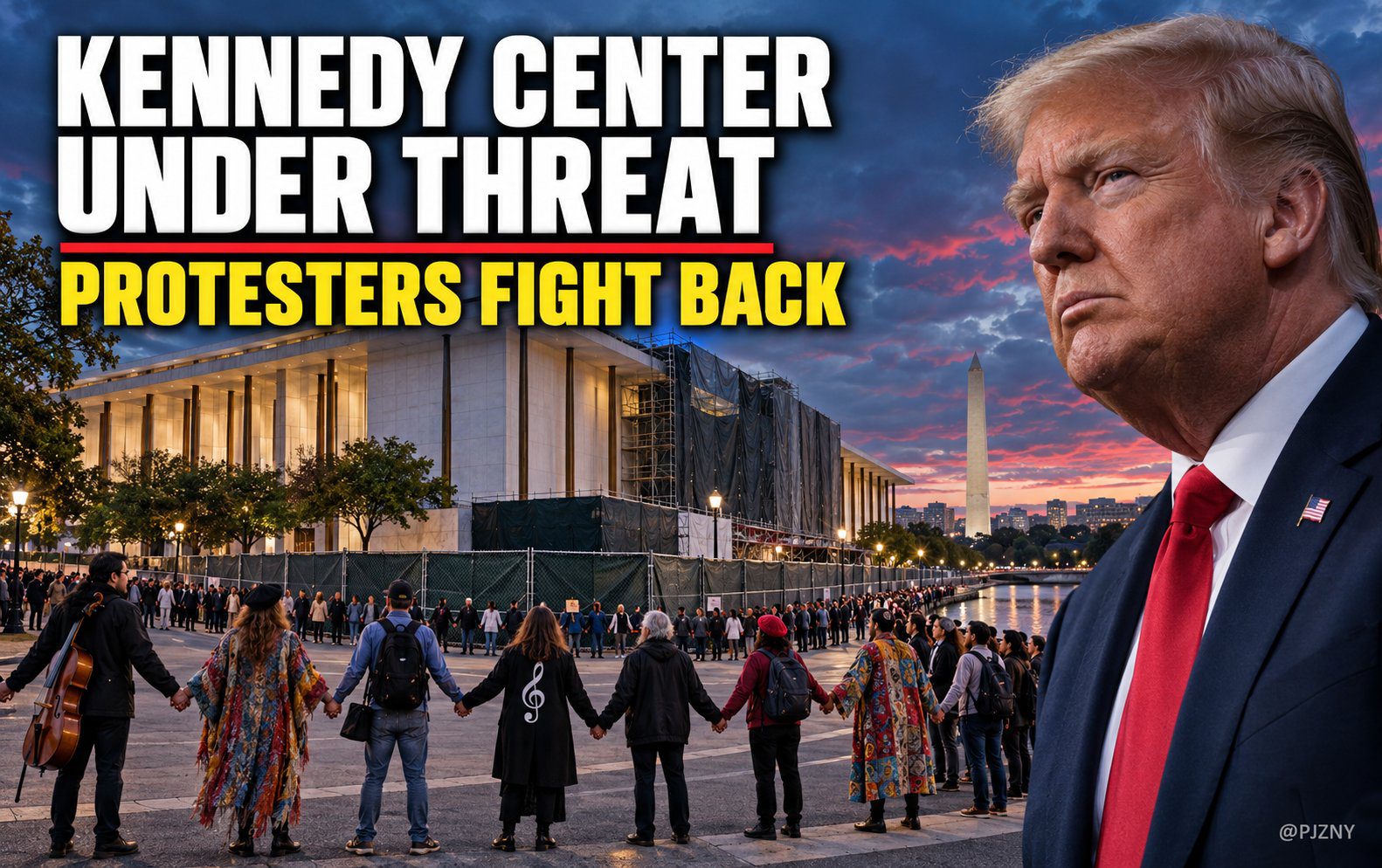
Thousands of protesters formed a human chain around the John F. Kennedy Center for the Performing Arts in Washington on Friday, escalating a national fight over President Donald Trump’s takeover of the institution, its abrupt closure and the growing possibility that his administration could demolish or fundamentally transform one of America’s most important cultural landmarks.
Musicians, artists, former Kennedy Center employees, educators and activists joined the “Hands Around the Kennedy Center” demonstration, surrounding the building while carrying signs and demanding that the federally designated memorial remain dedicated to President John F. Kennedy. The demonstration was organized by Hands Off the Arts amid mounting fears that Trump’s campaign to control, rename and renovate the center could end with the building being partially or completely demolished.
The protest was not simply about another dispute over federal architecture. It reflected a much broader confrontation over whether a sitting president can seize control of a national cultural institution, replace its leadership, redirect its programming, attach his own name to the building and potentially tear it down after the courts rejected his attempted rebranding.
Trump Refuses to Rule Out Demolition
Trump intensified those concerns when he declined to provide a clear answer about whether the Kennedy Center could be demolished. He has publicly described the building as a “dump” and suggested it could be “ripped down,” “decimated” or otherwise rebuilt if his administration determines renovation is insufficient.
The controversy grew after an image circulated showing Trump examining material that appeared to reference the Kennedy Center being demolished. Although the White House has not announced a finalized demolition plan, the combination of Trump’s statements, the building’s sudden closure and the administration’s legal maneuvering has convinced critics that demolition is no longer a hypothetical concern.
A federal judge has now ordered the administration to provide at least 30 days’ notice before taking any steps toward demolishing the center. That restriction followed an emergency legal challenge from Democratic Rep. Joyce Beatty of Ohio, an ex-officio Kennedy Center trustee who has challenged Trump’s efforts to rename and restructure the institution. The order does not permanently prevent demolition. It creates a temporary legal barrier intended to stop the administration from making irreversible changes while the broader case remains before the courts.
Kennedy Center Closed as Administration Cites Safety and Repairs
The Kennedy Center’s Trump-aligned board voted to close the main facility as management cited safety concerns, deferred maintenance and the need for extensive renovations. The administration has discussed a two year, $257 million reconstruction project, although uncertainty remains over the scope of the work and whether the building will reopen in its current form. The facility has remained closed under an emergency order, with security personnel and workers wearing construction helmets around the property. Tarps have covered portions of the exterior involved in the ongoing dispute over signage bearing Trump’s name.
CNN reported that approximately a dozen additional employees were laid off following the closure, further reducing a workforce already damaged by earlier departures, dismissals and institutional upheaval. The reductions have intensified doubts about whether the current leadership is preparing for a conventional renovation or dismantling the center’s existing operations before a much more radical transformation. Trump and his appointees maintain that the building requires immediate intervention. Critics counter that the administration has repeatedly used claims about safety, finances and physical deterioration to justify consolidating control over an institution that resisted Trump’s political and cultural agenda.
Trump Wants Recognition for “Saving” the Center
Trump has portrayed himself as the Kennedy Center’s rescuer while simultaneously refusing to rule out tearing it down. He has argued that his administration deserves credit for obtaining federal renovation funding and suggested that future assistance should be accompanied by formal recognition of his role. That demand lies at the center of the dispute.
Trump’s allies previously moved to place his name alongside Kennedy’s on the building, promoting the rebranded institution as the “Trump-Kennedy Center.” A federal judge rejected that effort and concluded that the board lacked the authority to rename a national memorial established by Congress.
The administration subsequently pursued revised signage crediting Trump with restoring and renovating the center. That proposal also triggered legal scrutiny because critics argued it represented another attempt to accomplish through construction signage what the board could not legally accomplish through renaming.
The president has framed the controversy as a fight over whether he receives sufficient credit for rescuing a deteriorating institution. His opponents see it as an extraordinary act of presidential vanity: using federal authority, public funding and control of a national memorial to secure permanent personal recognition.
Trump’s Board Takeover Reshaped the Institution
The current crisis began well before the closure. After returning to office, Trump removed members of the Kennedy Center’s traditionally bipartisan board and installed political allies. The reconstituted board then selected Trump as its chairman, giving the president direct influence over the leadership and direction of the institution.
The administration also moved aggressively against programming associated with diversity, LGBTQ communities and initiatives Trump and his allies characterized as “woke.” Those changes prompted resignations, artist boycotts and performance cancellations, destabilizing the center’s programming and damaging its relationship with parts of the artistic community.
Trump’s defenders argue that the changes restored ideological balance and redirected the center toward more traditional or patriotic programming. Critics say the administration transformed a national performing-arts institution into a political loyalty project, punishing artistic expression that did not conform to the president’s cultural agenda.
The resulting exodus of artists, employees and audiences contributed to operational and financial pressures that the administration now cites as evidence that the center requires drastic intervention.
Kennedy Family Joins the Resistance
Members of the Kennedy family have joined the public opposition to Trump’s takeover and attempted rebranding of the memorial.
Kerry Kennedy and other relatives have publicized resistance efforts and argued that the center’s identity cannot be separated from its congressional designation as a memorial to President Kennedy. Their involvement has added historical weight to a dispute that might otherwise be treated as a conventional fight over management, renovations or cultural programming.
The Kennedy family does not control the federal institution, but its members have become visible defenders of the memorial’s original purpose. Their position is straightforward: the Kennedy Center was created to commemorate an assassinated president, not to provide another sitting president with a monument to himself.
Congress Created a National Memorial, Not Presidential Property
The Kennedy Center’s legal status makes the confrontation unusually consequential. Federal law designates the John F. Kennedy Center for the Performing Arts as the sole national memorial to the late president. Congress created the center as both a performing-arts institution and a living memorial, meaning its identity, name and commemorative purpose are established through federal law rather than ordinary branding decisions by its governing board.
That does not mean the building can never be renovated, expanded or even replaced. It does mean that the president and his appointed trustees do not possess unlimited authority to erase or redefine its congressional identity. The courts have already recognized that distinction in the naming dispute. Only Congress can change the center’s legal designation, regardless of who chairs its board or controls day to day operations.
Demolition would raise even larger questions. Tearing down the physical structure without eliminating the statutory memorial might still leave the government legally obligated to maintain a Kennedy Center in some form. Any attempt to replace the building while changing its identity, purpose or name would almost certainly generate additional litigation and congressional resistance.
A Cultural Institution Becomes a Test of Presidential Power
The battle over the Kennedy Center has evolved beyond architecture, performing arts or maintenance. It has become a test of whether public institutions created by Congress can be personally appropriated by a president willing to replace their leadership and use executive power to reshape their identity. Trump argues that he inherited a failing building and secured the money necessary to save it. His critics argue that he destabilized the institution, drove away performers and employees, attempted an unauthorized renaming and then used the resulting crisis to justify further control.
The human chain surrounding the Kennedy Center represented a direct response to that pattern. Demonstrators were not claiming that a line of people could physically stop a federal demolition project. They were making the political stakes visible: a national memorial built to honor John F. Kennedy is being treated as leverage in Donald Trump’s campaign for recognition.
For now, the courts have imposed a temporary guardrail. The administration must provide notice before moving toward demolition, and the legal fight over the closure, signage and board authority continues.The Kennedy Center remains closed, its staff diminished and its future uncertain. What happens next will determine more than the fate of one building. It could establish how far a president may go in converting an independent cultural institution and congressionally designated memorial into an extension of personal political power.

Sources & Further Reading
- CNN — Protesters Form Human Chain to Save Kennedy Center
- Associated Press — Thousands Join Kennedy Center Protest
- Reuters — Trump Declines to Rule Out Tearing Down Kennedy Center
- Reuters — Judge Orders 30 Days’ Notice Before Any Demolition Steps
- Reuters — Court Demands Explanation of Kennedy Center Closure
- U.S. Code — Kennedy Center’s Status as the Sole National Memorial to John F. Kennedy











































Want to join the conversation?
Create an account or sign in to share your thoughts, vote,
and reply to other readers.
Showing 0 of 0 comments
Don't have an account?
Already have an account?