The Bizarre Ties Between the Brightline High Speed Rail, Jared Kushner, and Israel

Follow Closely, There is a lot to Digest Here in This Twisted Arrangement

Florida’s Brightline was created and controlled through Fortress Investment Group, which backed Florida East Coast Industries and developed the passenger rail business that became Brightline. Fortress acquired the underlying Florida rail assets in the 2000s and used them as the basis for the privately operated train system between Miami, Orlando, and South Florida.

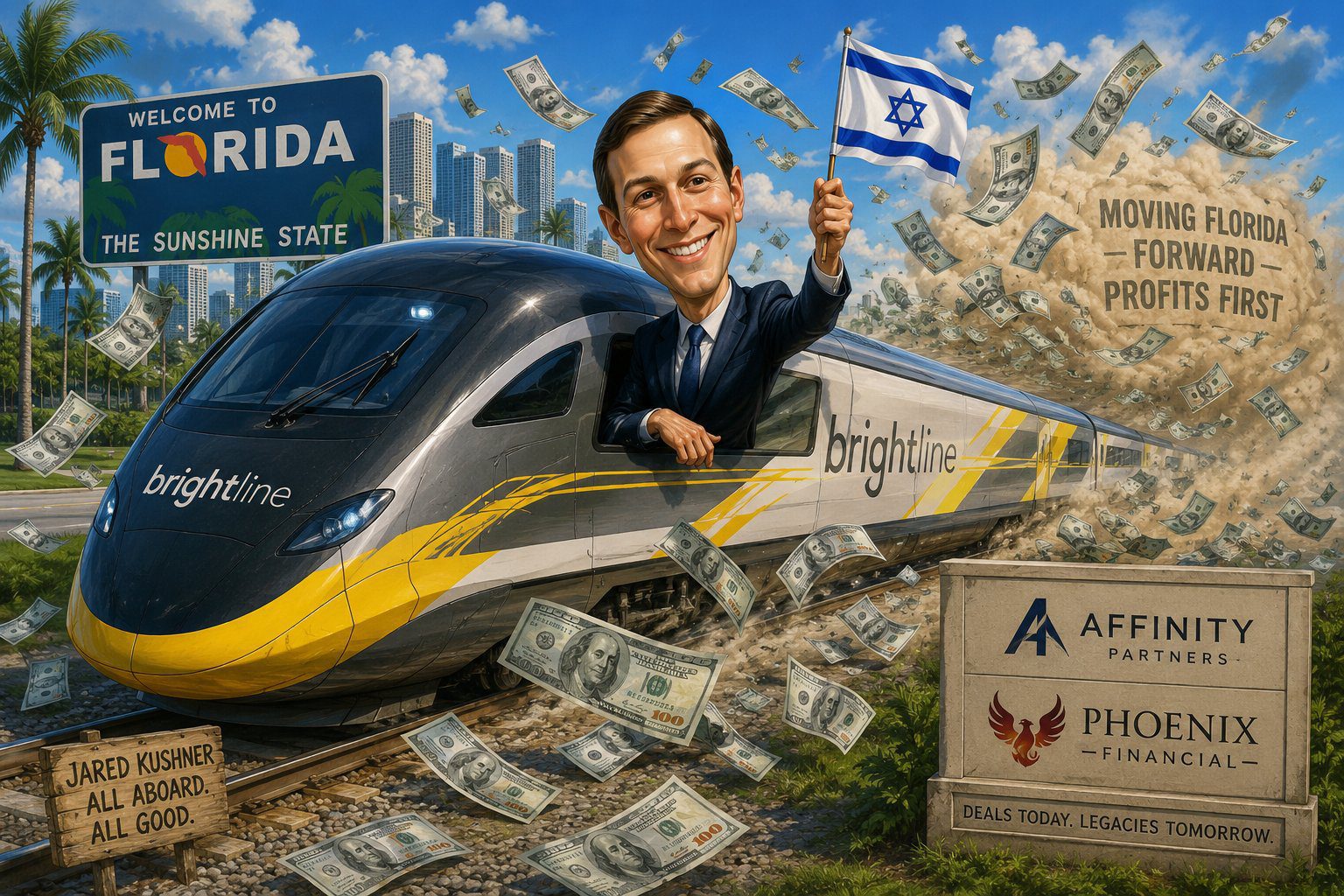
Where Jared Kushner enters the story is through finance and debt. There is no ownership of the railroad. In 2026, reporting showed that a Kushner backed investment connection emerged because an Israel based financial firm tied to Kushner’s investment orbit accumulated a meaningful position in Brightline related bonds as the company entered debt restructuring talks.

Bloomberg reported that a Kushner-backed Israeli firm (through an entity connected to Phoenix Financial) moved into Brightline’s corporate debt while the rail company struggled with billions in obligations and negotiated with creditors. That means the connection is essentially Kushner linked capital may hold or influence debt tied to Brightline, not that Jared Kushner “owns” or “runs” the train.

Another reason people sometimes assume a tighter link is geography and politics. Kushner’s investment firm, Affinity Partners, is based in Miami and invests heavily in U.S., Israeli, and Middle East-connected businesses, while Brightline is a major Florida infrastructure project. But there is no public evidence that Affinity Partners owns Brightline or that Kushner sits in management or governance of the train system.
Who is Jared Kushner?

Jared Kushner is a real-estate heir, investor, and political adviser best known for being married to Ivanka Trump and serving as one of the most influential aides to Donald Trump. Born in 1981 in New Jersey, Kushner comes from the wealthy Kushner real-estate family and took a larger leadership role in the family business after his father, Charles Kushner, was convicted on federal charges in 2005. Jared expanded the family’s real-estate holdings, became publisher of the New York Observer, and gained attention for high-profile Manhattan property deals, including the troubled purchase of 666 Fifth Avenue in New York. He graduated from Harvard University and later earned joint law and business degrees from New York University.

jared kushner photo

During Trump’s first presidency (2017–2021), Kushner served as a senior White House adviser and had an unusually broad portfolio: Middle East diplomacy, criminal justice reform, trade issues, government modernization, and parts of the COVID response. Supporters point to his role in helping broker the Abraham Accords, which normalized relations between Israel and several Arab nations, as one of his biggest accomplishments. Critics argued he wielded enormous influence despite limited government experience and raised concerns about ethics, nepotism, and conflicts of interest tied to business and diplomacy.

After leaving the White House, Kushner shifted heavily into finance and launched Affinity Partners, a Miami-based investment firm focused largely on deals tied to the U.S., Israel, and the Middle East. The firm drew major attention because a significant amount of its funding came from Gulf sovereign wealth funds, particularly a reported $2 billion commitment from Saudi Arabia’s Public Investment Fund. Supporters describe Kushner as using his geopolitical knowledge and relationships to build an investment empire; critics say the overlap between foreign governments, diplomacy, and business creates potential conflicts of interest.

In the present day, Kushner remains influential behind the scenes in Trump-world while also focusing on investment deals. Reporting in 2025–2026 described him as involved again in Middle East diplomatic efforts around conflicts in Gaza and regional negotiations, while continuing to grow Affinity Partners and its assets. At the same time, Democrats and ethics watchdogs have pushed scrutiny into whether his diplomatic role and fundraising overlap too closely. Supporters see him as a pragmatic dealmaker with international reach; detractors see a blurred line between public influence and private profit.

Have You Ridden on the Brightline High Speed Rail?

Brightline is a privately owned passenger train system that connects major cities in Florida, offering an alternative to driving or flying between South Florida and Orlando. It began as a project called “All Aboard Florida” in 2012 and was developed by Florida East Coast Industries, which was backed by Fortress Investment Group. Unlike Amtrak, Brightline is operated as a private business and is often described as the only privately owned intercity passenger railroad in the United States.

The service first launched in 2018 between Fort Lauderdale and West Palm Beach, later expanding to Miami that same year. In 2022, stations in Boca Raton and Aventura opened, and in 2023 Brightline completed its biggest expansion by extending service to Orlando, creating a roughly 235-mile corridor connecting Florida’s biggest tourism and business hubs. The train now links Miami, Aventura, Fort Lauderdale, Boca Raton, West Palm Beach, and Orlando International Airport. Travel time from Miami to Orlando is about 3½ hours, with top speeds reaching roughly 125 mph on parts of the route.

What makes Brightline unique is that it blends transportation with real estate and infrastructure development. The company invested heavily in sleek downtown stations, premium seating, lounges, Wi-Fi, food service, and development around station areas in hopes of reshaping how Floridians travel and stimulating nearby business growth. Supporters see it as proof that modern rail can work in America, while critics question whether the economics can justify the enormous costs of building and maintaining private rail.

Today, Brightline has millions of riders and record ridership months, but it has also faced scrutiny over high debt loads and financial sustainability as it tries to turn long-term infrastructure spending into profits. Even so, it has changed transportation in Florida by giving people a realistic rail option between cities that previously depended almost entirely on highways or airports. The company is also pursuing expansion projects, including a separate high-speed line between Southern California and Las Vegas called Brightline West.

Share this post :

Join the Conversation:

guest
0 Comments
Newest Oldest Most Voted
Inline Feedbacks
View all comments
[approved_comments_ajax]
0
Would love your thoughts, please comment.x
()
x