
Why So Many Just Can’t Flush a Toilet and Be Done With It
For most people in the developed world, going to the bathroom is an event so ordinary that it barely registers. You walk into a private room, sit on a toilet, flush, wash your hands and get on with your day. Humanity (in the first world) has become so accustomed to indoor plumbing that it is easy to forget just how extraordinary the system actually is.
But globally, that basic convenience remains out of reach for billions of people.
According to the latest monitoring data from the World Health Organization and UNICEF, approximately 1.5 billion people still lack even basic sanitation services. That means they do not have access to a private, adequate toilet or latrine. Even more striking, approximately 3.4 billion people lack safely managed sanitation, meaning their human waste is not reliably contained, transported, treated or safely disposed of.
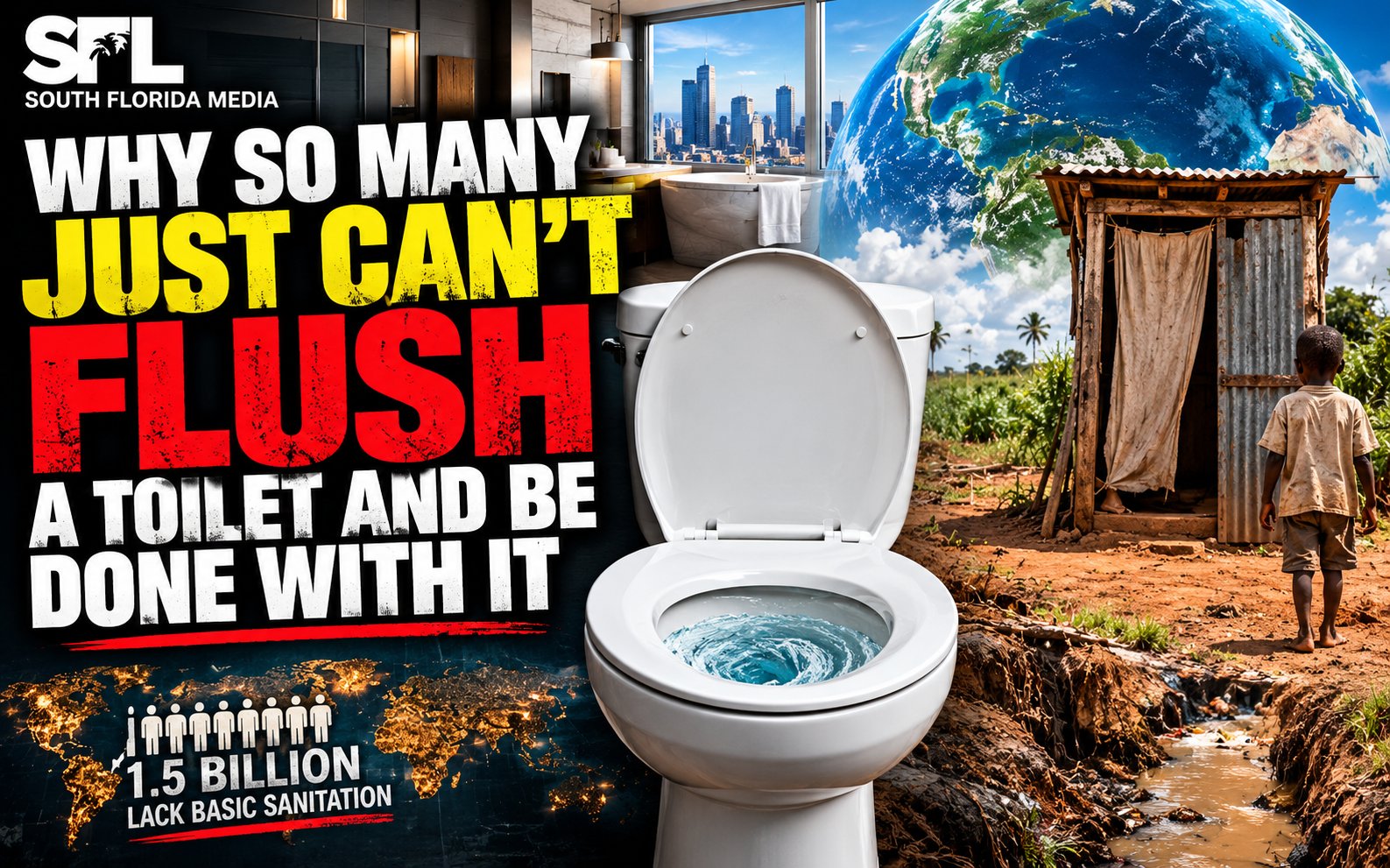
And get ready for this one…roughly 354 million people still practice open defecation, using fields, forests, waterways, beaches or other open areas as bathrooms.
Those numbers are difficult to comprehend. The world has satellites orbiting Mars, artificial intelligence writing computer code and smartphones capable of translating dozens of languages instantly. Yet hundreds of millions of human beings still have nowhere to go to the bathroom.
Why Is This Still Happening?
The obvious question is why. The answer is considerably more complicated than simply saying that poor countries need to “build more toilets.” A toilet is only the first piece of a much larger system.
A functioning sanitation system requires toilets, water or another means of moving waste, septic systems or sewer networks, treatment facilities, reliable electricity in many cases, roads and collection systems, trained workers, government regulation and enough money to keep everything operating. Building a toilet without figuring out what happens to the waste afterward simply moves the problem a few feet down the road.
This is one reason the distinction between basic sanitation and safely managed sanitation matters. A household can have a toilet and still lack safely managed sanitation. UNICEF defines safely managed sanitation as requiring the waste to be safely disposed of on site or removed and treated elsewhere. In other words, flushing is not the end of the story. It is merely the beginning of the journey.
Poverty is at the Center of the Problem
The biggest obstacle is money.
The communities with the greatest sanitation needs are often the communities least capable of paying for the infrastructure themselves. A wealthy city can finance enormous sewer systems through taxes, utility fees, municipal bonds and private investment. A remote rural village with widespread poverty has a very different financial reality.
UNICEF identifies financing as one of the major barriers to achieving universal sanitation. Its programs have increasingly looked at creative financing models that combine public money, donor guarantees and private investment to make sanitation loans affordable for poorer households. Pilot programs in Ghana, Nigeria and Togo, for example, have demonstrated that families can use financing to construct toilets when the terms are actually accessible to them.
That suggests an important lesson: sometimes people don’t lack toilets because they don’t want them. They lack toilets because they cannot afford the infrastructure.
Rural Areas Face a Different Challenge
Geography makes the problem even harder.
Installing a sewer network in a densely populated city can be expensive, but connecting thousands of households along relatively compact streets is at least technically straightforward. Trying to accomplish the same thing across scattered rural communities can be enormously expensive.
That is why solutions cannot consist exclusively of gigantic centralized sewer systems.In some places, properly designed septic systems, composting toilets, container-based sanitation, decentralized wastewater treatment and other technologies can make more sense than attempting to build conventional sewer networks everywhere.
UNICEF is also examining nature-based wastewater treatment systems and other technologies that can provide sanitation without requiring every community to reproduce the infrastructure of a major Western city.
The Health Consequences Are Enormous
This isn’t simply about whether somebody has a bathroom.
Poor sanitation contributes to the transmission of diseases including cholera, dysentery, typhoid, intestinal worm infections and polio. WHO also links inadequate sanitation to malnutrition, stunting and the spread of antimicrobial resistance. There is also a basic issue of human dignity and personal safety.
A person who has to walk outside at night to find somewhere to relieve themselves faces risks that someone with a private bathroom never has to consider. For women and girls, inadequate sanitation can create additional concerns involving privacy, harassment and sexual violence. Poor sanitation can also interfere with school attendance and economic opportunities.
In other words, the toilet is not merely a porcelain fixture. It is infrastructure connected to health, education, economic productivity, safety and human dignity.
So What Can Actually Be Done?
The first solution is surprisingly unglamorous: build more sanitation infrastructure and maintain what already exists.
Governments and international organizations need to treat sanitation as long-term infrastructure rather than a one-time charitable project. Building a toilet and taking a photograph for a development report accomplishes very little if nobody has the money or equipment to maintain it five years later.
Second, governments need to make sanitation financing easier for poor households. Subsidies, low-interest loans, sanitation vouchers and blended-finance programs can help families build facilities without requiring governments to pay the entire cost upfront. UNICEF has already experimented with these approaches, including sanitation vouchers in Nigeria that helped more than 30,000 households construct toilets.
Third, countries need to stop assuming that one technology will work everywhere. A sewer system may be appropriate for a major city. A septic system may make more sense in a suburban or rural community. A decentralized treatment facility may be preferable for a remote settlement. In some circumstances, newer technologies could be substantially cheaper than attempting to recreate century-old infrastructure.
Fourth, governments need to invest in the entire sanitation chain. That means toilets, collection, transportation, treatment and final disposal. The sewage nobody sees still has to go somewhere.
And finally, sanitation needs to become a political priority.
That may sound obvious, but there is a reason politicians are more likely to cut ribbons on bridges, airports and stadiums than wastewater treatment plants. Sewage infrastructure is essential, enormously expensive and almost completely invisible when it works properly. Nobody throws a parade because the sewer system successfully prevented an outbreak of cholera. Perhaps they should.
Humanity Has Actually Made Progress
There is another side to these statistics that is worth acknowledging.
The world is not standing still. Between 2015 and 2024, approximately 1.2 billion people gained access to safely managed sanitation, increasing global coverage from 48% to 58%. The number of people practicing open defecation fell by approximately 430 million during that period, from 784 million to 354 million. That is significant progress.
The problem is that progress is not happening fast enough. UNICEF says no Sustainable Development Goal region is currently on track to achieve universal access to safely managed sanitation by 2030, and the rate of progress would need to increase roughly sixfold to meet the global target.
So the question is no longer whether the world knows how to solve the sanitation problem. It does. The question is whether governments, international organizations, investors and local communities are willing to spend the money and build the systems necessary to finish the job.
The Toilet May Be One of Civilization’s Greatest Inventions
There is something almost absurd about the fact that one of humanity’s most important technologies is also one of the least celebrated.
The modern toilet and sanitation system dramatically changed human civilization. It helped cities grow without drowning in their own waste and dramatically reduced exposure to deadly pathogens. Yet sanitation remains one of those infrastructure systems people notice primarily when it stops working.
For the billions of people who still lack it, however, the issue is impossible to ignore. The ultimate solution is not simply handing somebody a toilet. It is creating an entire system that makes that toilet useful, affordable, safe and sustainable. Humanity has already demonstrated that it can put a man on the Moon. Perhaps getting everyone a working toilet should be the easier assignment.
SOURCES PROVIDED:
| Global Household Sanitation Data | WHO/UNICEF JMP Sanitation Progress Reports |
| Global Household WASH Data Portal | WHO/UNICEF JMP Household WASH Interactive Database |
| WHO Water & Sanitation Overview | World Health Organization (WHO) Monitoring Overview |















































Want to join the conversation?
Create an account or sign in to share your thoughts, vote,
and reply to other readers.
Showing 0 of 0 comments
Don't have an account?
Already have an account?