
Why America’s Roads Have Turned Black, White and Gray
Take a look around a parking lot or sit in traffic for a few minutes and something becomes pretty obvious: America’s cars have gotten remarkably boring. There was a time when the average American road looked like somebody had dumped a box of crayons onto the highway. Bright red Chevys, blue Ford trucks, yellow sports cars, green sedans and even some wonderfully questionable shades of brown and orange were everywhere.
Today, things are different. Black, white, gray and silver dominate the roads, while colors like red, blue, green and yellow have been pushed toward the back of the automotive parking lot. CBS News correspondent Evyn Moon recently examined the phenomenon in a report asking why America’s cars have seemingly lost their color. The answer involves everything from resale value and consumer psychology to changing automotive design and the economics of manufacturing.
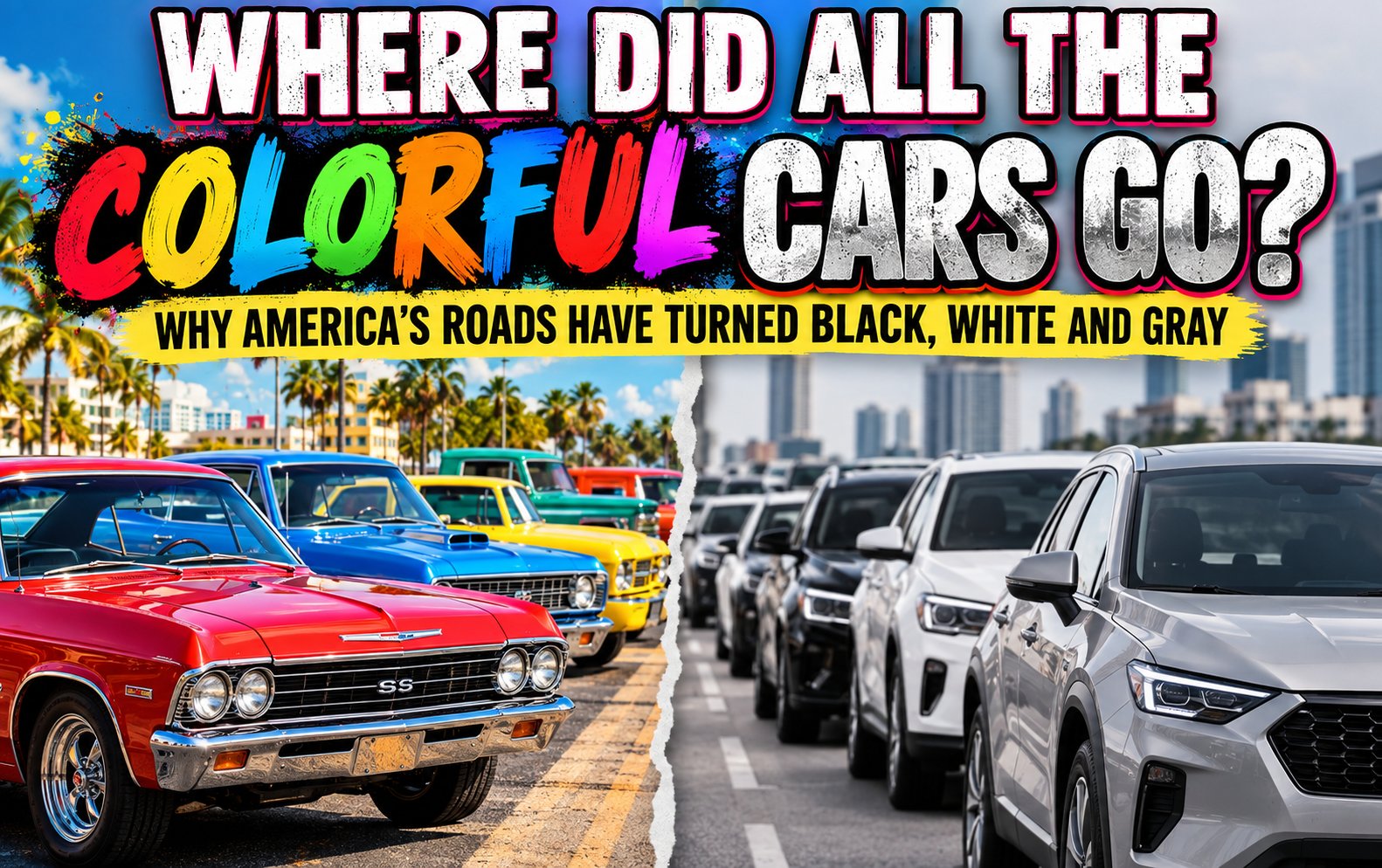
And the numbers make the change difficult to ignore. According to iSeeCars‘ analysis of the U.S. market, 80.4% of cars in 2025 were painted in grayscale colors: white, black, gray or silver. That’s up dramatically from 47.3% in 1996. In other words, America’s automotive palette has gone from something resembling a box of crayons to something resembling the settings menu on a printer.
Gray has experienced one of the biggest transformations. In 1996, only about 3.6% of vehicles were gray. By 2025, gray accounted for roughly 22.9% of the market, according to iSeeCars. Red has gone in the opposite direction. Among passenger cars, red fell from about 20.2% in 1996 to 7.1% in 2025. Green dropped even more dramatically, from about 10.1% to just 1%. Gold, brown and purple have also become much less common.
When Did Cars Become So Boring?
One major reason is simple economics. When people buy a new vehicle, many aren’t thinking about what color will make them smile every morning. They’re thinking about what happens when they eventually sell it.
Neutral colors generally appeal to a larger number of potential buyers. Black, white, gray and silver are considered safer choices in the used-car market, while an unusual color can potentially narrow the audience when the vehicle is resold. That creates a feedback loop.
Consumers choose neutral colors because they’re easier to live with and potentially easier to resell. Automakers see those sales numbers and build more vehicles in neutral colors. Dealers then stock more neutral vehicles because they know they have a broader customer base. And suddenly everyone is driving a gray crossover.
There are practical considerations too. Silver and certain medium-gray colors can hide dirt relatively well, while black and white tend to show grime more readily. Then there is the changing shape of the American vehicle. The United States has moved heavily toward SUVs, crossovers and pickup trucks. These vehicles are frequently marketed around words like rugged, premium, sophisticated, modern and upscale. Neutral colors fit that design language particularly well.
A bright yellow SUV can certainly exist. But put the same SUV in metallic gray with black wheels and suddenly the marketing department can call it “premium.” Human beings will apparently pay several thousand dollars for the privilege of owning something called “Urban Titanium.”
Cars Used to Be Much More Colorful in the Past
The difference becomes especially obvious when you look back at American cars from the 1950s, 1960s and 1970s. Automakers weren’t afraid of color. Manufacturers offered cars in bright reds, turquoise, orange, yellow, greens, blues, pinks and all kinds of pastel shades. Muscle cars in particular became closely associated with bold colors.
Color was part of the personality of the vehicle. A car wasn’t merely transportation. It was an expression of the owner. That was especially true during the era when Americans were buying cars that were dramatically different from one another. Large fins, chrome bumpers, vinyl roofs, muscle-car stripes and enormous engines already made those vehicles visually loud. Adding a bright color wasn’t exactly a difficult decision.
The automotive industry also used color as a way to distinguish different models and create excitement around new vehicles. Today’s cars, by comparison, often share similar aerodynamic shapes. Crossovers from completely different manufacturers can look surprisingly similar when they’re all painted gray.
Technology Changed the Paint, Too
Modern automotive paint is considerably more sophisticated than the paint used decades ago. Today’s finishes can contain metallic effects, pearl pigments, layered coatings and other technologies designed to create depth and visual effects.
Axalta’s 2025 Global Automotive Color Popularity Report found that white accounted for 29% of vehicles globally, followed by black at 23% and gray at 22%. Blue was the most popular traditional chromatic color at only 6%, while red represented 3%.
North America was somewhat more colorful than the global average, but neutral colors still dominated. Axalta reported white at 31%, gray at 21%, black at 19%, blue at 10%, silver at 8% and red at 7%. So this isn’t simply an American obsession with boring cars. It’s part of a much broader automotive trend.
Color May Be Coming Back?
There is one interesting twist to the story. The automotive industry may already be seeing the beginning of a reversal. BASF’s 2025 automotive color report found that colored finishes actually increased slightly in the Americas, with green, brown, beige and violet gaining attention. Green has also been gaining popularity internationally.
The trend isn’t necessarily toward the screaming neon colors of decades past. Instead, automakers are experimenting with more sophisticated versions of color: muted greens, earthy browns, unusual blues, deep purples and other colors designed to stand out without looking ridiculous. Electric vehicles are also giving designers another opportunity to experiment. With many EVs already marketed as futuristic or technologically advanced, distinctive paint and finishes can help manufacturers make one vehicle look different from the next.
And nostalgia is doing what nostalgia always does: bringing back things people once thought were old-fashioned. There is growing interest in retro-inspired vehicles, classic design cues and colors that remind people of earlier automotive eras. Car enthusiasts have always understood something that spreadsheets tend to forget: a car can be transportation and still have a personality.
The Great Automotive Beige-ification
The strange thing is that today’s cars are more technologically advanced than ever. They have giant touchscreens, cameras in every direction, adaptive cruise control, automatic emergency braking, heated and ventilated seats, sophisticated electric drivetrains and computers powerful enough to practically run a small space program. And then we paint them gray.
The shift toward neutral colors isn’t necessarily because people don’t like color anymore. It’s partly because buying a car is an expensive decision, and consumers tend to become conservative when several tens of thousands of dollars are involved. A bright yellow car might make you happy every time you walk toward it. But when you’re thinking about depreciation, resale, practicality and whether you’ll still like that color five or ten years from now, gray suddenly starts looking very reasonable.
That’s how we arrived here. America didn’t wake up one morning and decide that color was illegal. Consumer preferences gradually changed, manufacturers followed those preferences, dealers adjusted their inventories and resale considerations reinforced the cycle. Still, the next time you’re sitting in traffic surrounded by black, white and gray vehicles, take a second to remember that American roads weren’t always like this.
There was a time when a parking lot looked like a rainbow. Now it looks like someone selected “grayscale” and forgot to turn it off. And, remarkably, the automotive industry may finally be reaching for the color wheel again.
Sources for the Story
- CBS News / Evyn Moon – “From red and blue to black and silver: Why America’s cars have lost their color”
CBS News report via Yahoo News - iSeeCars – “The Most Popular Car Colors in America”
This is the key source for the historical comparison between 1996 and 2025. iSeeCars analyzed more than 22 million used vehicles and found that grayscale colors accounted for 80.4% of the market in 2025, compared with 47.3% in 1996.
iSeeCars: The Most Popular Car Colors in America - Axalta – 2025 Global Automotive Color Popularity Report
Axalta’s annual report tracks automotive color trends globally. For 2025, it found white at 29%, black at 23%, gray at 22%, silver at 7%, blue at 6% and red at 3%.
Axalta 2025 Global Automotive Color Popularity Report - BASF Coatings – 2025 Automotive Color Report: Americas
BASF’s regional data shows that black, gray, silver and white continued to dominate the Americas, while green, brown, beige and violet have been gaining attention.
BASF 2025 Automotive Color Report: Americas - BASF Coatings – Green and gray redefine the 2025 automotive color landscape
This report provides additional information about changing color preferences and the renewed interest in chromatic colors, particularly green, in different markets.
BASF Automotive Color Report 2025










































Want to join the conversation?
Create an account or sign in to share your thoughts, vote,
and reply to other readers.
Showing 0 of 0 comments
Don't have an account?
Already have an account?