
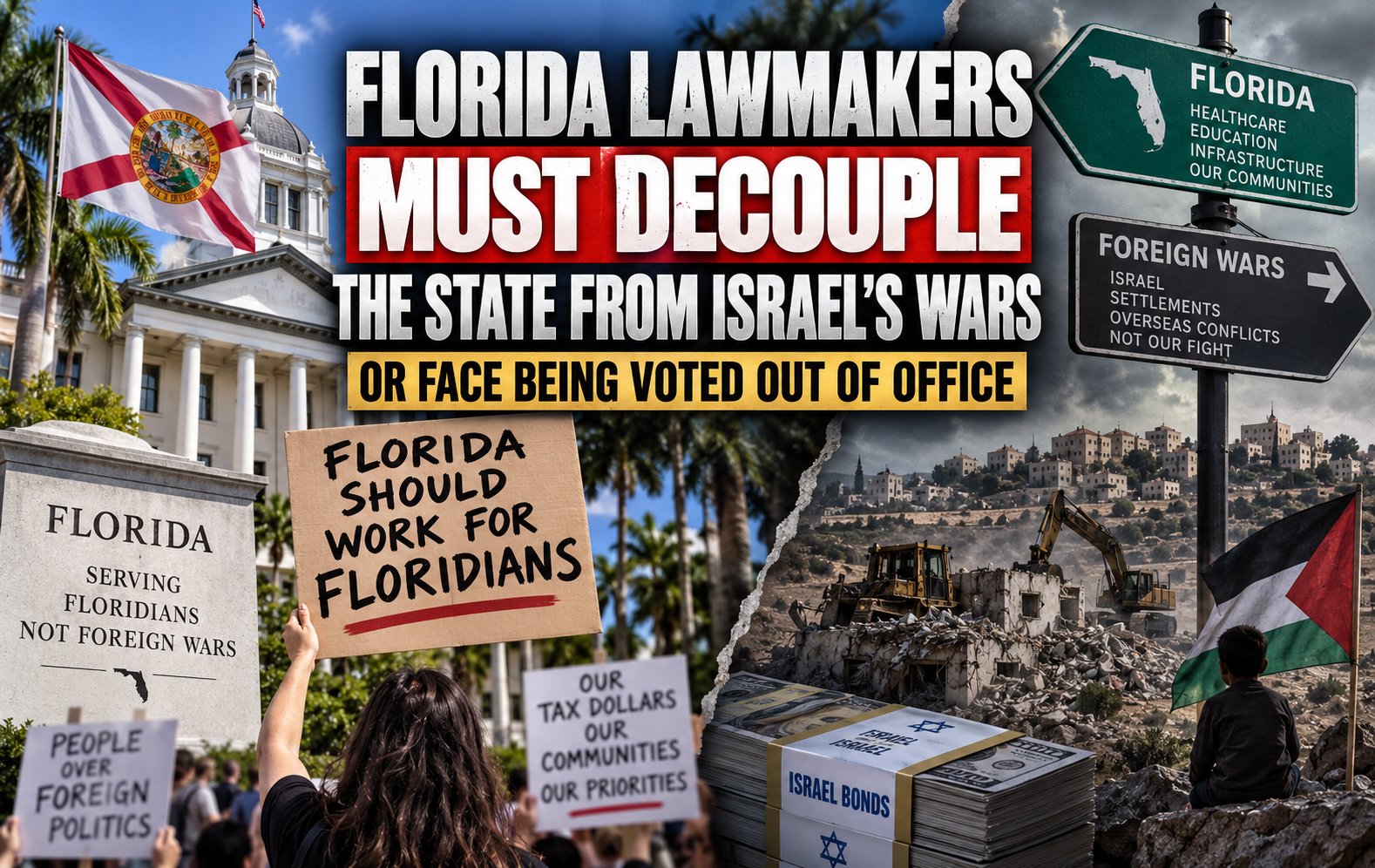
Why Is Florida Making Foreign Policy for Israel? State Anti-Boycott Laws Collide With a Global Crackdown on West Bank Settlements
As Britain, France and Canada move against commerce with Israeli settlements in the occupied West Bank, Florida law goes in the opposite direction, extending state economic protections to businesses operating in “Israeli controlled territories” while Miami-Dade expands how much public money can be invested in Israeli government debt.
Florida is thousands of miles from the occupied West Bank, but state law increasingly places Florida taxpayers, government contractors and public investment policy directly inside one of the world’s most contentious international disputes.
That contradiction became particularly difficult to ignore this week. Britain announced plans to prohibit imports from Israeli settlements in the occupied West Bank in coordination with France and Canada as those governments intensify pressure over settlement expansion and violence against Palestinians. The measures explicitly distinguish between Israel itself and settlements established in territory occupied since 1967, a distinction maintained by the United Nations, most governments and major international institutions but disputed by Israel.
Florida law takes a markedly different approach. The state’s anti-boycott statute defines a boycott of Israel broadly enough to encompass commercial actions against people and companies doing business not only in Israel but also in “Israeli controlled territories.” Florida maintains a government list of companies and other entities deemed to boycott Israel, restricts state investment in listed companies and can bar entities participating in covered boycotts from certain public contracts.
The result is an extraordinary intersection of state economic policy and international politics. Florida is not merely declaring support for Israel. Through its investment and procurement laws, it has created tangible economic consequences for certain organizations that restrict commercial relations involving Israel or Israeli controlled territories.
Supporters say Florida is exercising its legitimate authority as a buyer and investor and protecting Israel from discriminatory economic campaigns. Critics see a state government using taxpayer backed economic power to influence conduct involving a foreign country and disputed territory, an area in which the federal government traditionally exercises predominant constitutional authority.
The latest international developments make that debate considerably more consequential.
Florida Law Explicitly Reaches Into Israeli Controlled Territories
Florida Statute §215.4725 defines a boycott of Israel as refusing to deal, terminating business activities or taking other actions to limit commercial relations with Israel, or with people and entities doing business “in Israel or in Israeli controlled territories,” when done in a discriminatory manner. That wording is significant because it does not simply protect commercial relationships inside Israel’s internationally recognized pre-1967 boundaries. It can also encompass businesses operating in territories under Israeli control, including the West Bank settlement context that has become a growing point of conflict between Israel and several Western governments.
Florida’s State Board of Administration is required to maintain a Scrutinized Companies or Other Entities that Boycott Israel List. The SBA is prohibited from acquiring direct holdings in companies on that list and is required to review and publish the list quarterly. Newly identified entities receive notice and an opportunity to clarify or change their conduct before additional consequences can apply.
Florida’s procurement law provides another layer of economic leverage. Under the current 2026 version of Florida Statute §287.135, an entity generally may not bid on, enter or renew a contract worth $100,000 or more with a Florida agency or local governmental entity if it is on the scrutinized Israel-boycott list or is engaged in a boycott covered by the statute.
The precise threshold is important. Earlier descriptions of Florida’s law have sometimes overstated its scope by suggesting that the restriction applies to every government contract regardless of value. Under the current statute, the relevant Israel boycott contracting threshold is $100,000. Florida has nevertheless constructed a substantial government apparatus linking public contracting and investment decisions to commercial conduct involving Israel and Israeli-controlled territories.
Britain, France and Canada Are Moving in the Opposite Direction
Britain, France and Canada announced coordinated measures this week targeting imports from Israeli settlements in the occupied West Bank. Britain said its legislation would be implemented over the coming months, while France announced that it was beginning its own process to end commerce in settlement products.
The measures do not constitute general boycotts of Israel. France explicitly characterized its action as targeting settlements rather than Israel itself, while the participating governments presented their policies as attempts to preserve the possibility of a negotiated two state solution. France cited rapid settlement expansion and escalating settler violence as central reasons for its decision. Britain went further, with Foreign Secretary Ed Miliband accusing Israel of allowing ethnic cleansing of Palestinians in parts of the West Bank, an allegation Israel strongly rejects.
Israel responded angrily. Foreign Minister Gideon Saar accused Britain of interfering in Israeli affairs and announced the closure of Britain’s consulate in East Jerusalem, along with additional retaliatory measures. The United States has taken a different position. Secretary of State Marco Rubio criticized the European measures as potentially destabilizing and said Washington would not block imports from Israeli settlements.
The divide illustrates precisely why the issue raises questions about Florida’s role. Foreign governments are adopting conflicting policies toward Israeli settlements, and the federal government has established its own position. Florida has simultaneously created an independent state economic framework that can affect companies based on their commercial treatment of Israel and Israeli-controlled territories.
The West Bank Settlement Dispute Is Not Merely Symbolic
The argument over settlements can sound abstract when reduced to statutes, procurement rules and diplomatic statements. On the ground, the consequences increasingly involve Palestinians losing access to homes, grazing areas, farmland, water infrastructure and, in some cases, entire communities. United Nations humanitarian monitors reported that between January 2023 and July 13, 2026, more than 6,200 Palestinians, including more than 3,000 children, were displaced in the context of settler attacks and related access restrictions across the West Bank. More than 2,300 of those displacements occurred during 2026 alone.
By mid July, 122 Palestinian communities had experienced full or partial displacement since January 2023, including 47 communities that were completely displaced. The communities affected have predominantly been Bedouin and herding communities in Area C of the West Bank.
Those figures require careful description. They do not mean that every one of the more than 6,200 Palestinians had a privately titled house literally seized and occupied by a settler. The documented phenomenon is broader and more complicated: families and communities have been displaced through combinations of settler attacks, threats, restrictions on access to land and services, damage to homes and infrastructure and coercive conditions that residents say made remaining increasingly dangerous or impossible. The distinction makes the reporting more accurate without diminishing the severity of what has occurred.
Entire Palestinian Communities Have Disappeared
The displacement figures become more striking when viewed at the community level.
In July, U.N. humanitarian monitors documented the complete displacement of Jabal al Aqra’a, a longstanding Bedouin community whose residents had reportedly lived in the area for more than 70 years. According to local sources cited by the United Nations, settlers had raided the community roughly a week earlier and warned residents to leave within a month while claiming ownership of the land.
Jabal al Aqra’a became the 47th Palestinian community recorded as fully displaced since January 2023 in the context of recurrent settler attacks and related access restrictions. The Jordan Valley has been particularly affected. The United Nations reported that more than 2,000 Palestinians there had been displaced by settler attacks and related restrictions since January 2023, compared with 645 displaced through permit related demolitions during the same period. Eleven communities in the Jordan Valley had been completely displaced, including five during 2026.
The monthly rate of settler attacks in the Jordan Valley resulting in casualties, property damage or both had risen to approximately 23 incidents by July 2026, compared with approximately two per month in 2020. Whatever political terminology governments choose to apply, the physical transformation of portions of the West Bank is measurable.
Reuters Found Settler Expansion Is Receiving Israeli Government Support
Fresh Reuters reporting published this week provides additional context for the international reaction. Reuters documented how Israeli brothers Eliav and Harel “Coco” Libi and their construction operations have helped establish at least nine unauthorized settlement outposts since 2023. According to the investigation, the brothers’ activities have received forms of Israeli government assistance ranging from funding and permits to military coordination even though some of the outposts themselves are unauthorized under Israeli law.
The reporting described a model in which farms, prefabricated structures, livestock grazing and infrastructure can rapidly establish an Israeli presence across large areas of the West Bank. Palestinians living nearby have reported intimidation, restrictions on movement and loss of access to grazing and agricultural land.
The Israeli government and settlement advocates argue that Jews have historic and security claims to the territory and reject the characterization that settlement activity amounts to illegal dispossession. Israeli authorities also point to Palestinian attacks against Israeli civilians and soldiers as part of the security environment in which West Bank policy operates.
Those arguments remain part of the broader dispute, but they do not erase the documented displacement or the rapidly expanding physical footprint of Israeli settlement activity.
International Law Is Clearer Than the Politics Surrounding It
The legal status of Israeli settlements has been debated politically for decades, but the dominant international position is clear.
The United Nations, Palestinians and most governments consider Israeli settlements in the occupied West Bank illegal under international law. Israel disputes that interpretation and argues that the territories are disputed rather than straightforwardly occupied in the manner asserted by its critics. In a sweeping 2024 advisory opinion, the International Court of Justice concluded that Israel’s continued presence in the occupied Palestinian territory is unlawful and said Israel must cease new settlement activity and evacuate settlers from the occupied territory.
An advisory opinion is not the same as a judgment imposing enforceable obligations between litigating states, but it represents the legal conclusions of the United Nations’ principal judicial organ and carries substantial international legal authority. That international context makes Florida’s statutory reference to “Israeli controlled territories” particularly consequential. Florida has chosen an economic policy framework that can protect commercial relationships involving territory whose settlement regime is rejected as unlawful by most of the international community.
Airbnb Demonstrated That Florida’s Law Has Real Economic Power
Florida’s policy is not theoretical. In 2018, Airbnb announced that it would remove approximately 200 listings in Israeli settlements in the West Bank following criticism of the company’s commercial activity in occupied territory. Florida subsequently placed Airbnb on its scrutinized companies list. The dispute provided a direct test of Florida’s statutory language because Airbnb’s policy concerned West Bank settlement listings rather than a general withdrawal from Israel.
Airbnb reversed course in 2019 and announced that it would continue allowing the listings while donating profits from them to humanitarian organizations. Florida subsequently removed the company from its scrutinized list. Governor Ron DeSantis celebrated the reversal, saying Florida had successfully opposed what he characterized as discriminatory treatment of Israel. The governor’s own office described Florida’s pressure as a factor in Airbnb’s policy reversal.
For supporters, the episode demonstrated that Florida’s anti-boycott law worked exactly as intended. For critics, it demonstrated something more troubling: a U.S. state successfully used its economic leverage to influence a multinational corporation’s commercial policy concerning settlements in disputed territory thousands of miles away.
The State Board of Administration has continued using the mechanism. Its current materials state that Florida law requires a quarterly scrutinized list and prohibits the SBA from acquiring direct holdings in companies determined to participate in covered boycotts.
The Constitutional Question Is More Complicated Than Saying Foreign Policy Is Exclusively Federal
Criticism of Florida’s policy should not depend on overstating constitutional law. The federal government unquestionably possesses dominant constitutional authority over American foreign relations. The president conducts diplomacy and recognizes foreign governments, Congress regulates foreign commerce, the Senate participates in treaty making, and states are constitutionally prohibited from independently entering treaties or alliances.
The Supreme Court has also invalidated state policies that interfere with federal foreign policy decisions. In Crosby v. National Foreign Trade Council, the Supreme Court struck down a Massachusetts law restricting state purchases from companies doing business with Burma because it conflicted with a federal sanctions regime. The Court concluded that the state law undermined Congress’s chosen approach and interfered with the president’s ability to conduct diplomacy.
In American Insurance Association v. Garamendi, the Supreme Court invalidated a California law involving Holocaust-era insurance claims after concluding that it interfered with federal foreign policy implemented through executive agreements. Those cases do not establish that Florida’s anti-BDS statutes are automatically unconstitutional. States retain significant authority over their own purchasing decisions and public investments, and courts have not adopted a rule that every state contracting policy with international implications is invalid.
Indeed, litigation over anti-BDS laws elsewhere has produced significant victories for states. The U.S. Supreme Court declined in 2023 to review an Eighth Circuit decision upholding Arkansas’ contractor anti-boycott law, leaving that ruling intact without itself deciding the constitutional question nationally.
The more defensible constitutional argument is therefore narrower: states possess substantial procurement and investment authority, but that authority is not unlimited when state policy collides with federal law or substantially interferes with the federal government’s conduct of foreign affairs. Whether a particular application of Florida’s law crosses that line would depend on the facts, applicable federal policy and the legal theory asserted in court.
Florida Is Not the U.S. State Department
The policy question exists separately from the constitutional question. Florida has enormous responsibilities of its own. The state manages roads, schools, universities, prisons, environmental policy, emergency response, insurance regulation and one of America’s largest public pension systems. Local governments confront housing shortages, transportation demands, infrastructure costs and affordability problems affecting millions of residents.
The Israeli Palestinian conflict involves international borders, military occupation, diplomacy, trade restrictions, national security, international law and U.S. relations with foreign governments. Those are precisely the subjects for which the United States maintains a president, Congress, State Department, diplomatic corps and federal foreign policy apparatus.
Florida lawmakers are entitled to support Israel. Florida residents are entitled to support Israel, oppose Israeli government policies, support Palestinian rights or hold any position between those poles. Those views are part of democratic debate. The more difficult question is whether state procurement rules, pension investments and government blacklists should become instruments for advancing one side of an international political dispute.
Miami-Dade Is Simultaneously Expanding Its Permissible Exposure to Israeli Debt
The debate extends beyond Tallahassee. On September 1, the Miami-Dade County Commission approved a policy change raising the maximum share of the county’s investment portfolio that may be invested in Israeli government bonds from 3% to 5%.
The distinction between authorization and an actual purchase is important. The commission did not vote to immediately transfer 5% of the county’s portfolio to Israel, nor did it approve an immediate $450 million purchase. It changed the county’s investment criteria, allowing Israel bonds to account for as much as 5% of a roughly $9 billion investment portfolio.
According to the county’s third-quarter investment figures cited in recent reporting, Miami-Dade held approximately $130 million in Israel bonds, or about 1.48% of its portfolio. Other recent reporting placed the holdings at approximately $141 million depending on the reporting date and bonds included.
The new policy therefore substantially increases the county’s potential future exposure without requiring officials to use the entire authorization. Miami-Dade began investing in Israel bonds in 2016, initially purchasing approximately $50 million. The holdings increased after the Hamas-led October 7, 2023, attack on Israel, when county officials announced additional investment.
Florida Changed the Rules for Israeli Government Bonds in 2025
The Miami-Dade decision did not occur in isolation. Florida lawmakers enacted HB 669 in 2025, changing state law to prohibit local government investment policies from requiring a minimum bond rating for investments in rated or unrated bonds issued by the Israeli government. That law took effect July 1, 2025.
Miami-Dade’s September 2026 policy change subsequently removed language that had required Israeli government bonds to carry an A rating or equivalent from at least two accredited rating agencies. The county also shortened the permitted maturity of those bonds from five years to three years.
Supporters argue that the changes provide investment managers with greater flexibility and liquidity and allow public money to pursue attractive returns. Commissioner René García, the sponsor of the Miami-Dade measure, said the county’s investment portfolio exists to generate returns that help fund public services. Critics question why Florida law specifically prevents local governments from imposing minimum credit rating requirements on the sovereign debt of one particular foreign country. That is a legitimate public finance question regardless of one’s position on Israel.
Miami-Dade Is Facing Significant Local Financial Pressure
The timing adds another layer to the debate. Miami-Dade is confronting substantial budget pressure, with recent reporting describing a projected fiscal 2027 shortfall approaching $100 million and proposed service reductions, including potential changes to bus routes.
County officials emphasize that the roughly $9 billion investment portfolio does not consist of discretionary money that could simply be redirected dollar for dollar into new programs. Public funds held for investment are governed by liquidity, safety, maturity and statutory requirements, and investments generate returns used in county operations.
That distinction is important. Purchasing a bond is not equivalent to making a grant or giving money away; the county purchases debt securities with the expectation that principal will be repaid with interest. The policy question remains whether increasing the allowable concentration in Israeli sovereign debt, and removing a local minimum rating requirement because state law now specifically permits rated or unrated Israeli bonds, represents the best risk-adjusted use of public funds.
Protesters Were Removed From the Miami-Dade Commission Meeting
The September vote became more controversial because of what happened inside the commission chamber. Residents attempted to object to the Israel bond policy after commissioners had approved it as part of a grouped vote. Several speakers had their microphones cut, and some protesters were escorted from the chamber after attempting to discuss the measure while speaking on unrelated agenda items.
Commission Chair Anthony Rodriguez said the speakers were violating procedural rules because the Israel-bond item had already gone through its applicable public comment process during an earlier committee meeting. Commissioners maintained that residents had previously been given an opportunity to address the proposal.
That procedural context matters. The available evidence does not establish that speakers were removed simply because they opposed Israel or the bond investments. Officials said they were removed or cut off because they continued addressing an item that was not properly before the commission during that portion of public comment.
The optics were nevertheless striking. A county government had just expanded its authority to invest public funds in the sovereign debt of a foreign government, and residents attempting to object watched microphones go dead and some speakers escorted from the room. The episode demonstrated how far a decision described by supporters as routine investment management has moved into the territory of international politics and public controversy.
Florida’s Israel Policy Is Becoming Harder to Separate From Foreign Policy
Florida’s defenders can reasonably argue that the state is deciding how to spend and invest its own money. They can argue that anti-BDS rules protect Israel from discriminatory treatment and that Israel bonds are legitimate sovereign investments capable of producing returns for taxpayers.
Critics can reasonably respond that Florida has gone considerably further than simply purchasing securities. The state has established a statutory definition of boycotting Israel that expressly encompasses commercial relationships in Israeli controlled territories, maintains a government list of entities deemed to participate in covered boycotts, restricts investment in those companies and limits access to qualifying government contracts.
The state has separately enacted legislation specifically addressing the credit-rating rules local governments may impose on Israeli sovereign bonds. Those are concrete government policies with consequences beyond symbolic expressions of support.
The tension becomes particularly obvious when major U.S. allies are moving in the opposite direction. Britain, France and Canada are distinguishing Israeli settlements from Israel proper and moving to restrict settlement commerce. Florida law can treat certain discriminatory commercial restrictions involving entities operating in Israeli controlled territories as a boycott of Israel.
That is no longer merely a philosophical disagreement about the BDS movement. It creates the potential for multinational companies operating under different national legal regimes to confront incompatible political and commercial pressures.
Florida Law Now Contemplates Statements by Foreign Governments
The current statute reaches even further than many Floridians may realize. Florida’s 2026 statutory definition states that a declaration by a company, educational institution, nonprofit, government agency, local government or even a foreign government that it is participating in a boycott of Israel may be considered by the State Board of Administration as evidence when determining whether a company or other entity is participating in such a boycott.
The statute also expressly excludes trade practices preempted by federal law, an acknowledgment that Florida’s authority operates within constitutional and federal limits. That language does not mean Florida can punish Britain, France or Canada as sovereign governments under an ordinary state procurement contract. It does, however, illustrate how extensively the state has legislated in an area now directly intersecting with the official policies of foreign governments.
As foreign countries begin legally restricting settlement commerce, the possibility of multinational companies being required to navigate conflicting government policies becomes increasingly concrete.
Criticism of Israeli Government Policy Is Not Criticism of Jewish Floridians
One distinction should remain explicit throughout this debate. Florida is home to a large Jewish population, and antisemitism is a genuine problem that government has a legitimate responsibility to confront. Jewish Floridians are not collectively responsible for decisions made by the Israeli government, Israeli settlers or political parties in Israel.
Questioning Florida’s anti-BDS statutes, West Bank settlement policy or Miami-Dade’s Israel-bond investments is therefore not inherently criticism of Jewish people or Judaism. These are questions about government policy, constitutional authority, public investment, international law and the actions of a foreign state. The same principle applies to Palestinian Americans and other residents who criticize Israeli policies. Opposition to settlements or support for Palestinian rights should not automatically be characterized as hostility toward Jewish people.
Conversely, support for Israel or opposition to BDS does not by itself establish hostility toward Palestinians. Maintaining those distinctions is essential if the debate is to remain focused on government policy rather than religion or ethnicity.
The West Bank Is Exactly Why Florida’s Statutory Language Matters
The phrase “Israeli controlled territories” can appear to be technical language buried inside a financial statute. Developments in the West Bank demonstrate why those words matter. They connect Florida’s economic policy to territory where more than 6,200 Palestinians have been displaced since January 2023 in the context of settler attacks and related access restrictions, where dozens of Bedouin and herding communities have been completely displaced and where settlement expansion is provoking increasingly severe diplomatic consequences for Israel.
They also connect Florida’s policy to territory at the center of one of the world’s longest running diplomatic disputes. Israel argues that historical claims, security concerns and negotiated agreements must be considered in determining the territory’s future. Palestinians seek the West Bank as the core of a future independent state. Most of the international community considers the Israeli settlements there illegal, while Israel disputes that interpretation.
Those competing claims are precisely why decisions concerning the West Bank ordinarily belong at the highest levels of national diplomacy. Florida has nevertheless attached state economic consequences to commercial decisions involving that territory.
Florida Should Have to Explain the State Interest
The most important question for Tallahassee may ultimately be the simplest: What specific Florida governmental interest is served by extending anti-boycott protections to commercial relationships involving Israeli controlled territories?
Supporters offer several answers. They argue that the laws combat discriminatory treatment of Israel, protect a close American ally and ensure that Florida’s public money is not used to support economic campaigns the Legislature considers discriminatory. Those are identifiable policy rationales, and they deserve to be stated accurately.
Critics are equally entitled to ask why those objectives require Florida to police commercial decisions involving disputed foreign territory. If the purpose is combating unlawful discrimination, lawmakers can explain why ordinary anti-discrimination protections are insufficient. If the objective is supporting a strategic U.S. ally, they can explain why state procurement and pension policy should supplement federal foreign policy. If the objective is financial, the state can demonstrate the measurable financial benefit to Florida taxpayers.
Miami-Dade officials face a parallel obligation. Increasing the permissible concentration of public investments in Israeli sovereign debt may ultimately prove financially beneficial, but officials should be able to demonstrate that conclusion through risk, liquidity and return analysis rather than geopolitical solidarity.
Public officials are entitled to support Israel and oppose BDS. Residents are equally entitled to ask whether those political convictions should determine the rules governing public contracts and investments. Once political beliefs become statutes, procurement restrictions, investment mandates and government scrutinized lists, taxpayers are entitled to demand a clear public purpose.
Florida’s Israel Policy Now Faces a Very Different International Environment
Florida’s anti-BDS framework was created when Western governments were generally less willing to impose meaningful economic consequences on Israeli settlement expansion. The international environment is changing.
Britain, France and Canada are moving against settlement commerce. The International Court of Justice has issued a sweeping advisory opinion on Israel’s presence in the occupied Palestinian territory. United Nations monitors are documenting accelerating displacement associated with settler violence and access restrictions. Reuters has documented Israeli government support reaching some of the people and operations driving rapid settlement expansion.
Florida has positioned its economic policy differently. At the same time, Miami-Dade has expanded how much of its approximately $9 billion investment portfolio may be allocated to Israeli government debt, while Florida law now prevents local investment policies from requiring a minimum credit rating for Israeli government bonds.
Supporters describe these policies as solidarity with an important American ally, resistance to discriminatory boycotts and prudent management of public investments. Critics see state and local governments inserting themselves into an international dispute that should primarily be managed through Washington.
The constitutional answer cannot responsibly be reduced to the claim that states are forbidden from making any decision touching foreign affairs. They are not. States have substantial authority over procurement and investment. But neither can state officials pretend that these decisions have nothing to do with foreign policy.
When Florida determines which companies can receive qualifying public contracts based partly on their commercial conduct involving Israeli-controlled territory, when the state directs public investment policy around those same decisions, and when Florida specifically changes financial rules governing local investment in the debt of Israel, it has moved well beyond issuing a ceremonial resolution supporting an ally.
Florida lawmakers should therefore be prepared to explain why protecting commercial relationships involving disputed West Bank territory advances the interests of Floridians, and Miami-Dade officials should be prepared to demonstrate why increasing permissible exposure to Israeli sovereign debt is financially advantageous for the residents whose money they manage.
Those questions do not require hostility toward Israel, indifference to Israeli security or tolerance of antisemitism. They require the same scrutiny that should accompany any government policy involving public money, constitutional authority and international consequences.
Florida was elected to govern Florida. The federal government was created to represent the United States abroad. State governments retain important economic powers, but when those powers begin shaping conduct in one of the world’s most volatile territorial conflicts, the public has every reason to ask where state financial policy ends and foreign policy begins.

Sources & Further Reading
Florida Anti-Boycott Law and State Investment Policy
Florida Legislature — Florida Statute §215.4725, Prohibited Investments; Companies and Other Entities That Boycott Israel
https://www.leg.state.fl.us/Statutes/index.cfm?App_mode=Display_Statute&URL=0200-0299/0215/Sections/0215.4725.html
Florida Legislature — Florida Statute §287.135, Prohibition Against Contracting With Scrutinized Companies or Entities
https://www.leg.state.fl.us/Statutes/index.cfm?App_mode=Display_Statute&URL=0200-0299/0287/Sections/0287.135.html
State Board of Administration of Florida — Global Governance Mandates and Scrutinized Companies That Boycott Israel
https://www.sbafla.com/governance/global-governance-mandates/
Airbnb and Florida’s Enforcement of the Law
Executive Office of Governor Ron DeSantis — Florida Removes Airbnb From Scrutinized Companies List Following West Bank Policy Reversal
https://www.flgov.com/eog/news/press/2019/governor-ron-desantis-statement-removing-airbnb-scrutinized-companies-list
Executive Office of Governor Ron DeSantis — Florida Places Morningstar-Sustainalytics on Scrutinized Companies That Boycott Israel List
https://flgov.com/eog/news/press/2023/florida-places-morningstar-sustainalytics-list-scrutinized-companies-boycott-israel
West Bank Settlements and New International Measures
Reuters — Israel Retaliates After UK, France and Canada Move to Ban Imports From Israeli Settlements
https://www.reuters.com/world/uk/uk-announce-trade-ban-israeli-west-bank-goods-2026-09-08/
Reuters — France Moves to Ban Products From Israeli Settlements in the West Bank
https://www.reuters.com/world/europe/france-ban-products-israeli-settlements-west-bank-foreign-minister-2026-09-08/
Reuters — How Two Israeli Brothers Are Driving a West Bank Settler Land Grab
https://www.reuters.com/world/middle-east/how-two-israeli-brothers-are-driving-west-bank-settler-land-grab-2026-09-08/
Palestinian Displacement and Settler Violence
United Nations Office for the Coordination of Humanitarian Affairs — Humanitarian Situation Report, July 16, 2026
https://www.ochaopt.org/content/humanitarian-situation-report-16-july-2026
United Nations OCHA — Occupied Palestinian Territory
https://www.ochaopt.org/
International Law and the Occupied Palestinian Territory
International Court of Justice — Legal Consequences Arising From the Policies and Practices of Israel in the Occupied Palestinian Territory, Including East Jerusalem
https://www.icj-cij.org/case/186
Miami-Dade’s Israel Bond Investments
Miami-Dade County — Investment Policy and Legislative Records
https://www.miamidade.gov/govaction/
Local 10 — Speakers Escorted Out as Miami-Dade Commission Raises Israel Bond Investment Cap
https://www.local10.com/news/local/2026/09/01/speakers-escorted-out-as-miami-dade-commission-votes-to-increase-cap-on-israel-bonds/
Axios Miami — Miami-Dade Weighs Increased Israeli Bond Investments
https://www.axios.com/local/miami/2026/09/01/miami-dade-consider-increasing-investments-israeli-bonds
Jewish Telegraphic Agency — Miami-Dade Raises Limit on Investments in Israel Bonds
https://www.jta.org/2026/09/07/united-states/miami-dade-county-in-florida-raises-the-limit-on-investments-in-israel-bonds
Florida’s 2025 Israel Bond Legislation
Florida Laws — Chapter 2025-174, HB 669, Israeli Bonds
https://laws.flrules.org/2025/174
Florida Senate — 2025 Legislative Summary, HB 669, Israeli Bonds
https://www.flsenate.gov/Committees/billsummaries/2025/html/669
Federalism, Foreign Affairs and State Economic Policy
U.S. Supreme Court / Cornell Legal Information Institute — Crosby v. National Foreign Trade Council
https://www.law.cornell.edu/supremecourt/text/530/363
U.S. Supreme Court / Cornell Legal Information Institute — American Insurance Association v. Garamendi
https://www.law.cornell.edu/supremecourt/text/02-722
American Civil Liberties Union — Supreme Court Declines Review of Arkansas Anti-Boycott Law Challenge
https://www.aclu.org/press-releases/supreme-court-declines-to-review-challenge-to-law-restricting-israel-boycotts


















































Want to join the conversation?
Create an account or sign in to share your thoughts, vote,
and reply to other readers.
Showing 0 of 0 comments
Don't have an account?
Already have an account?