
Australia Is Developing a Condom That Could Feel More Like Skin Than Latex
The condom has been around in recognizable modern form for decades, and while manufacturers have managed to make them thinner, stronger, lubricated, flavored and available in enough varieties to make the human race question its own imagination, the basic technology has remained remarkably similar.
Now, Australian researchers are working on something considerably different: a condom made from hydrogel, a water-rich material designed to provide the protection of a traditional condom while potentially feeling much more like human skin.
The product, known as GELdom, is being developed by Australian company Eudaemon Technologies, in collaboration with researchers from the University of Wollongong and other Australian institutions. The project originated from a challenge launched by the Bill & Melinda Gates Foundation to encourage researchers around the world to reinvent the condom. Australia apparently decided that “make it thinner” wasn’t ambitious enough.
So What Exactly Is a Hydrogel Condom?
Hydrogels are materials containing a large amount of water held within a solid-like structure. They are already used in a variety of medical applications, including contact lenses and other products that need to interact comfortably with the human body.
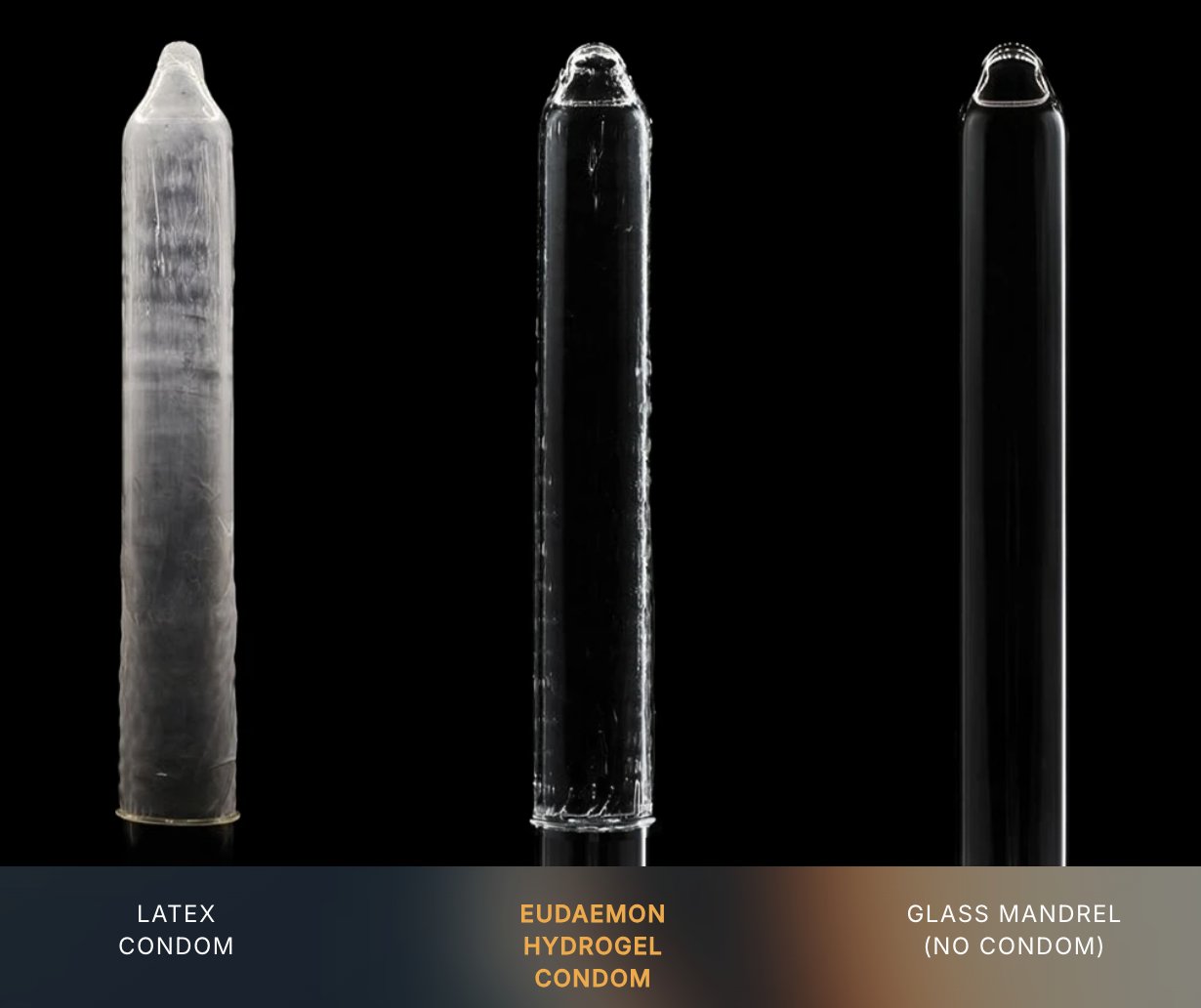
The Australian team developed a tough, transparent hydrogel specifically for use as a condom. According to information from Eudaemon, the material is approximately 50% water, with the goal of creating a condom that is soft, flexible and more closely resembles the feel of skin than conventional latex.
That is the central selling point. Rather than simply making a conventional latex condom thinner, the researchers changed the material itself.
The hope is that the hydrogel can provide a more natural sensation while still functioning as a physical barrier against sperm and infectious organisms. The University of Wollongong says the material was developed to be tough enough for condom applications while meeting the necessary mechanical and barrier-performance requirements.
It Has Already Been Tested on Humans
This isn’t simply something sitting in an Australian laboratory next to a beaker and an optimistic scientist.
GELdom has already gone through a clinical study comparing the experimental hydrogel condom with a commercially available latex condom. The Australian New Zealand Clinical Trials Registry lists the study as a randomized crossover trial examining preference, acceptability, slippage and breakage during vaginal intercourse.
The important catch is that this initial study was not designed to prove that GELdom prevents pregnancy or sexually transmitted infections. Instead, researchers were evaluating how participants experienced the product and how it performed compared with a conventional latex condom. The results are intended to help design the larger “pivotal” studies necessary to establish those claims.
According to Eudaemon, nearly two-thirds of participants who expressed a preference in the pilot study selected the hydrogel condom over the latex comparison. That’s an interesting result, although it should be understood as a preliminary user-preference finding, not proof that the product is safer or more effective than existing condoms.
The Australian Condom Could Also Be Easier to Manufacture
One of the more interesting aspects of the project is that the researchers aren’t just trying to invent a fancy material. They are also working on how to manufacture it at scale. Eudaemon says it is developing a manufacturing operation in Sydney and has discussed eventually producing as many as 27 million condoms per year. The company is also preparing for a larger clinical trial involving approximately 300 couples.
That matters because creating a promising laboratory material is one thing. Producing millions of identical medical devices that have to withstand stretching, friction, storage and transportation without failing is another matter entirely. Humanity has spent centuries perfecting the art of making things cheaply and then discovering that manufacturing them consistently is the annoying part.
Could It Replace Latex Condoms?
Not yet.
Traditional external condoms remain an established form of contraception and STI protection. Australian health authorities say condoms can significantly reduce the risk of pregnancy and transmission of several STIs when used correctly, although they are not perfect and can fail through breakage, slippage or incorrect use.
GELdom is still an investigational product, meaning it has not yet completed the clinical and regulatory process necessary to establish it as a widely available replacement for conventional condoms. The initial human study was specifically intended to gather information for subsequent pivotal testing.
The potential advantages, however, are intriguing. A material that feels more natural could address one of the longstanding complaints associated with condoms: reduced sensation. A different material could also offer an alternative for people who don’t tolerate traditional latex.
And hydrogel technology could eventually do more than simply imitate the feeling of skin. Researchers have suggested that hydrogel condoms could potentially be engineered to incorporate additional compounds, including substances intended to enhance pleasure or provide antiviral effects, although those possibilities remain areas of development rather than established features of the current product.
From Latex to Hydrogel
The evolution of condoms has been surprisingly complicated. Modern condoms are commonly manufactured from latex, while non-latex alternatives include materials such as polyurethane, polyisoprene and nitrile. Australia’s health authorities recognize both external and internal condoms, with internal condoms generally using nitrile, a synthetic rubber.
The Australian hydrogel project represents a different approach: instead of modifying an existing rubber or plastic, researchers are attempting to create an entirely different material with the mechanical properties necessary to function as a reliable barrier.
The project dates back more than a decade. The University of Wollongong received $1 million from the NSW Government’s Medical Devices Fund in 2018 to help advance the hydrogel condom, following earlier support connected to the Gates Foundation’s global condom challenge. After years of development, manufacturing challenges and clinical testing, the project is now moving toward larger-scale testing.
The Bill and Melinda Gates Connection
The Bill & Melinda Gates Foundation connection is actually central to the Australian condom’s origin story, not some random funding footnote.
In 2013, the Gates Foundation launched a Grand Challenges Explorations initiative specifically asking researchers to come up with a “next-generation condom.” The objective was to address a very practical problem: condoms are highly effective when used correctly and consistently, but some people avoid them because they reduce sexual sensation. The Gates Foundation wanted researchers to develop condoms that could increase pleasure and therefore increase condom use, particularly in developing countries where unintended pregnancy and HIV/STIs remain major public-health concerns.
That’s where Professor Robert Gorkin and his team at the University of Wollongong in Australia entered the picture. They weren’t originally condom researchers. Their specialty was advanced materials, including hydrogels, which are water-rich materials capable of being engineered to behave more like biological tissue. Gorkin’s team realized that the material they were developing for other biomedical applications might work as a condom.
In 2014, the Gates Foundation awarded Gorkin’s team a $100,000 grant to develop the concept. The University of Wollongong says the project was one of just 52 grants selected worldwide from more than 1,700 applications. The Gates program also allowed promising projects to compete for follow-on funding of up to $1 million.
The Gates Foundation specifically described the Australian project as an attempt to develop a latex alternative using tough hydrogels. The material could potentially be engineered to feel, look and behave more like natural tissue, while also potentially incorporating properties such as self-lubrication or drug delivery.
Why Does Gates Care About Condoms?
The foundation’s interest wasn’t really about making sex more enjoyable for Australians. It was about global public health. The theory was that if researchers could make condoms feel better, people might be more willing to use them consistently. More consistent condom use could mean fewer unintended pregnancies and fewer transmissions of HIV and other sexually transmitted infections. The Gates Foundation has funded HIV prevention, contraception and reproductive-health research for decades.
The University of Wollongong actually describes the goal of its original Gates-funded project very plainly: develop a condom that “significantly preserves or enhances pleasure, in order to improve uptake and regular use.”
And there’s a nice twist to the story. The Gates Foundation helped spark the project, but it didn’t pay for the entire journey. The Australian government later became a major financial supporter. In 2018, the NSW Government’s Medical Devices Fund awarded the hydrogel condom project A$1 million to help move the technology toward commercialization.
So the timeline is essentially:
2013: Gates Foundation announces a challenge to reinvent the condom.
2014: University of Wollongong researchers receive $100,000 from Gates to develop their hydrogel concept.
2015 & onward: Researchers investigate whether people actually perceive the hydrogel as more pleasurable and tissue-like.
2018: NSW Government provides $1 million toward development and commercialization.
2024: GELdom undergoes a clinical user-experience trial comparing it with a commercial latex condom.
2026: The project remains an investigational product moving toward regulatory submission, rather than an ordinary condom already sitting on Australian store shelves.
So yes, Bill Gates’ foundation essentially helped launch the Australian hydrogel-condom project. It identified the problem, solicited unconventional solutions and provided the initial research funding that allowed the University of Wollongong team to pursue GELdom. And frankly, “Bill Gates helped fund the invention of a condom designed to make sex feel better so people would actually use condoms” is considerably more interesting than burying the Gates connection three paragraphs into the story.
The Bottom Line
Australia’s GELdom isn’t a magic condom that has suddenly made every other condom obsolete. It is an experimental hydrogel condom moving toward the larger clinical studies needed to determine whether the technology can deliver on its promises. But the underlying idea is genuinely interesting. Instead of asking how to make a latex condom slightly thinner, Australian researchers have spent years asking a much more fundamental question: What if the condom were made from something completely different?
If the larger clinical trials demonstrate that hydrogel can provide the necessary protection while delivering the more natural sensation researchers are pursuing, the little piece of rubber that humanity has been using for generations could eventually have a very different future. Because apparently even condoms needed a technological revolution.




















































Want to join the conversation?
Create an account or sign in to share your thoughts, vote,
and reply to other readers.
Showing 0 of 0 comments
Don't have an account?
Already have an account?