
This is as In-Depth as It Can Get, and the Numbers Don’t Lie
So I asked ChatGPT a bunch of questions about the demographics surrounding AI, and I was very surprised by what I learned.
It pulled together the latest comparable data, and there’s a pretty fascinating picture here. The big surprise is that AI adoption is not highest in the United States. The U.S. is a huge AI market in absolute numbers, but several much smaller countries have a substantially higher percentage of their population using AI.
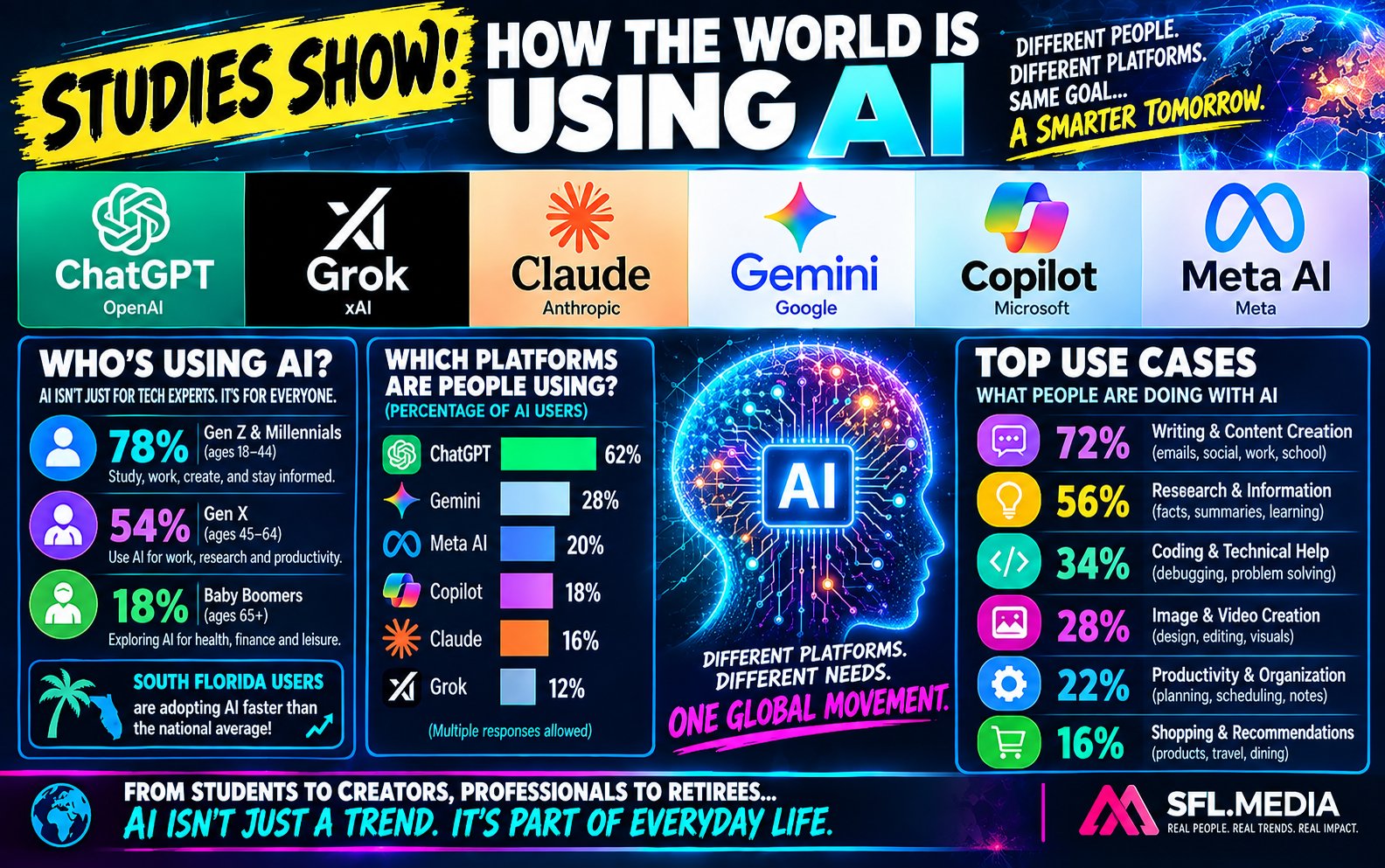
One important caveat: there isn’t one worldwide database that measures every person, every AI product, and every use case identically. So I’ll separate global country adoption, demographics, what people actually use AI for, and provider rankings rather than pretending they’re all measuring exactly the same thing.
AI Usage Around the World
Microsoft’s AI Economy Institute has one of the better apples-to-apples global measures. It defines AI diffusion as the percentage of the working-age population using a generative-AI product, based on anonymized Microsoft telemetry adjusted for internet penetration, device markets and population.
For the second half of 2025, the leading countries were:
The UAE was #1 at 64%, followed by Singapore at 60.9%. The United States was only 24th at 28.3%.
And there’s already newer data: Microsoft’s Q1 2026 update put global working-age AI adoption at 17.8%, up from 16.3% at the end of 2025. The UAE reached 70.1%, Singapore 63.4%, and the U.S. moved up to 21st at 31.3%.
There’s a substantial digital divide. Microsoft estimates working-age adoption in the Global North at 27.5% versus 15.4% in the Global South in Q1 2026.
Interestingly, the U.S. being #1 in AI investment and AI model development doesn’t translate into #1 consumer adoption.
Who is Using AI?
Here the pattern is much more intuitive: young adults use AI considerably more than older adults. Pew’s February 2026 U.S. survey gives us a particularly good demographic snapshot:
Ever used an AI chatbot
18–29…66%
30–49…61%
50–64…42%
65+…23%
All adults…49%
That’s up dramatically from 2024, when the corresponding figures were 55%, 41%, 25%, and 12%.
Pew Research Center for ChatGPT Usage Specifically:
18–29…61%
30–49…55%
50–64…37%
65+…19%
U.S. adults…44%
But there’s an interesting wrinkle: Millennials appear to be the “power-user” generation, rather than Gen Z simply dominating everything. Menlo Ventures found that Gen Z (18–28) has the highest overall adoption, but Millennials (29–44) report more daily AI usage. Even 45% of Baby Boomers in their survey had used AI during the previous six months, with 11% using it daily.
Menlo Ventures says AI isn’t just a kids’ thing anymore. This one has changed considerably. Pew’s 2026 survey found that overall chatbot usage is now essentially equal between men and women:
Men: 44%
Women: 44%
That’s notable because two years earlier, men had an 11-percentage-point advantage. Women’s adoption has grown faster and essentially closed the overall gap. But there’s still a difference in frequency:
Men using chatbots daily: 27%
Women using chatbots daily: 20%
And the individual services show some pretty interesting differences:
ChatGPT…Men…44%…Women…44%
Gemini…Men…29%…Women…20%
Copilot…Men…22%…Women…13%
Grok…Men…11%…Women…4%
Claude…Men…9%…Women…4%
Meta AI…Men…13%…Women…15%
So ChatGPT is unusually gender-balanced. The biggest male-skewed products are Gemini, Copilot, Grok and Claude, while Meta AI is slightly more female-skewed.
What are People Actually Using AI For?
This may be the most interesting part. The reality is considerably less sci-fi than the headlines. People aren’t primarily using AI to build Skynet. They’re using it to get shit done. Menlo Ventures’ 2025 consumer research found the most common activities among U.S. adults were:
AI use and % of U.S. adults
Writing emails…19%
To-do lists…18%
Researching topics…18%
Writing assistance…18%
Meal planning…16%
Managing expenses…15%
Organizing notes…15%
Creating images…15%
Researching health questions…14%
And that’s important, as no individual use case dominates. Even the #1 use, email writing, only reaches 19% of American adults. AI is being used across dozens of little tasks rather than one giant killer application.
You can broadly divide today’s consumer AI usage into these buckets:
1. Information/research – “Explain this to me.” “Research this.” “Compare these.” “What’s the answer?”
2. Writing and communication – Emails, articles, social media, rewriting, proofreading, brainstorming.
3. Work/productivity – Summaries, meeting notes, spreadsheets, planning, presentations, reports.
4. Education – Tutoring, explaining concepts, homework assistance, studying and research.
For example, a 2025 survey of U.K. university students found 88% had used generative AI for assessments, with explaining concepts, summarizing articles and generating research ideas among the most common uses.
5. Image/video/creative work – Creating images, editing photographs, making videos, thumbnails, advertisements, music and other creative material.
6. Personal/life assistance – Meal planning, travel planning, shopping, organizing, budgeting and managing family responsibilities.
7. Coding/technical work – Programming, debugging, automation and technical research.
8. Companionship/entertainment – Character chatbots, role-playing, conversations and increasingly AI-generated entertainment.
And then there’s a rapidly growing category:
9. AI agents…And this is the big one to watch.
Instead of:
“Tell me how to do this.” The next generation is: “Go do this for me.”
That means AI searching websites, filling out forms, writing and sending things, shopping, scheduling, manipulating software, researching a problem and completing multi-step tasks. That’s a much bigger deal than simply having a smarter chatbot.
Which AI Providers are Used the Most?
This is where we need to distinguish usage share from total users, because companies measure these differently. The best current global assistant numbers I found come from Sensor Tower data reported by TechCrunch.
Global AI assistant ranking — 2026
Rank, Provider, Approx. monthly users / share
1…OpenAI / ChatGPT…1.1B+ / 46.4%
2…Google / Gemini…662M / 27.7%
3…Anthropic / Claude…245M / 10.3%
4…xAI / Grok…<5%
5…Perplexity…<5%
6…DeepSeek…<5%
7…Meta Platforms / Meta AI…<5%
So ChatGPT is still the clear global leader, but its dominance has weakened dramatically. It fell below 50% of measured assistant usage for the first time, reaching 46.4%, while Gemini climbed to 27.7% and Claude to 10.3%.
And there’s an important caveat with those numbers: Meta, Google and other companies have enormous built-in distribution. An AI assistant inside WhatsApp, Instagram, Facebook, Chrome, Gmail, Android, etc. can reach people who may not think of themselves as “AI users.” That makes raw chatbot-market-share comparisons somewhat messy.
The U.S. Provider Picture
Pew’s 2026 survey is particularly useful because it asks people directly whether they’ve ever used each chatbot:
Rank…AI chatbot asked to U.S. adults
1…ChatGPT…44%
2…Gemini…24%
3…Copilot…17%
4…Meta AI…14%
5…Grok…8%
6…Claude…6%
7…Character.ai…3%
That ranking is remarkably consistent across age groups: ChatGPT is #1 in every age group.
Among 18–29-year-olds, for example:
ChatGPT…61%
Gemini…30%
Copilot…17%
Meta AI…14%
Claude…10%
Grok…9%
Character.ai…7%
The Really Interesting Big Picture
There are several things jumping out of this data. First: AI adoption is happening ridiculously fast. Stanford’s 2026 AI Index says generative AI reached 53% population-level adoption within three years of its mass-market introduction, faster than the personal computer or the internet.
Second: the U.S. isn’t the world’s most AI-adopting country. The UAE is way ahead on percentage adoption, followed by Singapore and several European countries. The U.S. is powerful in AI development but relatively mediocre in the percentage of its population actually using it.
Third: the gender gap is disappearing. Men used to be substantially more likely to use AI chatbots. In 2026, overall usage is 44% vs. 44%. The remaining difference is primarily frequency and which products people choose.
Fourth: age still matters enormously. Two-thirds of Americans 18–29 have used AI chatbots, compared with only 23% of people 65+. But older Americans are catching up rapidly.
Fifth: AI’s killer application isn’t actually “AI.” It’s convenience. People use it because it saves them five minutes here, ten minutes there, explains something they don’t understand, writes something they don’t want to write, researches something they don’t want to research, or organizes something that’s a pain in the ass.
And those little conveniences compound.
That’s why the next stage, AI that actually performs the task rather than merely advising you how to perform it, could be substantially more disruptive than the chatbot revolution we’ve already experienced.
One other number puts the scale into perspective: DataReportal estimated 2.42 billion active generative-AI users globally in early 2026, equivalent to about 29.2% of the world’s population, while noting that the figure may not represent unique individuals.
The different estimates from Microsoft, Stanford, and private research firms aren’t necessarily contradictory; they’re measuring different populations, definitions, and activity levels.
All in all, the numbers don’t lie. And this shows that the numbers are shifting by AI providers, but the number of users keeps growing and growing and growing!



















































Want to join the conversation?
Create an account or sign in to share your thoughts, vote,
and reply to other readers.
Showing 0 of 0 comments
Don't have an account?
Already have an account?