
Trump DOJ Targets James Comey for Third Time as FBI Raids Swalwell Donor’s Mansion Days Before Midterm Elections
The Justice Department’s latest case against former FBI Director James Comey and a federal search tied to former Democratic Congressman Eric Swalwell are intensifying questions about political retaliation, prosecutorial independence, and the timing of high profile investigations ahead of the November 3 elections.
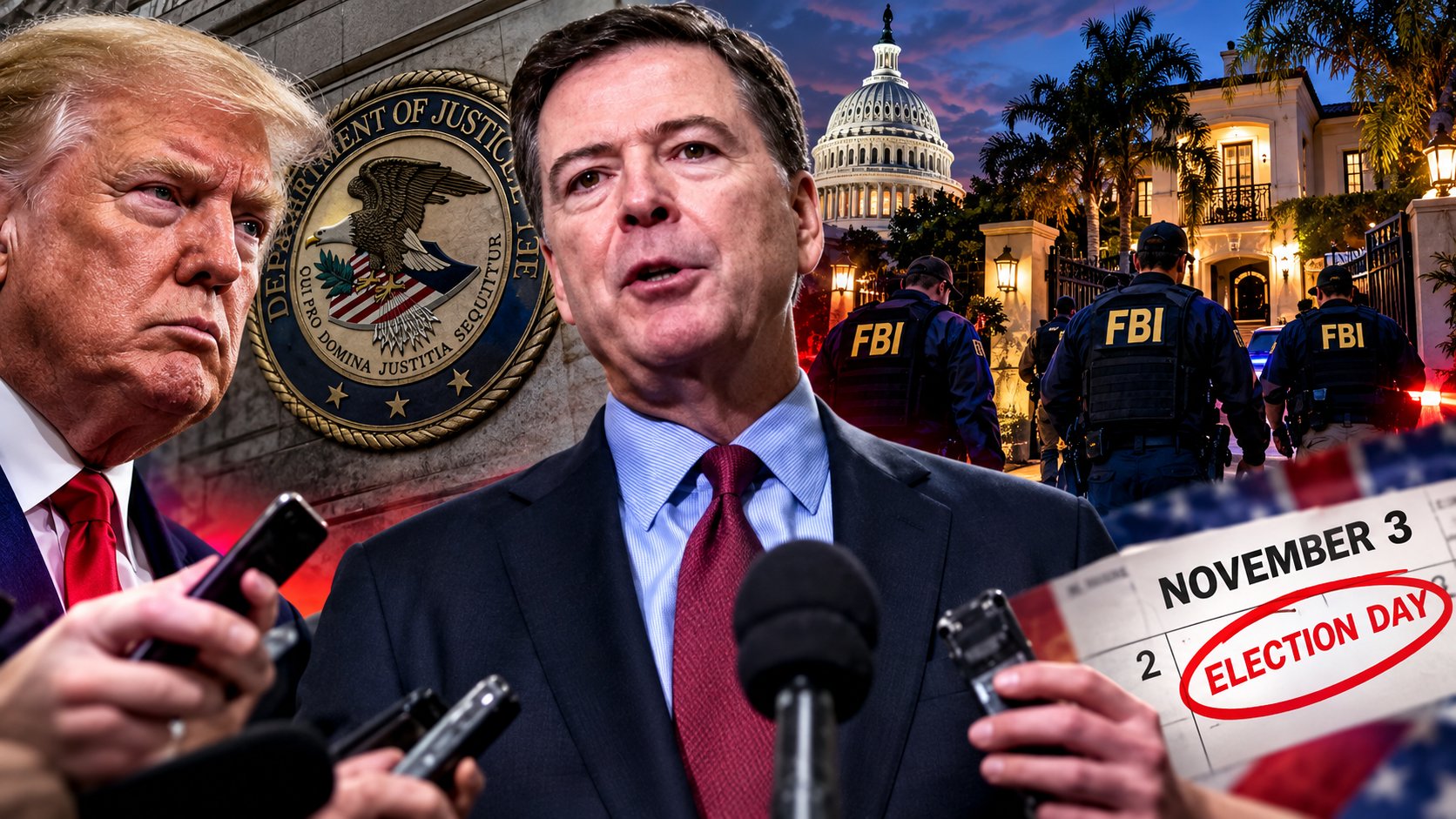
WASHINGTON — President Donald Trump’s Justice Department has initiated a third criminal case against former FBI Director James Comey, accusing one of the president’s longtime political adversaries of unlawfully disclosing national defense information nearly a decade ago. The latest prosecution surfaced publicly on October 26, just eight days before the November 3 midterm elections, adding to an extraordinary series of legal confrontations between the administration and officials who have criticized Trump or investigated his conduct.
Less than 24 hours later, FBI agents executed a search warrant at the Beverly Hills mansion of billionaire developer Stephen Cloobeck, a former financial supporter of ex-Democratic Congressman Eric Swalwell. The October 27 search was connected to an ongoing federal investigation into sexual misconduct allegations against Swalwell, who resigned from Congress earlier this year and has denied criminal wrongdoing. The investigations are legally separate, and no publicly established evidence demonstrates that the two actions were coordinated for electoral purposes. Nevertheless, their proximity to a national election has renewed scrutiny of how the Justice Department exercises its authority in politically sensitive cases.
The Comey prosecution is particularly controversial because federal prosecutors previously brought charges against him that were dismissed after a court found the prosecutor responsible for the case had been unlawfully appointed. Another case involving a social media photograph interpreted by prosecutors as a threat against Trump remains pending. Comey denies wrongdoing in all three matters, and his attorneys argue that the latest allegations concern conduct previously examined by federal prosecutors who declined to bring charges.
The developments come as Attorney General Pam Bondi and Deputy Attorney General Todd Blanche face criticism over the Justice Department’s independence, the administration’s treatment of perceived political opponents, and changes affecting professional oversight of federal lawyers. They also raise a fundamental question for the American justice system: How should prosecutors pursue legitimate criminal investigations involving politically prominent figures without allowing federal law enforcement to become a tool of electoral influence?
Comey’s Third Criminal Case Centers on Alleged Leaks From October 2016
The latest allegations against Comey concern an October 2016 disclosure of sensitive government information to a reporter while he was serving as FBI director. Federal prosecutors allege that Comey directed or participated in the transmission of national defense information to someone who was not legally authorized to receive it and conspired with others to facilitate the disclosure.
According to court records and reporting by CBS News, NBC News, and The Washington Post, the Justice Department filed a two count criminal information in federal court in Washington, D.C. The allegations concern the transmission of national defense information and a related conspiracy, with prosecutors contending that Comey was responsible for improperly providing sensitive material to the news media.
The procedural distinction between a criminal information and a grand jury indictment is central to the controversy. An indictment is issued by a grand jury after prosecutors present evidence supporting criminal charges. A criminal information, by contrast, is filed by a prosecutor without a grand jury’s approval. Although federal law permits informations in certain circumstances, felony prosecutions ordinarily require an indictment unless the defendant validly waives that right.
In Comey’s case, prosecutors filed the information without obtaining a grand jury indictment. The Justice Department said the filing was intended to preserve the allegations before the applicable statute of limitations expired, while Comey’s lawyers have challenged both the timing and the legality of the procedure.
A Justice Department spokesperson told CBS News that the case remained an ongoing criminal investigation and declined to discuss it further. The department’s explanation establishes a stated legal rationale for the filing, but it does not resolve the defense’s objections or determine whether the allegations can proceed to trial. The distinction is especially important because the existence of a charging document does not establish guilt. Prosecutors must still overcome procedural challenges and, if the case proceeds, prove the alleged offenses beyond a reasonable doubt.
Comey Says the New Prosecution Is an Abuse of the Justice Department
Comey responded publicly after the latest allegations were unsealed, condemning the administration’s continued pursuit of criminal cases against him and maintaining that he had committed no crime.
His attorney, Patrick Fitzgerald, said Comey steadfastly maintains his innocence and intends to contest the allegations. Fitzgerald also identified the disputed disclosure as connected to an October 5, 2016, New York Times article concerning American surveillance activities, arguing that the matter had previously been examined by prosecutors during Trump’s first administration.
According to Fitzgerald, two separate prosecution teams investigated the underlying conduct and decided against bringing criminal charges. If substantiated by the investigative record, that history would be relevant to evaluating why prosecutors reached a different decision a decade later. A previous decision not to prosecute does not automatically prevent a later prosecution, but it can become significant when defense attorneys challenge the factual basis, timing, or motivations of a new case.
Comey has also characterized the repeated prosecutions as retaliation for his history with Trump. The president fired Comey in May 2017 while the FBI was investigating Russian interference in the 2016 election, an episode that contributed to the appointment of special counsel Robert Mueller.
The Mueller investigation documented extensive Russian interference in the 2016 election but did not establish a criminal conspiracy between the Trump campaign and Russia. Comey subsequently became an outspoken critic of Trump, while the president repeatedly attacked his leadership of the FBI and accused him of misconduct. That history makes the current prosecution unusually politically sensitive. It also requires careful separation between the president’s publicly documented hostility toward Comey and the separate legal question of whether federal prosecutors possess sufficient admissible evidence to establish a crime.
Two Previous Comey Cases Explain Why the Third Attempt Is Facing Scrutiny
The latest filing is not an isolated prosecution. It follows two earlier criminal cases initiated during Trump’s second presidency, each involving different allegations and legal circumstances.
The first concerned accusations that Comey made false statements to Congress and obstructed a congressional proceeding. Those charges were dismissed after a federal judge concluded that the prosecutor who brought the case had been unlawfully appointed. That ruling addressed the legality of the prosecutor’s appointment rather than establishing that Comey had been factually exonerated of every allegation.
The second case involved a photograph Comey posted on social media showing seashells arranged to form the numbers 86 and 47. Federal prosecutors interpreted the image as a threat against Trump, the 47th president, and obtained an indictment in April 2026 alleging threats against the president and transmission of a threatening communication in interstate commerce.
Comey disputed the interpretation of the photograph. The controversy centered on whether the image constituted a legally actionable threat or expression protected by the First Amendment, a question that requires examination of the communication, surrounding circumstances, and applicable legal standards.
That second case has not been established as dismissed in the reporting reviewed for this article. Consequently, describing all previous prosecutions as having been thrown out would be inaccurate. One earlier case was dismissed on an appointment-related legal issue, another remains pending, and the latest filing faces substantial procedural challenges.
The sequence nevertheless creates an unusual pattern: three criminal matters involving the same former FBI director, all brought under an administration led by a president who has publicly identified Comey as an adversary. Whether that pattern establishes improper selective or retaliatory prosecution is a separate legal question that cannot be resolved solely by counting the number of cases.
The Latest Charges Arrived Just Eight Days Before Election Day
The timing of the latest Comey filing has attracted particular attention because the allegations became public on October 26, only eight days before the November 3 midterm elections. The case itself had been proceeding under seal since early October, and the public disclosure followed litigation over whether the charging documents should remain confidential.
The Justice Department has longstanding policies intended to prevent prosecutors and investigators from taking actions for the purpose of influencing elections. These principles reflect a recognition that law enforcement announcements, indictments, and public investigative activity can affect political campaigns even when the people under investigation are not themselves candidates.
However, there is an important distinction between those principles and the commonly discussed 60-day or 90-day election rules. Federal law does not impose a universal prohibition on criminal charges or search warrants during the final two or three months before an election. Justice Department guidance instead emphasizes that prosecutors must not select the timing of investigative steps or public announcements for the purpose of affecting an election.
That distinction means the Comey filing is not automatically illegal because of its proximity to Election Day. Prosecutors may pursue time sensitive cases when legitimate investigative or statutory deadlines require action. In this instance, the department has specifically cited the statute of limitations as its reason for filing the criminal information.
The relevant question is whether the timing resulted from legitimate legal necessity, improper political influence, or some combination of factors that requires further examination. Answering that question would require evidence concerning internal communications, prosecutorial decisions, the applicable limitations period, and the circumstances surrounding the public release of the allegations.
The fact that the filing was initially sealed also complicates claims that prosecutors necessarily intended to generate immediate election publicity. At the same time, the unsealing placed another high profile prosecution of a Trump critic into the public debate immediately before voters went to the polls.
FBI Searches Billionaire Stephen Cloobeck’s Beverly Hills Mansion in Swalwell Investigation
While the Comey case was attracting national attention, federal agents conducted a separate high profile operation in California. On the morning of October 27, FBI agents executed a search warrant at a Beverly Hills mansion belonging to Stephen Cloobeck, a wealthy real estate and timeshare developer who previously supported Eric Swalwell’s political campaigns. The search occurred at a property on Roxbury Drive near Benedict Canyon Drive. Local television coverage documented the law enforcement activity, while the FBI confirmed that agents had conducted an operation in the Los Angeles area related to an ongoing criminal investigation.
The Associated Press, Los Angeles Times, and Washington Post reported that the search was connected to the federal investigation involving Swalwell. The former Democratic congressman resigned from the House in April after multiple women accused him of sexual misconduct, including serious allegations of sexual assault. Swalwell has denied criminal wrongdoing, and the allegations have not resulted in a publicly reported criminal conviction. Cloobeck had previously contributed more than $23,000 to Swalwell’s congressional campaigns, according to campaign finance records cited by ABC7 Los Angeles. He also supported Swalwell’s campaign for California governor before distancing himself from the former congressman following the misconduct allegations.
The search warrant documents remained sealed, limiting public knowledge about the specific evidence investigators sought at the mansion. The existence of a judicially authorized search warrant indicates that investigators obtained authorization to search the property, but it does not establish that the homeowner or any other individual committed a crime. There is also no verified basis for describing the Beverly Hills search as a raid on Swalwell’s own residence. The property searched on October 27 belonged to Cloobeck, although investigators had previously searched Swalwell’s Washington home and seized electronic devices during an earlier stage of the investigation.
The Swalwell Investigation Involves Serious Allegations That Require Independent Examination
The federal investigation into Swalwell concerns allegations that differ substantially from those in the Comey prosecution. Multiple women have accused the former congressman of sexual misconduct, including allegations of sexual assault, and law enforcement authorities have investigated whether any of the alleged conduct violated federal or state law.
According to the Los Angeles Times, federal investigators have examined whether Swalwell may have violated a civil rights statute prohibiting individuals acting under government authority from willfully depriving others of constitutionally protected rights. Authorities have also sought electronic evidence, including devices belonging to the former congressman, while investigators in other jurisdictions have examined separate allegations.
Swalwell has denied wrongdoing. His resignation from Congress and withdrawal from California’s gubernatorial race followed the public emergence of the allegations, but neither decision establishes criminal guilt. The individuals who made allegations against him are entitled to have their claims investigated seriously, just as Swalwell is entitled to the presumption of innocence and the procedural protections afforded to anyone under investigation.
The FBI’s October 27 search must therefore be evaluated on its own evidentiary and legal merits. If investigators have credible evidence supporting a search warrant, the existence of an approaching election does not automatically require them to abandon or postpone an investigation involving alleged sexual misconduct.
Conversely, a legitimate investigation does not exempt federal officials from rules prohibiting political interference. The question is whether the investigative steps were selected for proper law enforcement reasons, whether the warrants were supported by legally sufficient evidence, and whether officials followed the department’s applicable procedures.
The public record does not currently establish that the Beverly Hills search was ordered to influence the midterm elections, and allegations of political motivation should not be presented as proven without evidence.
The Justice Department’s Election Rules Prohibit Political Manipulation, Not All Pre Election Investigations
The legal standard governing the timing of politically sensitive investigations is more precise than the commonly repeated claim that the Justice Department cannot act within 60 or 90 days of an election.
The Justice Manual, which sets out policies for federal prosecutors, specifically prohibits investigators and prosecutors from selecting the timing of investigative steps, criminal charges, or public statements for the purpose of affecting an election or benefiting or disadvantaging a candidate or political party.
The policy is significant because it addresses intent rather than establishing an automatic blackout period. Federal prosecutors remain responsible for investigating crimes, protecting victims, preserving evidence, and complying with statutes of limitations, including during election season.
The Justice Department’s own guidance also recognizes that certain politically sensitive actions require consultation with its Public Integrity Section. Those procedures are intended to safeguard prosecutorial neutrality and reduce the risk that legitimate investigations become entangled with partisan political objectives.
The distinction matters in both cases. Comey’s defense can challenge whether prosecutors followed proper procedures and whether the filing was legally sufficient to preserve the charges. In the Swalwell investigation, investigators must demonstrate that searches and seizures were supported by appropriate legal authorization and relevant evidence.
Critics of the administration argue that repeated investigations involving Trump’s political adversaries warrant particularly close scrutiny. The administration, meanwhile, maintains that the Justice Department has a responsibility to enforce federal law regardless of the political identities of those under investigation.
Determining whether either case crossed the line into improper political interference requires more than establishing that the actions occurred close to an election. It requires evidence that political considerations improperly influenced investigative or prosecutorial decisions.
Pam Bondi and Todd Blanche Face Ethics Complaints Over Justice Department Conduct
The controversy surrounding the latest prosecutions also intersects with a broader dispute over professional accountability for senior Justice Department officials.
Former Attorney General Pam Bondi and senior Justice Department official Todd Blanche have faced formal ethics complaints alleging that their conduct violated professional responsibilities imposed on licensed attorneys. The complaints are part of an ongoing debate over whether state bar associations can effectively oversee federal government lawyers when their actions are connected to politically sensitive litigation or prosecutorial decisions.
In May 2026, a coalition including Democracy Defenders Fund, Lawyers Defending American Democracy, and former judges submitted a complaint to The Florida Bar seeking an investigation into Bondi’s conduct during her tenure as attorney general. The filing alleged that Bondi encouraged or tolerated practices that compromised professional independence and placed pressure on subordinate lawyers to pursue positions inconsistent with their ethical obligations.
The allegations included concerns about supervisory responsibilities, compliance with court orders, and the treatment of attorneys who resisted directives they considered improper. The complaint was supported by former judicial officials and legal scholars, but its submission does not establish that Bondi violated professional rules or that disciplinary authorities have sustained the allegations.
Blanche has faced separate complaints concerning his supervisory role and alleged conflicts of interest connected to his previous representation of Trump. The New York City Bar Association has documented complaints against Blanche and other Justice Department officials while criticizing a proposed federal rule that could restrict or alter state disciplinary oversight of government attorneys.
That proposed rule has generated significant opposition among legal organizations concerned that it could weaken accountability by making it more difficult for state bar regulators to investigate federal lawyers. Supporters of the administration’s approach have argued that state disciplinary complaints can themselves become politicized and that federal attorneys need protection against retaliatory complaints arising from their official duties.
The dispute raises an important institutional question: how to ensure that federal prosecutors can perform their responsibilities independently while remaining accountable to professional standards that apply to other licensed attorneys.
One factual distinction is essential. Bondi is a former attorney general, having left that position earlier in 2026. Describing her as the current head of the Justice Department would be inaccurate. The complaints involving her tenure remain relevant to the wider debate about professional responsibility, but they should not be confused with a finding that she personally directed the October 2026 Comey filing or the Swalwell related search.
Can a Former Attorney General or Deputy Attorney General Be Disbarred?
Federal officials who are licensed attorneys are not automatically exempt from professional discipline simply because they serve in senior government positions. State bar associations and other authorized disciplinary bodies can investigate alleged violations of professional conduct rules, subject to the applicable jurisdiction’s laws, procedures, and constitutional limitations.
Potential sanctions can range from private or public discipline to suspension or disbarment, depending on the nature of the violation and the rules governing the attorney’s license. However, an ethics complaint is only the beginning of a disciplinary process and does not itself establish misconduct. Investigators must examine the underlying facts, determine whether professional rules apply, and evaluate the available evidence. Attorneys facing disciplinary proceedings are also entitled to procedural protections, and disagreements over prosecutorial policy or political priorities do not automatically constitute ethical violations.
Disbarment is generally reserved for sufficiently serious professional misconduct under the governing jurisdiction’s standards. Establishing that an attorney participated in an unpopular prosecution, supported a controversial administration, or adopted an aggressive legal interpretation would not alone justify that sanction.
In the cases involving Bondi and Blanche, the relevant questions concern their actual conduct, supervisory responsibilities, alleged conflicts, and whether specific professional obligations were violated. Those determinations belong to the appropriate disciplinary authorities and, where applicable, reviewing courts.
Comey’s Daughter Wins Separate Court Ruling Against the Trump Administration
The latest Comey prosecution emerged amid another legal development involving his family. On October 26, the same day the newest allegations against the former FBI director became public, a federal judge ruled that the Trump administration had unlawfully fired Comey’s daughter, Maurene Comey, a former federal prosecutor who worked on prominent cases involving Jeffrey Epstein and Sean Combs.
The ruling added another dimension to the longstanding conflict between the Comey family and the administration. Maurene Comey’s dismissal had drawn scrutiny because of her father’s adversarial relationship with Trump, although the legal issues surrounding her employment must be evaluated separately from the criminal allegations against James Comey.
The court’s finding that her firing was unlawful is a judicial determination concerning the government’s employment action. It does not, by itself, establish that the Justice Department’s latest criminal filing against her father was improperly motivated or legally invalid. Nevertheless, the simultaneous developments are likely to intensify attention on the administration’s treatment of officials and former officials associated with investigations or prosecutions that have drawn Trump’s criticism.
Early Voting Claims Require Actual Election Data
The political significance of the prosecutions is heightened by the approaching midterm elections, but claims about their likely electoral consequences require reliable evidence.
Early voting participation can reveal important information about turnout, geographic patterns, and the number of ballots cast by registered voters affiliated with different political parties. However, those figures do not necessarily establish which candidates are receiving votes, particularly in states where ballots are secret and party registration does not determine how individuals vote.
Comparisons with previous election cycles must also account for differences in voting rules, the availability of mail ballots, changes in the electorate, and the timing of ballot processing. High participation among voters registered with one party does not automatically translate into an equivalent advantage in the final results. Without a specific, verified set of state level early voting data, it would be misleading to conclude that the Comey prosecution or Swalwell investigation has failed to influence voters, that one party is guaranteed a decisive victory, or that the Justice Department’s actions were motivated by knowledge of an impending electoral defeat.
The election’s outcome will be determined by ballots cast and counted under applicable state laws. Any attempt to evaluate the political impact of these investigations must distinguish measurable voting behavior from speculation about voter intentions or the motivations of federal officials.
A Justice Department Under Scrutiny as the Midterms Approach
The renewed prosecution of James Comey and the federal search involving a former Eric Swalwell donor have placed two politically sensitive investigations into the national spotlight just days before Americans vote in the midterm elections. Although the cases involve different allegations, different individuals, and separate legal proceedings, their timing underscores the challenges facing a Justice Department whose independence has become a subject of intense public debate.
Comey’s case presents immediate procedural questions about the use of a criminal information, the statute of limitations, and whether prosecutors can sustain allegations that his attorneys say were previously investigated without charges. The Swalwell investigation raises different issues involving serious sexual misconduct allegations, the legal basis for federal searches, and the rights of both accusers and the accused.
Neither case can be fairly evaluated solely through the political identities of those involved. The government must have the authority to investigate credible allegations of criminal wrongdoing, including allegations involving former senior officials and political figures. At the same time, that authority carries an obligation to avoid retaliatory prosecutions, politically motivated investigative decisions, and public actions designed to influence elections.
The history between Trump and Comey, the unusual number of criminal cases brought against the former FBI director, and the Justice Department’s own election-related policies provide legitimate grounds for scrutiny. They do not, standing alone, establish that the latest prosecution is illegal or that the administration coordinated the separate Swalwell investigation for electoral advantage.
Ultimately, the courts will determine whether the Comey charges can proceed, investigators will have to substantiate any allegations arising from the Swalwell inquiry, and disciplinary authorities will decide whether complaints against government attorneys warrant sanctions. The larger institutional stakes extend beyond the outcome of any single prosecution. A justice system depends on public confidence that federal law enforcement is neither a shield for political allies nor a weapon against political opponents. Maintaining that confidence requires prosecutors to demonstrate that their decisions are grounded in evidence, authorized by law, and insulated from improper political influence.
As the November 3 election approaches, the burden remains on federal officials to show that their extraordinary powers are being exercised for legitimate law enforcement purposes rather than partisan advantage.
Sources & Further Reading

James Comey, Third Federal Criminal Case
Eric Swalwell Investigation and Beverly Hills Search
DOJ Election Policies and Legal Ethics
SFL Media Related Political and Justice Department Coverage
SFL Media has extensively covered the Trump administration, federal law enforcement, political accountability, and allegations of government misconduct. The following section can accompany the article, with verified internal story links added from the SFL Media archive.
SFL Media — Latest U.S. Political News, Justice Department Coverage and Investigations





































Want to join the conversation?
Create an account or sign in to share your thoughts, vote,
and reply to other readers.
Showing 0 of 0 comments
Don't have an account?
Already have an account?