
Iran’s Missile Barrage Exposes the Real Damage to U.S. Bases Across the Middle East
New images obtained by CBS News reveal destroyed aircraft, burned vehicles and shattered American facilities as Pentagon watchdog and CBO reports put the broader cost of the Iran war at tens of billions of dollars
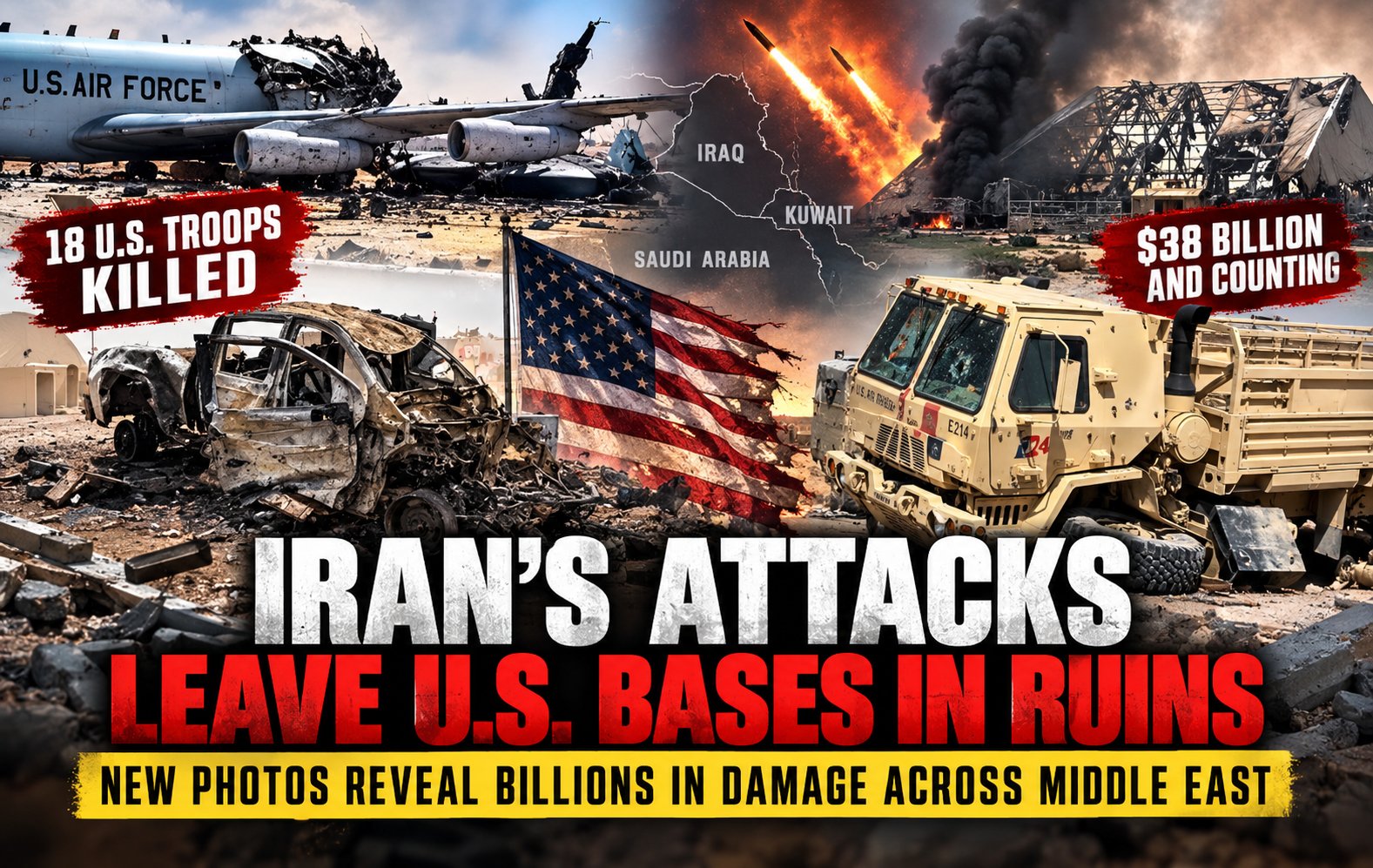
New photographs obtained by CBS News are providing one of the clearest public views yet of the physical destruction inflicted on American military positions during Iran’s missile and drone campaign across the Middle East, showing damaged buildings, burned vehicles and wrecked equipment at U.S. installations in Kuwait and Saudi Arabia. The images, provided to CBS News by active duty service members who requested anonymity because of military restrictions on speaking with the media, arrive alongside a new Pentagon inspector general report that offers the most extensive official accounting yet of damage to U.S. bases, aircraft and weapons inventories during the war with Iran.
Together, the disclosures paint a more complicated picture of the conflict than interception statistics alone suggest. American air defenses have destroyed large numbers of incoming Iranian missiles and drones, but Tehran has launched enough weapons across a broad enough geographic area that even a relatively small percentage penetrating those defenses has produced substantial damage.
The Pentagon inspector general reported Iranian strikes against American positions in Kuwait, Bahrain, Qatar, the United Arab Emirates, Saudi Arabia, Iraq, Oman and Jordan. Hundreds of buildings and other structures have been damaged or destroyed, while dozens of American aircraft and drones have been hit. The watchdog estimated equipment losses alone at as much as $3.7 billion. That figure is important because it corrects an early estimate circulating alongside the CBS report that placed physical base damage at roughly $5 billion. The available government accounting does not yet support describing $5 billion as a confirmed estimate for damage to U.S. bases alone. The inspector general’s documented figure is up to $3.7 billion in equipment losses, while rebuilding damaged facilities could add substantial costs that have not yet been fully calculated.
CBS Photos Show the Damage Up Close
The photographs obtained by CBS News show destruction at Camp Buehring and Camp Arifjan in Kuwait as well as Prince Sultan Air Base in Saudi Arabia. Camp Buehring is a major staging area for American ground forces, armored vehicles and aircraft, while Camp Arifjan has long served as one of the Army’s most important logistical hubs in the region. Images from the installations show damaged structures, burned-out vehicles and debris left behind after Iranian attacks. At Prince Sultan Air Base, the Pentagon inspector general separately documented damage to American aircraft, reinforcing what the photographs suggest: Iran’s attacks have not merely tested U.S. defenses but have destroyed or damaged expensive military assets on the ground.
The inspector general reported that as many as 30 MQ-9 Reaper drones were destroyed, aircraft that cost roughly $30 million each. Seven KC-135 aerial refueling aircraft were damaged or destroyed, including five hit by Iranian munitions while sitting on the ground in Saudi Arabia. Those losses matter beyond their dollar value. Tankers, reconnaissance aircraft and drones form part of the logistical architecture required to sustain prolonged American air operations across the Middle East. Destroying them on the ground can affect operational capacity even without successfully attacking American combat aircraft in the air.
Hundreds of Structures Damaged Across Eight Countries
The geographical scale of the damage is one of the most significant findings in the Pentagon watchdog report. Iranian strikes damaged or destroyed hundreds of buildings and other structures at American bases across Kuwait, Bahrain, Qatar, the United Arab Emirates, Saudi Arabia, Iraq, Oman and Jordan. The attacks forced U.S. Central Command to adapt its logistics network as some established facilities came under sustained threat.
The damage in Bahrain was particularly consequential because the country hosts major U.S. Navy infrastructure and serves as an important regional logistics center. According to the inspector general report, disruption there forced CENTCOM to shift some supply operations to more distant locations, including the joint U.S. British base on Diego Garcia in the Indian Ocean. That created logistics cycles lasting approximately 14 to 18 days, illustrating how attacks on fixed infrastructure can create strategic effects even when they do not destroy frontline combat units.
Iran Found the Weak Point in America’s Air Defense Mathematics
The destruction also highlights a fundamental problem confronting modern missile defense systems: an extraordinarily high interception rate can still produce serious losses when an adversary launches enough weapons. Iran has employed combinations of ballistic missiles and relatively inexpensive one-way attack drones against American and allied positions. Those weapons force defenders to detect, track and determine which threats must be intercepted, often using defensive missiles that can cost far more than the drones they are destroying.
The problem is partly mathematical. Even a hypothetical 95% interception rate means five weapons out of every 100 could reach their targets. Against large salvos repeated over months, those penetrations accumulate. A missile defense system therefore does not need to “fail” in the conventional sense for an adversary to inflict meaningful damage. Defenses can perform effectively overall while individual missiles and drones still penetrate the defensive network and strike aircraft, buildings, vehicles, radar systems or personnel. This becomes particularly consequential when bases contain unhardened buildings or aircraft parked in the open.
Six Americans Died in One Attack in Kuwait
The human consequences became clear almost immediately after the war began. On March 1, an Iranian drone struck a tactical operations center at the Port of Shuaiba in Kuwait, killing six U.S. service members. Reuters reported that the victims included soldiers from an Iowa-based Army Reserve unit. CBS News later reported that dozens of additional personnel suffered injuries including burns, traumatic brain injuries and shrapnel wounds.
The Shuaiba strike became the deadliest single attack on American forces of the conflict and the deadliest attack involving U.S. troops since 2021. Survivors subsequently challenged the Pentagon’s initial characterization of the attack. Defense Secretary Pete Hegseth had referred to the weapon as a “squirter,” terminology suggesting that an individual threat had slipped through an otherwise effective defensive system. Soldiers interviewed by CBS News described a more troubling situation, arguing that their position was inadequately protected against the type of attack Iran launched.
The Pentagon has disputed aspects of that characterization and has maintained that measures were taken to protect American personnel. The Army conducted an internal review of the Shuaiba attack and later briefed the families of those killed.
18 American Service Members Have Died During the War
The overall American death toll has continued to rise as the conflict has expanded. As of September 15, 18 U.S. service members have died during the Iran war, according to Reuters and other reporting based on military figures. Not all of those deaths resulted directly from Iranian weapons. The Pentagon inspector general’s accounting distinguished personnel killed in action from deaths resulting from non-hostile incidents associated with military operations.
Among the non-hostile losses was a KC-135 crash in Iraq following a collision with another tanker aircraft that killed six service members. Another service member died after a helicopter crashed into the Arabian Sea. The distinction is essential when assessing the human cost of the conflict: 18 American military personnel have died during the war, but that figure should not be represented as 18 Americans killed directly by Iranian strikes.
The Damage Extends Far Beyond Buildings
The new photographs provide a visual record of destruction, but the larger military problem may be what cannot be seen in them. The Pentagon inspector general concluded that the conflict has produced “strategic inventory shortfalls” and exposed industrial-base bottlenecks in the production and replacement of advanced munitions.
American forces have consumed large quantities of expensive interceptors and precision-strike weapons during six months of operations. Unlike relatively inexpensive drones that can be manufactured quickly and in large numbers, advanced American missiles can require sophisticated components, limited production lines and years of procurement planning.
The Pentagon has pushed back against reports that American forces face dangerous munitions shortages, maintaining that the military possesses the weapons necessary to execute its missions. The watchdog and Congressional Budget Office assessments nevertheless indicate that replacing weapons expended during the conflict could take years.
The Iran War Has Already Cost the United States About $38 Billion
The financial cost extends far beyond physical damage. The Congressional Budget Office reported September 15 that the six month war had cost approximately $38 billion through August 1 and projected that continued operations could add roughly $3 billion per month. The CBO found that much of the expense came from the rapid consumption of munitions. The Pentagon’s inspector general separately placed the cost through June 19 at approximately $33.4 billion. Defense Secretary Hegseth had previously told Congress that the war had cost approximately $37.5 billion and sought nearly $90 billion in emergency funding to replenish American weapons inventories. The different figures reflect varying accounting periods and methodologies rather than necessarily conflicting estimates.
More importantly, the $38 billion CBO estimate is not a comprehensive final price tag. Reuters reported that the CBO calculation does not include costs from more recent attacks on commercial vessels in the Strait of Hormuz, recent strikes on American military installations or the borrowing costs associated with financing the conflict. Reconstruction of damaged bases and replacement of destroyed infrastructure could push the eventual cost higher.
Billions in Aircraft and Equipment Have Been Lost
The equipment losses provide some indication of how rapidly costs can accumulate. Thirty MQ-9 Reapers valued at roughly $30 million each would represent approximately $900 million in aircraft alone if all were destroyed rather than merely damaged. Add damaged or destroyed KC-135 tankers, other aircraft, vehicles, radar equipment, communications systems, buildings and support infrastructure, and the financial consequences escalate quickly.
The inspector general placed equipment losses at as much as $3.7 billion.
U.S. diplomatic facilities have also suffered significant damage. The State Department estimated approximately $184 million in physical damage to diplomatic installations in Iraq, Kuwait, Saudi Arabia and the United Arab Emirates. It reported another $113 million in other conflict related costs, including contingency operations and evacuations. Approximately 9,000 U.S. citizens were evacuated from countries across the Middle East and Europe after the United States and Israel began striking Iran on February 28.
America Is Spending Expensive Weapons to Stop Cheap Ones
The war is also highlighting an economic imbalance that has concerned military planners for years. Iran can deploy comparatively inexpensive one-way attack drones in significant numbers. The United States and its allies may respond with sophisticated surface to air interceptors costing vastly more than the incoming weapon. That does not mean expensive interceptors are being “wasted.” A relatively inexpensive drone can destroy an aircraft worth tens or hundreds of millions of dollars, damage critical radar equipment or kill service members. The value of an interceptor is determined partly by what it protects, not simply by the cost of the weapon it destroys.
But prolonged exchanges create an unfavorable cost curve. An adversary capable of producing large numbers of cheaper weapons can pressure defensive inventories while forcing the defending military to continually manufacture and deploy much more sophisticated systems. The Pentagon watchdog’s warning about industrial-base bottlenecks suggests that the challenge is no longer theoretical.
The War Is Testing a Base Network Built for a Different Era
For decades, the United States constructed an enormous network of bases across the Middle East that enabled American forces to project military power with relatively little fear that those facilities themselves would face sustained precision attacks. Drone warfare and increasingly sophisticated ballistic missiles are changing that equation.
Large fixed installations concentrate valuable aircraft, personnel, fuel, ammunition, communications equipment and command infrastructure in known locations. Satellites and modern surveillance systems make those facilities difficult to conceal, while relatively inexpensive precision weapons allow adversaries to repeatedly target them from hundreds of miles away. The result is a military architecture increasingly forced to balance efficiency against survivability. Hardened aircraft shelters, dispersed operations, redundant command centers and mobile logistics networks can reduce vulnerability, but they are expensive and cannot eliminate risk. Iran’s attacks have demonstrated that the American military can maintain air superiority while still suffering substantial damage on the ground.
A 95% Defense Can Still Leave a Devastating 5%
Perhaps the most important lesson from the photographs is that missile defense performance cannot be measured solely by interception percentages. Stopping 95 out of 100 incoming weapons would represent extraordinary technical performance. But if the remaining five hit an aircraft parking area, fuel depot, command center or troop facility, the operational and human consequences can still be severe. That is the uncomfortable mathematics now visible in the photographs emerging from Kuwait and Saudi Arabia.
American defenses have prevented many Iranian weapons from reaching their targets, but they have not made U.S. installations invulnerable. Hundreds of damaged structures, billions of dollars in equipment losses, destroyed aircraft and the deaths of American service members demonstrate the consequences when even a small percentage of incoming weapons gets through.
Six months into the conflict, the United States is confronting not only the cost of fighting Iran but the cost of defending a vast network of military installations against a new generation of relatively inexpensive, increasingly accurate weapons. The photographs obtained by CBS News make that cost difficult to view as an abstraction.

Sources & Further Reading
Reuters — “Iran war cost hits $38 billion, forecast to rise $3 billion a month, CBO says”
CBS News — Army review of Iran conflict’s deadliest attack on U.S. soldiers
CBS News — Survivors dispute Pentagon account of deadly Kuwait attack
Reuters — Pentagon identifies first U.S. soldiers killed in Iran war
CBS News — Nearly 100 U.S. service members injured in Iranian strikes in July



















































Want to join the conversation?
Create an account or sign in to share your thoughts, vote,
and reply to other readers.
Showing 0 of 0 comments
Don't have an account?
Already have an account?