
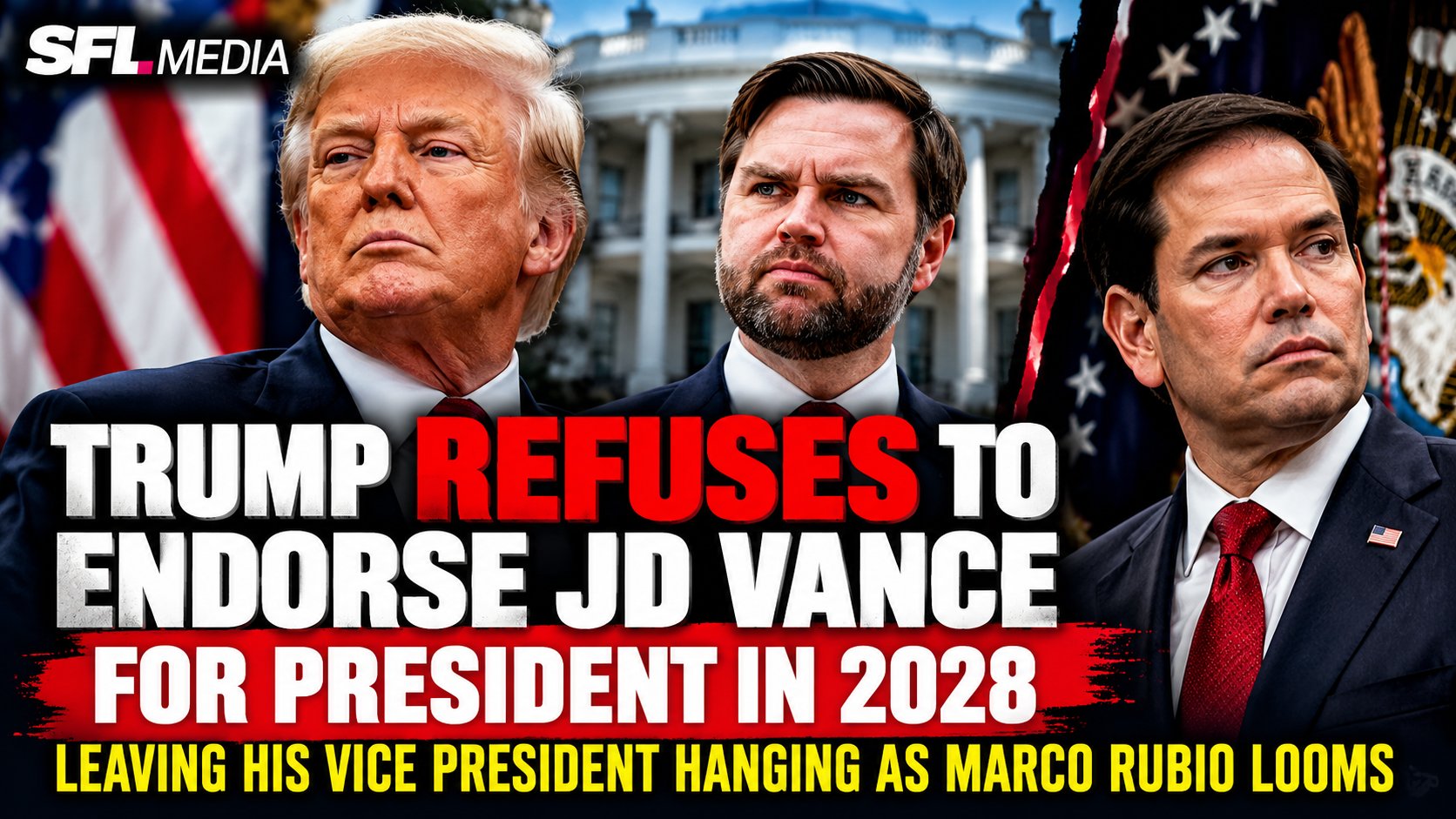
Trump Refuses to Endorse JD Vance for President in 2028, Even as Vice President Stands Beside Him
Just one day after JD Vance predicted Donald Trump would support his presidential ambitions, the president declined to make that commitment in front of reporters. The exchange raises new questions about the Republican succession battle, with Secretary of State Marco Rubio remaining a potential contender.
WASHINGTON, D.C. — President Donald Trump has declined to endorse Vice President JD Vance as his successor in the 2028 presidential election, delivering an unexpectedly noncommittal response during an Oval Office appearance while Vance stood nearby. The exchange came just one day after the vice president publicly expressed confidence that Trump would support him if he decided to seek the Republican presidential nomination.
The October 20 encounter highlighted a significant uncertainty surrounding the Republican Party’s political future: Although Vance has emerged as a leading potential successor to Trump, the president has not publicly committed to supporting his vice president’s presidential ambitions. Trump praised Vance’s abilities and character but said the two had never discussed a presidential endorsement. He also suggested that any decision about the 2028 election should wait until after the November 3 midterm elections, when Republicans will face a major test of their political standing.
The exchange was particularly notable because Trump has reportedly expressed support for Vance in private conversations with donors. According to earlier reporting by The Washington Post, the president told a group of supporters in August that Republicans needed to elect Vance, although several advisers disputed whether those remarks represented a final endorsement decision.
The apparent contrast between Trump’s private encouragement and his public reluctance has renewed attention on the possibility of a contested Republican presidential primary, particularly as Secretary of State Marco Rubio continues to be discussed as another potential candidate.
Trump Praises Vance but Refuses to Make a Presidential Commitment
The revealing exchange occurred during an October 20 Oval Office event announcing a whistleblower reward initiative. When a reporter asked whether he intended to endorse Vance for president in 2028, Trump acknowledged the vice president’s qualifications but stopped short of making any commitment.
“He’s a very talented person and he’s a very good person,” Trump said, before adding that the two had never discussed the possibility of a 2028 endorsement.
Standing nearby, Vance confirmed that they had not held such a conversation, responding, “No, sir.” Trump then emphasized that the next presidential election remained more than two years away and that the administration needed to focus on the approaching congressional elections. He described the discussion as premature and indicated that he would revisit the question later.
The president’s response was not an outright rejection of Vance. Trump did not criticize his vice president, suggest that he was unqualified or endorse another Republican contender. Nevertheless, his refusal to make a commitment was politically significant because Vance had expressed confidence in receiving precisely that endorsement just 24 hours earlier.
Presidential endorsements can carry substantial weight in Republican primaries, particularly when they come from a sitting president who remains influential with party voters, donors and elected officials. For Vance, Trump’s eventual support could help consolidate conservative activists and discourage potential rivals from entering the race. By withholding an endorsement, Trump has preserved his flexibility while leaving the Republican field uncertain.
JD Vance Predicted Trump’s Support Just One Day Earlier
The Oval Office exchange followed an October 19 interview in which Vance discussed his political future with journalist Mark Halperin. Asked whether Trump would support him if he pursued the presidency, Vance expressed confidence that the president would eventually back his candidacy.
“I think if I run, the president will endorse me,” Vance said.
The vice president also acknowledged that Trump might prefer to allow Republican candidates to compete before making a final decision. Vance has not formally announced a presidential campaign and has indicated that he remains focused on his responsibilities in the administration and the upcoming midterm elections. Those qualifications are important because Vance did not claim to have secured a formal endorsement. His comments reflected an expectation about Trump’s future decision rather than confirmation of an agreement.
Even so, the timing created an awkward political contrast. Within a day of Vance predicting the president’s support, Trump publicly declined to provide it while the vice president stood beside him. The moment quickly attracted attention from political commentators and late-night television hosts, including Seth Meyers, whose October 21 program highlighted the exchange. Although Meyers presented the episode through political satire, the underlying remarks were made during a documented White House appearance.
The larger political question is whether Trump’s reluctance reflects ordinary caution about an election still two years away or a deliberate decision to avoid giving Vance an early advantage over other Republicans.
Trump Reportedly Told Donors Republicans Needed to Elect Vance
The October exchange becomes more significant when viewed alongside earlier reporting about Trump’s private conversations with Republican donors.
In August, The Washington Post reported that Trump had expressed support for Vance during a private Oval Office meeting. According to two people familiar with the conversation, the president told donors, “At the end of the day, we need to elect JD.”
Fox News subsequently reported that a source familiar with the discussion corroborated the remark. However, the significance of Trump’s statement remained disputed among people close to the president.
According to The Washington Post, one adviser believed Trump had effectively settled on Vance as his preferred successor, while six other advisers and allies were not convinced that a final decision had been made.
That distinction complicates any suggestion that Trump has reversed his position. The president’s reported private remarks indicated support for Vance, but they did not amount to a formal campaign endorsement. His October comments likewise do not establish that he has abandoned Vance or decided to support someone else.
Instead, the available reporting suggests that Trump has expressed favorable views of his vice president while retaining the ability to evaluate the Republican field before making a public commitment. The approach also allows Trump to maintain influence over potential presidential contenders. As long as his endorsement remains uncertain, candidates seeking to inherit his political coalition have an incentive to maintain strong relationships with him and his supporters.
Whether that calculation explains Trump’s decision is unknown. The president has publicly cited the approaching midterms and the distance from the 2028 election rather than describing a broader succession strategy.
Marco Rubio Emerges as Another Potential Republican Contender
Secretary of State Marco Rubio remains an important figure in discussions about the Republican Party’s post-Trump future, even though he has not announced a presidential campaign and has publicly indicated that he would support Vance if the vice president decided to run.
Rubio, a former Florida senator who sought the Republican presidential nomination in 2016, brings a different political background and network of relationships to the discussion. His experience in foreign policy and connections with more traditional Republican donors could make him an attractive alternative for some party figures, while Vance has developed strong ties to younger conservative activists and the MAGA movement.
The Washington Post previously reported that Trump had asked advisers about both Vance and Rubio, including during a conversation aboard Marine One. Those discussions suggest that the president has considered the political strengths of more than one potential successor, although they do not establish that he has chosen between them.
Vance currently holds several advantages associated with his position as vice president, including national visibility, relationships with party officials and an active role in Republican fundraising and campaigning. Rubio, meanwhile, occupies one of the administration’s most prominent foreign policy positions and has an established political profile.
Rubio has not publicly launched a presidential campaign, and there is no confirmed evidence that Trump has secretly selected him as an alternative to Vance. His potential candidacy remains a subject of political speculation rather than an announced challenge.
Nevertheless, Trump’s decision to withhold an endorsement leaves room for Rubio and other Republicans to consider their options as the party approaches its next presidential nomination contest.
Why the November Midterms Could Shape the 2028 Republican Race
Trump’s refusal to endorse Vance comes less than two weeks before the November 3 midterm elections, when voters will determine control of the House of Representatives and Senate. The results could have significant implications for the president’s remaining two years in office and for the Republican politicians positioning themselves as potential successors.
A strong Republican performance could reinforce Trump’s influence within the party and strengthen the political standing of candidates closely associated with his administration. Significant Republican losses, on the other hand, could encourage competing factions to question the party’s direction and consider alternative candidates for 2028.
Vance has been heavily involved in Republican fundraising and campaign activities, giving him opportunities to build relationships with donors, state party officials and conservative activists. Those connections could become important assets if he ultimately enters the presidential race, particularly in a competitive primary involving multiple prominent Republicans.
Trump’s decision to defer the endorsement discussion until after the midterms also allows him to avoid shifting attention away from the immediate congressional contests. Publicly designating a successor more than two years before the presidential election could accelerate political maneuvering within the administration and Republican Party at a time when the president is attempting to maintain a unified electoral message.
Whether Trump will make an endorsement shortly after the midterms remains unknown. His comments established no specific timetable beyond suggesting that the discussion was premature.
Vance’s Political Future Remains Tied to Trump’s Influence
Vance’s relationship with Trump has already played a defining role in his political career. Trump’s endorsement during the 2022 Ohio Republican Senate primary helped elevate Vance in a crowded field, and his selection as Trump’s running mate in 2024 brought him onto the national presidential ticket.
As vice president, Vance has become one of the administration’s most recognizable political figures and a leading representative of the younger generation of conservative activists aligned with the MAGA movement. His potential 2028 candidacy would test whether that coalition can remain united behind a new leader after Trump’s presidency.
The president’s endorsement could provide Vance with a major advantage, but it would not eliminate the possibility of a contested primary or guarantee the Republican nomination. Other candidates could appeal to different segments of the party, particularly if the midterm results produce disagreements about Republican strategy, leadership or the administration’s record.
There have also been differences between Trump and Vance on specific foreign policy questions. On October 19, Vance declined to endorse Israeli Prime Minister Benjamin Netanyahu’s reelection campaign, despite Trump’s public support for Netanyahu. Vance explained that he preferred to focus on American elections and the approaching midterms rather than intervene in Israeli electoral politics.
That disagreement illustrates that the president and vice president do not always adopt identical public positions. However, there is no established evidence connecting Vance’s remarks about Netanyahu to Trump’s refusal to endorse him for 2028, and the two developments should not be presented as proof of a personal or political rupture.
Seth Meyers Highlights the Awkward Oval Office Exchange
The endorsement question also became material for late night political comedy. On the October 21 edition of Late Night with Seth Meyers, the host featured Trump’s response to Vance’s presidential expectations, drawing attention to the contrast between the vice president’s confidence and the president’s refusal to commit.
The segment focused on the political awkwardness of the exchange, particularly because Vance was physically present when Trump was asked about his future. Although the program presented the moment through satire, the underlying comments were documented in footage of the Oval Office event and independently reported by national news organizations.
The incident illustrates how early speculation about the 2028 election has already entered the national political conversation, despite the fact that no major Republican successor has formally secured Trump’s endorsement.
Trump Keeps the Republican Succession Question Open
For now, the central facts remain straightforward: Vance believes Trump will endorse him if he seeks the presidency, Trump has declined to make that commitment publicly, and Rubio remains among the Republicans discussed as potential contenders.
Earlier reporting that Trump privately encouraged donors to support Vance suggests that the vice president may have a meaningful advantage in the president’s thinking. Yet the conflicting accounts from advisers, combined with Trump’s latest remarks, demonstrate that a formal endorsement cannot be treated as a settled decision.
The uncertainty leaves Vance in an unusual position. He occupies the vice presidency, has substantial relationships within the Republican political establishment and is widely viewed as a leading potential candidate. Nevertheless, he has not announced a campaign and has not received the public endorsement that could help define the party’s next presidential contest.
With the midterm elections approaching, Trump has chosen to keep the focus on the immediate political battle rather than designate an heir. Whether that restraint continues into 2027 or gives way to an explicit endorsement will help determine how the Republican presidential field develops.
For now, the man who helped propel JD Vance into the vice presidency is not yet ready to publicly endorse him for the presidency itself.

Sources & Further Reading
1. PBS NewsHour — Trump Doesn’t Commit to Endorsing Vance for President in 2028 — Coverage of the October 20 Oval Office exchange.
2. RealClearPolitics — Trump on Endorsing Vance in 2028 — Video and transcript of the president’s response.
3. ABC News — JD Vance Says He Thinks Trump Would Endorse Him — Reporting on Vance’s October 19 interview with Mark Halperin.
4. The Washington Post — Trump Privately Tells Donors to Back Vance While Keeping 2028 Open — Reporting on Trump’s private remarks, advisers’ differing interpretations and Rubio’s potential role.
5. Fox News — Trump Told Donors Republicans Need to Elect JD — Independent corroboration of the reported donor remarks.
6. Late Night With Seth Meyers — Trump Declines Endorsement of JD Vance for President — October 21 political comedy segment covering the exchange.
7. Associated Press — Vance Declines to Endorse Netanyahu — Reporting on the vice president’s separate position regarding Israel’s election.
Related SFL Media Political Coverage
1. Republican Midterm Convention Brings Trump, Vance to Dallas — September 8, 2026. Covers Trump’s and Vance’s joint political appearances and Vance’s growing national profile.
2. Republicans Navigate Whether to Attend GOP Midterm Convention in Dallas — September 9, 2026. Examines Republican loyalty to Trump, Vance’s potential political future and the approaching midterms.
3. Republicans Are Now Running Ads Criticizing Trump as Midterm Candidates Fight to Save Their Seats — October 6, 2026. Explores divisions within the Republican Party and the political pressures surrounding Trump’s leadership.
4. SNL Savages Republican Midterm Panic as Trump Promises $5,000, Rubio Turns on Him and Hegseth Goes Full “High-T” Warrior — October 4, 2026. Satirical coverage featuring Trump, Vance and Rubio, relevant to the article’s late-night television angle.



























Want to join the conversation?
Create an account or sign in to share your thoughts, vote,
and reply to other readers.
Showing 0 of 0 comments
Don't have an account?
Already have an account?