
Trump’s Latino Support Plummets as Immigration Raids and Rising Living Costs Anger Voters
Donald Trump’s historic gains among Hispanic voters helped reshape the 2024 presidential election. Now, new polling and growing frustration over immigration enforcement, labor shortages, and affordability suggest that a significant portion of the coalition that helped return him to the White House is reconsidering its support.
The Latino Voters Who Helped Elect Trump Are Having Second Thoughts
Donald Trump entered his second presidency with a political achievement that Republicans had pursued for decades: a dramatic expansion of support among Hispanic voters, particularly in working class communities along the Texas Mexico border. His 2024 campaign made substantial gains among voters frustrated with inflation, immigration policy, and the Democratic Party’s handling of the economy. In parts of South Texas that had supported Democrats for generations, Trump demonstrated that traditional party loyalties were no longer secure.
Less than two years later, that political realignment is facing a significant test. New polling shows Trump’s approval among Latino voters has fallen sharply, while interviews with Hispanic business owners and families reveal mounting frustration over immigration raids, labor shortages, expensive groceries, housing costs, and the financial pressures of everyday life. The coalition that helped deliver his 2024 victory remains substantial, but its support is considerably weaker than it was at the beginning of his second term.
The shift is particularly important in Texas, where Republicans redrew congressional districts in 2025 with the expectation that Trump’s recent gains among Latino voters would help sustain Republican representation. Those assumptions now face a more complicated electorate, especially in South Texas communities where immigration enforcement has affected employers, workers, and families.
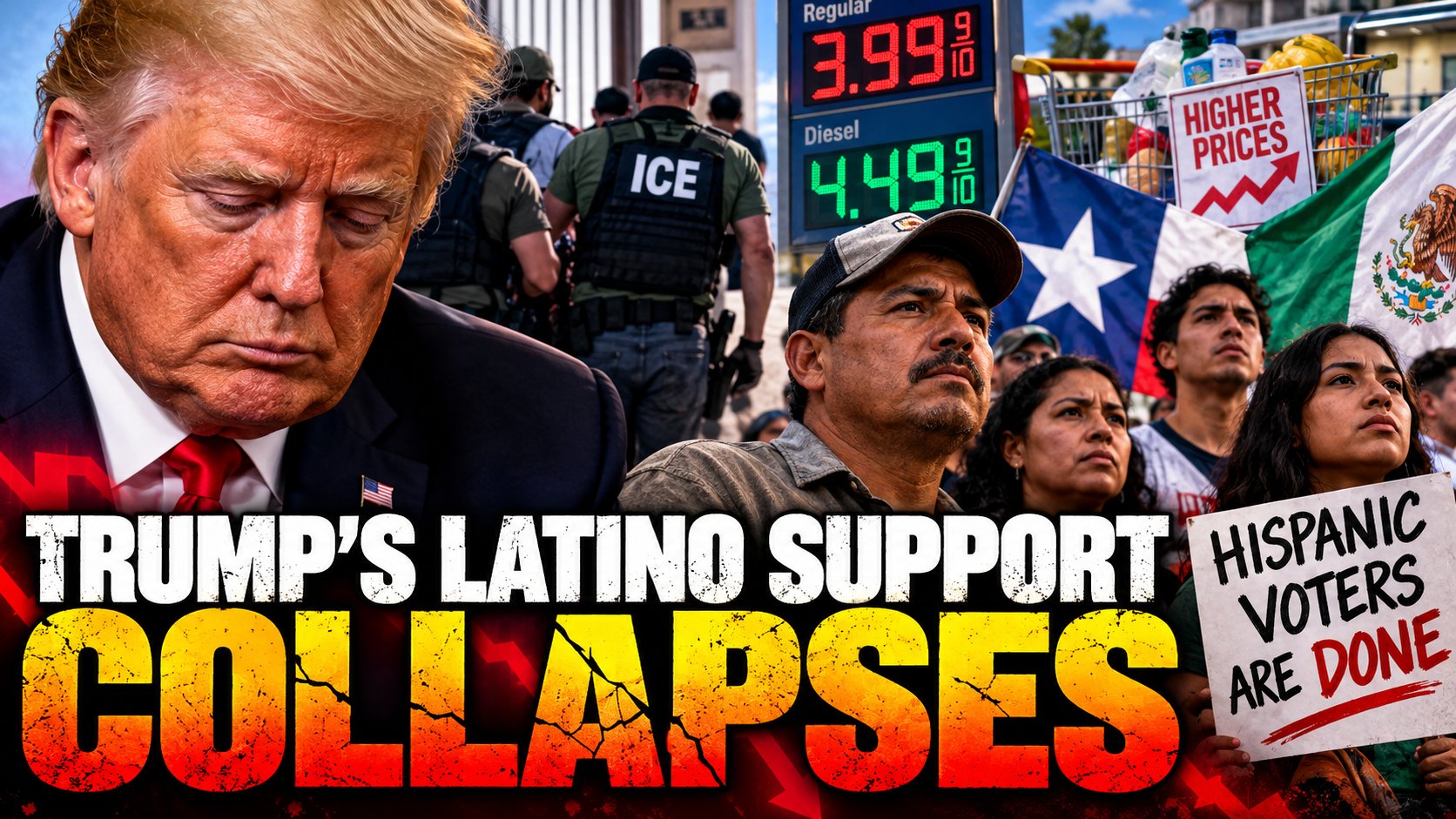
A September survey conducted for The Cook Political Report and TelevisaUnivision found Trump’s job approval at approximately 33% among likely Hispanic voters in Texas. A separate national Pew Research Center survey released October 16 found that only 24% of Latino registered voters approved of his performance, down from 38% in February 2025. Even among Latino voters who supported Trump in 2024, his approval has declined substantially. The numbers do not establish that Latino voters have permanently abandoned the Republican Party, nor do they predict how individual congressional contests will end. They do, however, reveal a major change in the political environment Republicans are navigating as the November 3 midterm elections approach.
New Polling Reveals a Sharp Decline in Latino Support
The national Pew Research Center survey, conducted September 28 through October 4 among 774 Latino registered voters, provides one of the clearest measures of the shift. Trump’s approval among Latino voters fell 14 percentage points between February 2025 and October 2026, dropping from 38% to 24%. Among Hispanic voters who personally supported him in 2024, approval declined from 93% at the beginning of his second term to 57%, a 36-point decrease.
That latter figure is especially revealing. Trump has not lost the approval of every Latino voter who supported him, and a majority of his 2024 Hispanic voters still approve of his performance. But the decline indicates that a substantial portion of his own coalition has become dissatisfied with his administration. Pew also found that only 65% of Latino Trump voters from 2024 currently support the Republican candidate in their congressional district, demonstrating that some voters who helped elect Trump are reconsidering their congressional preferences.
Texas polling tells a similarly consequential story. The Cook Political Report and TelevisaUnivision surveyed 1,000 likely Hispanic voters statewide between August 26 and September 3, with an overall margin of error of approximately 3.7 percentage points. The survey was conducted by the Republican firm OnMessage Inc. and Democratic firm Hart Research, providing a bipartisan research framework for assessing voter sentiment.
In the statewide survey, Democratic Senate candidate James Talarico led Republican Ken Paxton among Hispanic likely voters, 63% to 30%, while Democratic gubernatorial candidate Gina Hinojosa led Republican Governor Greg Abbott, 60% to 33%. These are measurements of Hispanic voters’ preferences, not statewide election forecasts, and should not be interpreted as predictions of either contest’s outcome. The broader significance is that Trump’s gains among Latino voters in 2024 did not necessarily translate into lasting approval of his administration or automatic support for Republican candidates two years later.
South Texas: The Center of Trump’s 2024 Political Breakthrough
The Rio Grande Valley and surrounding South Texas communities became central to Trump’s political success in 2024. For decades, Democrats had relied on strong Hispanic support in the region, even as voters maintained more conservative positions on religion, border security, business regulation, and other issues. Trump’s campaign capitalized on those differences, combining promises of tougher immigration enforcement with an economic message focused on inflation and household purchasing power.
According to reporting by The Texas Tribune, Trump won an estimated 55% of Latino voters in Texas in 2024, an unusually strong performance for a Republican presidential candidate in the state. The result encouraged Republican strategists to treat historically Democratic Latino communities as increasingly competitive political territory rather than dependable opposition strongholds.
That assumption influenced Texas’s 2025 congressional redistricting effort. Republican lawmakers redrew districts in ways intended to strengthen their representation, including configurations incorporating communities where Trump’s 2024 performance had improved. Yet the Cook Political Report survey found Democrats leading Republicans by 53% to 39% on the generic congressional ballot among likely Hispanic voters in an oversample covering three South Texas congressional districts.
The contrast illustrates the risks of treating a single presidential election as evidence of a permanent partisan transformation. Hispanic voters are not a politically uniform group, and their preferences can change with economic conditions, candidates, government policies, and the specific election being contested.
Immigration Raids Are Creating Fear, Labor Shortages, and Political Backlash
One of the most visible sources of dissatisfaction involves the Trump administration’s aggressive immigration enforcement policies. The president campaigned on mass deportations and stronger border controls, positions that appealed to some Hispanic voters concerned about illegal immigration and public safety. Yet the implementation of those policies has produced concerns extending beyond undocumented immigrants themselves.
In a PBS NewsHour investigation examining South Texas’s changing political environment, construction industry representative Mario Guerrero described how immigration raids and the fear surrounding them were disrupting businesses and reducing the availability of workers. Guerrero, who had previously supported Trump, explained that the enforcement campaign was affecting employers who depend on a reliable workforce and creating uncertainty throughout local industries.
His experience illustrates a conflict confronting some voters who supported stronger border enforcement but now question the economic consequences of large-scale workplace operations. Construction companies, agricultural businesses, restaurants, and other labor-intensive industries often depend on immigrant workers, including employees with lawful status who may nevertheless be affected by uncertainty, enforcement activity, or concerns about relatives and coworkers.
The economic consequences are not confined to South Texas. Reporting by The Wall Street Journal has described disruptions in the homebuilding industry associated with immigration enforcement, including labor shortages, project delays, and increased costs. Industry surveys cited in that reporting indicated that more than 60% of builders had experienced disruptions linked to enforcement activity, although those findings concern the construction industry broadly rather than Latino-owned businesses or Texas alone.
Supporters of the administration argue that immigration enforcement is necessary to uphold federal law, reduce unauthorized employment, and protect American workers. Critics counter that broad operations can disrupt families, frighten lawful residents, and impose substantial costs on industries already facing worker shortages. The political tension lies in how voters weigh those competing priorities against the consequences they observe in their own communities.
Affordability Remains the Biggest Issue for Hispanic Voters
Immigration enforcement has become a major source of controversy, but the latest research indicates that economic pressure remains the dominant concern among Hispanic voters. In the Cook Political Report and TelevisaUnivision survey, economic issues ranked approximately twice as high as immigration and Immigration and Customs Enforcement combined as voters’ leading priority. The finding challenges the assumption that Latino political preferences are determined primarily by immigration policy.
Pew’s October report provides an even clearer picture of the economic dissatisfaction. Among Latino registered voters nationwide, 86% said the economy was very important to their congressional vote, while 80% expressed serious concern about gasoline and energy prices. Another 80% were very concerned about housing costs, 78% about food and consumer goods, and 77% about healthcare expenses. The percentage very concerned about unemployment rose to 59%, compared with 40% in January 2024.
Only 19% of Latino registered voters rated national economic conditions as excellent or good, and 74% said Trump’s policies had made economic conditions worse. Those figures reflect respondents’ perceptions of the administration’s economic performance rather than an independent determination that every increase in living costs was caused by presidential policy. Nevertheless, they help explain why dissatisfaction has grown among voters who supported Trump partly because they expected financial relief.
The pressure has been compounded by higher fuel costs and broader inflation. October reporting linked increases in gasoline prices partly to disruptions associated with the conflict involving Iran, while consumers continued facing higher transportation, food, and household expenses. These developments have complicated the administration’s economic message and placed additional pressure on families whose budgets were already stretched.
For households working multiple jobs or operating small businesses, the political question is often practical rather than ideological: Are wages keeping pace with expenses, can employers find workers, and are families more financially secure than they were before?
Even Some Trump Voters Are Questioning His Deportation Policies
The latest Pew survey found that 62% of Latino registered voters believe the Trump administration is doing too much to deport immigrants living in the United States illegally. Another 22% said the administration was doing about the right amount, while 14% believed it was doing too little. The findings indicate substantial opposition to the scale of enforcement, although Latino voters remain divided along political lines.
Among Latino voters supporting Democratic congressional candidates, 86% said deportations had gone too far. Among Latino voters backing Republicans, only 19% agreed, while 47% said enforcement was appropriately balanced and 33% wanted more aggressive action. These differences demonstrate that criticism of the administration is widespread but not universal, and that many Hispanic Republicans continue to support its immigration priorities.
Even within Trump’s own 2024 Hispanic coalition, however, Pew found that 30% now believe the administration is doing too much on deportations. The Cook Political Report’s Texas survey likewise found that nearly two thirds of Hispanic likely voters were less inclined to support candidates who backed Trump’s deportation policy. These are different measurements involving different questions and populations, but both identify immigration enforcement as a meaningful source of political dissatisfaction.
The distinction between supporting border security and supporting every immigration enforcement tactic is increasingly important. Voters may favor stronger controls at the border while opposing raids that disrupt local employers, separate families, or generate fear among residents with lawful immigration status. That tension is becoming visible in South Texas, where immigration policy is not an abstract national debate but a daily economic and community concern.
Monica De La Cruz, Bobby Pulido, and a Test of South Texas Politics
The congressional contest between Republican Representative Monica De La Cruz and Democratic challenger Bobby Pulido provides a concrete example of how these issues are unfolding in South Texas. De La Cruz has supported Trump’s border security agenda while arguing that immigration enforcement should focus on criminals and cartels. Pulido, a Tejano music performer who entered politics, has emphasized local concerns and voter engagement.
In the PBS NewsHour report, correspondent Liz Landers interviewed Mario Guerrero, who leads a regional builders association and said he had voted for Trump in every presidential election in which Trump appeared on the ballot. Guerrero described immigration raids as disruptive to the construction workforce and said the resulting fear was affecting job sites and the wider local economy.
Guerrero also said he intended to support Pulido rather than De La Cruz, explaining that he wanted elected officials to represent their constituents’ interests rather than simply follow party positions. His comments offer an example of a former Trump supporter reconsidering his political choices in response to the practical effects of federal policy.
De La Cruz, meanwhile, told PBS that she had spoken with federal leadership and repeatedly emphasized that enforcement should target criminals and cartels. Her position illustrates an important distinction within the Republican coalition between support for border security and concerns about the breadth of interior immigration operations.
One voter’s decision cannot establish a districtwide trend, but the exchange captures the larger political tension: voters who supported Trump’s promises of stronger enforcement may evaluate the administration differently when those policies affect local businesses, employees, or families.
Texas Republicans Redrew the Political Map, but Voters Are Changing Their Minds
Texas Republicans redrew congressional districts in 2025 amid expectations that Trump’s 2024 gains among Hispanic voters would persist. Redistricting can alter the partisan composition of districts, but it cannot guarantee that voters will maintain the same preferences across different elections. A congressional district built around a recent presidential voting pattern can become more competitive if the political environment changes.
October reporting by Reuters identified several Texas districts affected by Republican redistricting as important congressional contests, while other reporting described changes in voter sentiment that complicated assumptions about the durability of the party’s recent gains. Polling in the redrawn 9th Congressional District, for example, showed Republican Alex Mealer leading Democrat Leticia Gutierrez by six points, 48% to 42%, despite the district’s substantially larger Republican presidential margin under its new boundaries.
Those figures should be interpreted cautiously. District polls are snapshots, candidate support can differ from presidential voting, and congressional outcomes depend on turnout, local campaigns, fundraising, and other factors. Still, the contrast demonstrates why analysts are closely examining the durability of the Republican Party’s recent gains among Latino voters.
The broader lesson is that political maps reflect past elections, while voters respond to present conditions. A district designed around Trump’s 2024 performance may contain voters whose priorities have changed significantly since he returned to office, particularly when those voters are experiencing economic pressures or immigration enforcement firsthand.
The Latino Backlash Is Spreading Beyond Texas
The erosion in Trump’s Latino approval is not confined to the Rio Grande Valley. Pew’s national October survey found Democratic congressional candidates leading Republicans among Latino registered voters, 51% to 24%, with 18% undecided and 7% favoring another candidate. The survey also found that 55% of Latino registered voters viewed their congressional vote as a vote against Trump, compared with 14% who viewed it as a vote supporting him.
An Equis Research survey conducted between September 23 and October 2 among 1,800 Hispanic or Latino registered voters found Democrats leading Republicans 57% to 31% on the generic congressional ballot. The different surveys used different methods and question formats, but both recorded a substantial Democratic advantage among Latino respondents.
The findings are consistent with broader reporting about dissatisfaction in Latino communities across Arizona, Colorado, California, and Texas. Associated Press interviews published October 18 described voters frustrated with gasoline prices, economic pressures, and immigration policies, while also noting that disappointment with Republicans does not necessarily translate into enthusiasm for Democrats.
That distinction is essential. Some voters may change parties, others may support individual candidates regardless of affiliation, and some may decide not to participate. Polling measures current preferences and attitudes, not the final composition of the electorate.
Trump’s 2024 Latino Breakthrough Is No Longer a Guarantee of Support
The 2024 election demonstrated that Latino voters cannot be treated as a permanent voting bloc for either major party. Trump’s gains reflected a combination of economic dissatisfaction, changing turnout patterns, candidate preferences, and support for some Republican positions on immigration and social issues. Those factors varied considerably by region, generation, national origin, income, and political affiliation.
The 2026 polling demonstrates that those preferences remain responsive to current conditions. The same voters who supported Trump because they wanted lower prices or stronger border security may now evaluate his administration based on inflation, employment, the treatment of immigrant communities, and the practical consequences of enforcement policies.
Yet the data also show continued Republican support among a meaningful portion of the Latino electorate. A majority of Hispanic voters who backed Trump in 2024 still approve of his presidency, and many Latino Republican voters support his deportation policies. The evidence therefore supports a conclusion of substantial erosion, not the disappearance of his Hispanic political base.
As the November midterms approach, Republicans are defending a coalition that expanded dramatically in 2024, while Democrats are attempting to reconnect with voters who previously moved away from their party. Both developments are unfolding against a backdrop of economic strain and increasingly contentious immigration enforcement.
The Political Reckoning: Trump’s Latino Coalition Faces a Major Test
Donald Trump’s 2024 success among Hispanic voters changed the American political map and demonstrated that the Republican Party could make significant inroads into communities long considered Democratic strongholds. But the latest polling, combined with interviews in South Texas, reveals that those gains have become more fragile as voters assess the administration’s record on immigration enforcement and the cost of living.
The clearest warning comes from voters who previously supported Trump but now question whether his policies have delivered the economic stability and practical solutions they expected. Business owners facing labor shortages, families struggling with everyday expenses, and residents concerned about immigration raids are evaluating the administration through their own experiences rather than simply through party affiliation.
The evidence does not support declaring that Trump has permanently lost the Latino vote. It does establish that his approval has fallen substantially, that many Hispanic voters are dissatisfied with his economic performance, and that immigration enforcement has become a source of political tension even among some of his previous supporters.
For Texas Republicans, the stakes extend beyond one election cycle. Their redistricting strategy and broader political ambitions depend in part on the durability of the Latino gains that helped reshape the 2024 election. For Democrats, the challenge is whether dissatisfaction with Trump can be translated into renewed trust and participation among voters who previously rejected their message.
The fundamental lesson is that political loyalty must be continually earned. Latino voters helped deliver one of Trump’s most important electoral breakthroughs in 2024, but their support cannot be treated as permanent. With the November 2026 midterms approaching, the economy, immigration enforcement, and the lived experiences of Hispanic communities have become central measures of whether that coalition remains intact.

Sources & Further Reading
- PBS NewsHour — GOP’s Big Bet on Texas Latino Voters Could Backfire in Midterms (September 25, 2026). Original reporting featuring Mario Guerrero, Monica De La Cruz, Bobby Pulido, and South Texas voters.
https://www.pbs.org/video/vote-2026-1790376582/ - PBS NewsHour — Original Video Report.
https://www.youtube.com/watch?v=M2RumcY9AXY - The Cook Political Report — Texas Hispanic Voter Survey (September 2026). Statewide polling methodology, approval ratings, and South Texas congressional district findings.
https://www.cookpolitical.com/survey-research/2026-texas-hispanic-voters-univision-poll - The Cook Political Report — Exclusive Analysis of Hispanic Voters in Texas.
https://www.cookpolitical.com/analysis/house/texas-house/exclusive-new-poll-hispanic-texas-voters-shows-collapse-gops-2024 - Pew Research Center — How Latino Voters Are Experiencing the 2026 Midterm Elections (October 16, 2026). Presidential approval, congressional voting preferences, and immigration attitudes.
https://www.pewresearch.org/race-and-ethnicity/2026/10/16/how-latino-voters-are-experiencing-the-2026-midterm-elections/ - Pew Research Center — The Economy Is the Top Issue for Latino Voters in the 2026 Midterms (October 16, 2026). Inflation, employment, housing, fuel prices, and healthcare concerns.
https://www.pewresearch.org/race-and-ethnicity/2026/10/16/the-economy-is-the-top-issue-for-latino-voters-in-the-2026-midterms/ - The Texas Tribune — One in Five Latino Trump Voters Would Not Repeat Their Vote (May 27, 2026). Earlier evidence of declining support in Texas.
https://www.texastribune.org/2026/05/27/texas-latino-voters-poll-trump-republican-support-2026-midterms/ - Reuters — U.S. House Races to Watch in the 2026 Elections (October 12, 2026). Congressional redistricting and competitive districts.
https://www.reuters.com/legal/government/us-house-races-watch-2026-elections-2026-10-12/ - Axios — Mike Johnson’s Latino Voter Problem Keeps Getting Worse (October 13, 2026). Equis Research polling and national political trends.
https://www.axios.com/2026/10/13/trump-mike-johnson-latino-voters-house - Associated Press — Latino Voters Helped Put Trump Back in the White House. What’s Their Next Move? (October 18, 2026). Interviews with Hispanic voters across several states.
https://apnews.com/article/e022e43e08124e8f279c858a110860d0 - The Wall Street Journal — The Immigration Crackdown Is Making It Much Harder to Build Houses. Construction labor shortages and immigration enforcement.
https://www.wsj.com/us-news/the-immigration-crackdown-is-making-it-much-harder-to-build-houses-ec00f4da - Reuters — High Gasoline Prices Expected to Boost U.S. Consumer Inflation (October 14, 2026). Inflation and energy-price pressures.
https://www.reuters.com/world/us/high-gasoline-prices-expected-boost-us-consumer-inflation-september-2026-10-14/

















































Want to join the conversation?
Create an account or sign in to share your thoughts, vote,
and reply to other readers.
Showing 0 of 0 comments
Don't have an account?
Already have an account?