
SNL Savages Republican Midterm Panic as Trump, Rubio, Hegseth and McConnell Try to Save the GOP
‘Saturday Night Live’ Imagines a Republican Campaign Operation So Desperate That Trump Offers Voters $5,000, Rubio Turns on Him in Spanish and Pete Hegseth Breaks Into Anti-Woke Slam Poetry
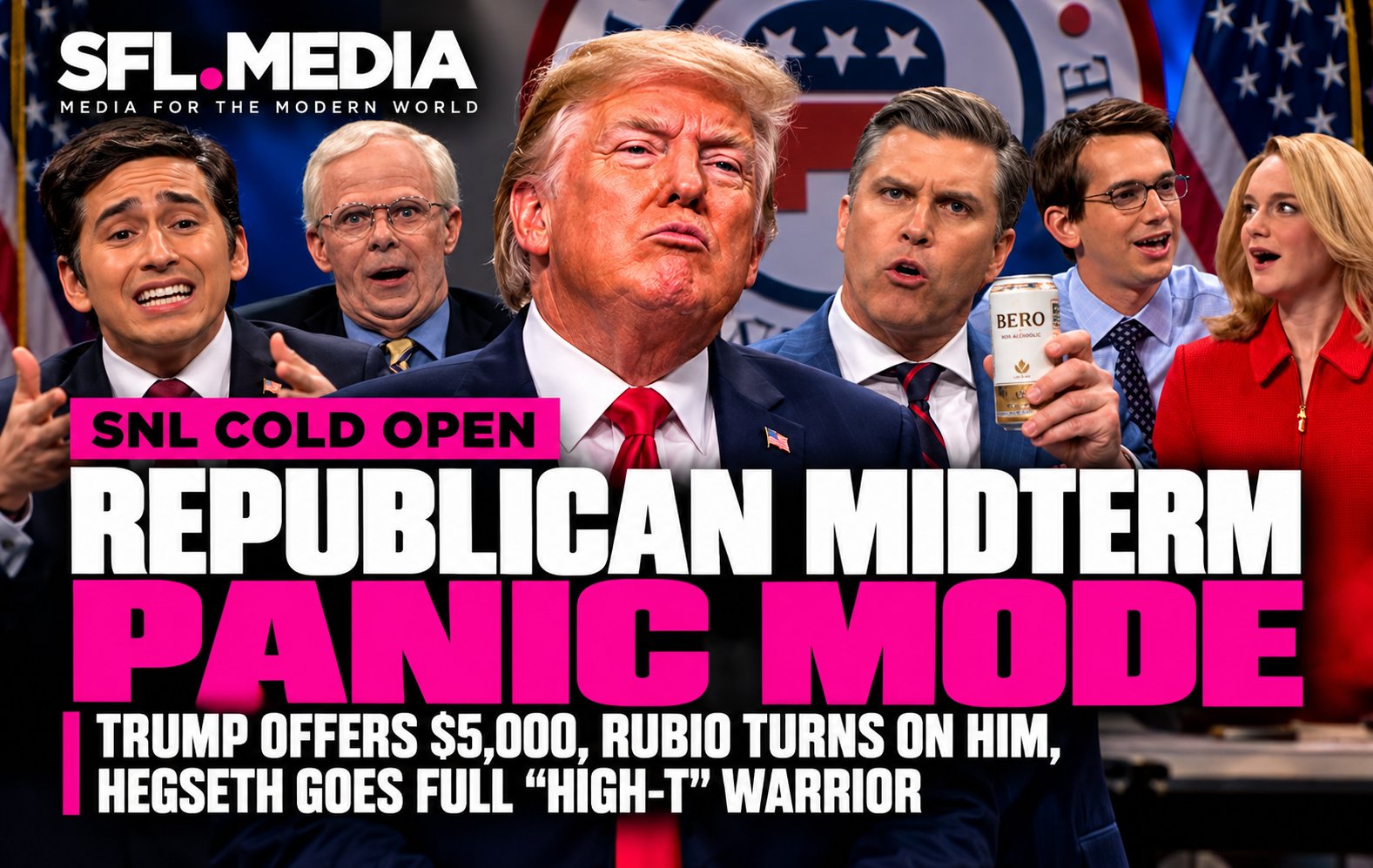
NEW YORK — Saturday Night Live opened its October 3 episode by imagining the Republican Party confronting a problem political advertising cannot easily solve: what happens when the candidates and surrogates brought in to rescue the message become the message themselves? The nearly seven-minute “Republican Midterm Ads” cold open transformed Republican National Committee headquarters into a dysfunctional campaign ad studio, where fictional GOP strategists played by Andrew Dismukes and Ashley Padilla attempt to record a series of get-out-the-vote spots as Republicans confront a difficult political environment heading into the November midterm elections.
One by one, Secretary of State Marco Rubio, Sen. Mitch McConnell, Vice President JD Vance, Defense Secretary Pete Hegseth and finally President Donald Trump arrive to help. Instead, SNL turns each appearance into a different satire of the Republican Party’s current political vulnerabilities. The sketch was built around recognizable political stories dominating the weeks before the 2026 midterms, including Republican concerns about the electoral environment, Trump’s foreign policy record, questions surrounding McConnell’s health, Hegseth’s rhetoric about the military and Trump’s proposed $5,000 payments to Americans.
Marco Rubio Is Asked to Reach Latino Voters and Immediately Turns on Trump
Marcello Hernández opens the parade of Republican officials as Marco Rubio, who is brought in to record an appeal aimed at Spanish-speaking voters. Instead of delivering a conventional Republican campaign message, SNL’s Rubio begins speaking Spanish and rapidly turns the commercial into a panicked confession about Trump. The fictional Rubio tells viewers that Trump “tricked” Latino voters, and Rubio himself, before launching into an increasingly frantic complaint about an administration bouncing between Venezuela, Iran and even Canada. The character also complains about Trump’s eating habits as the campaign staff slowly realizes that its supposedly targeted Latino outreach ad has become an attack on the president it was supposed to help.
The joke works on two levels. Hernández turns Rubio’s fluency in Spanish into the mechanism for saying things his fictional Republican handlers would rather not hear, while SNL uses the character to parody the political tension between Trump’s coalition and Latino voters Republicans have spent years trying to court.
SNL Turns Mitch McConnell’s Health Into an Uncomfortable Sight Gag
The campaign team next turns toward what it calls Reagan Republicans and brings in Kentucky Sen. Mitch McConnell, played by Mikey Day. What follows is intentionally uncomfortable: McConnell is wheeled into the studio and appears virtually frozen when the director calls “action.” Repeated attempts to get the fictional McConnell to deliver his lines produce almost nothing before he eventually manages a peace sign and appears to misunderstand where he is in the broadcast, prematurely attempting to launch into SNL’s traditional “Live from New York” opening.
The sketch is parody, but its target is unmistakable. The 84 year old McConnell has faced renewed public scrutiny over his health following a hospitalization earlier this year and a reduced public presence, giving SNL an unusually dark piece of real world material to work into its fictional Republican advertising disaster.
JD Vance’s Best Campaign Strategy Is Apparently Not Talking
Vice President JD Vance, played by Jeremy Culhane, gets one of the shortest appearances in the entire sketch, which is precisely the joke. Vance steps forward and begins introducing himself with “Hi, I’m JD Vance,” only for the fictional campaign team to immediately stop recording and declare the take a success. Rather than building an elaborate impersonation around the vice president, SNL essentially turns Vance’s absence of screen time into the punchline, treating him as a political surrogate whose most useful contribution to the campaign might be keeping the message as short as humanly possible.
Colin Jost’s Pete Hegseth Goes Full Testosterone Warrior
The sketch then shifts into its most aggressive parody when Colin Jost reprises his portrayal of Defense Secretary Pete Hegseth. Hegseth arrives carrying BERO, actor Tom Holland’s nonalcoholic beer brand, and immediately shotguns the drink while mocking it for being alcohol-free. From there, Jost’s Hegseth launches into a hyper-masculine campaign pitch built around masculinity, sexuality, Christianity, military culture and the administration’s attacks on diversity initiatives. He boasts about eliminating DEI from the armed forces, claims he is putting God back into war and urges Republican voters to turn out in language deliberately designed to sound like an overcaffeinated locker room speech.
The character eventually abandons anything resembling a conventional political advertisement and moves into what the campaign workers describe as “weird slam poetry,” rattling through a crude anti-woke rhyme about the military. The sequence parodies Hegseth’s public image as much as any individual policy, depicting him as a defense secretary whose constant performance of toughness has become indistinguishable from self parody. The timing was deliberate, with the sequence drawing on Hegseth’s recent public rhetoric about reshaping military culture and removing what he characterizes as “woke” policies from the armed forces.
Then Trump Arrives and Offers America $5,000
Just as the fictional Republican operatives appear ready to give up, James Austin Johnson’s Donald Trump enters with his familiar impersonation and announces that he has the solution to the party’s electoral problems: money. SNL’s Trump promises Americans $5,000 if Republicans win the midterm elections, then immediately undercuts the offer by explaining that it cannot be considered a bribe because he has no intention of actually delivering the money.
The line was not created entirely from thin air. The sketch was parodying Trump’s real world proposal involving $5,000 payments to Americans, making the fictional president’s admission that he would never follow through the comedic twist rather than the underlying idea itself. Johnson’s Trump then urges voters to behave as though the president himself is on the midterm ballot and turns that thought into another absurd campaign slogan: “Imagination makes a MAGA nation.” The character immediately imagines the phrase appearing on clothing in Myrtle Beach before veering into another characteristically rambling tangent.
SNL Also Works Ken Paxton Into Trump’s Rambling Campaign Pitch
The Trump impersonation continues wandering away from the supposed purpose of the advertisement, eventually moving into a riff involving Texas Attorney General Ken Paxton. The reference lands within a broader political environment in which Republican candidates face the difficult task of deciding when to embrace Trump and when to distance themselves from unpopular elements of his administration’s record as voters prepare for the midterms.
SNL reduces that dilemma to its most absurd form: Republican strategists desperately need a disciplined campaign message, but every prominent Republican brought into the studio either cannot deliver it, does not want to deliver it or hijacks the advertisement entirely.
Trump Records the Same Speech Whether Republicans Win or Lose
The sketch saves perhaps its clearest political joke for the end. The fictional producers ask Trump to prerecord a message that can be aired if Republicans win the midterms, prompting Johnson’s Trump to enthusiastically announce victory and boast that nobody has ever won so much. Then the staff asks him to record a second version in case Republicans lose, and Trump gives them essentially the same victory speech.
The punchline directly targets Trump’s long running refusal to accept electoral defeat, turning the familiar political controversy into the final organizing joke of the cold open: in SNL’s version of Republican politics, the actual result of the election is irrelevant because Trump’s response has already been recorded. The character then finally delivers the line Mikey Day’s confused McConnell nearly stole several minutes earlier: “Live from New York, it’s Saturday Night!”
SNL’s Real Target Was Republican Midterm Anxiety
For all the individual impersonations, the sketch’s central target was not Rubio, McConnell, Vance, Hegseth or even Trump individually. It was the Republican Party’s challenge of constructing a coherent message with the November midterms rapidly approaching. The fictional campaign professionals begin with a straightforward assignment: create advertisements capable of motivating Republican voters. Rubio instead attacks Trump in Spanish, McConnell barely responds, Vance is considered most effective when immediately silenced, Hegseth turns his appearance into a testosterone soaked culture war performance, and Trump promises voters cash, rambles off message and prepares to declare victory regardless of what voters actually decide.
That structure allowed SNL to do more than cycle through celebrity impressions. The cold open presented the Republican coalition as a collection of competing political liabilities that campaign professionals are desperately trying to package into something voters will buy. And unlike political sketches that depend almost entirely on exaggeration, much of the material was anchored to recognizable controversies and public events: Hegseth has made military culture a central component of his public message, questions about McConnell’s health have returned to public attention, Republicans are navigating the approaching midterm elections, Trump has floated a $5,000 payment proposal, and government advertisements featuring Trump have separately drawn scrutiny only weeks before voters head to the polls.
SNL simply took those ingredients, put them inside an imaginary Republican campaign studio and asked what might happen if the party’s most recognizable figures were left alone in front of a camera. The answer, at least according to Saturday Night Live, was that the advertisements practically wrote themselves.
Sources & Further Reading
Saturday Night Live — “Republican Midterm Ads Cold Open”
The Washington Post — SNL Coverage
TheWrap — SNL Cold Open Coverage
Variety — SNL Political Sketch Coverage
Salon — SNL Republican Midterm Cold Open
Reuters — Trump Government Ads Draw Scrutiny Ahead of Midterm Elections




















Want to join the conversation?
Create an account or sign in to share your thoughts, vote,
and reply to other readers.
Showing 0 of 0 comments
Don't have an account?
Already have an account?